INFOGRAPHIC. What business does Carrefour have in Romania, the retailer that is thinking of exiting the market


Carrefour Romania has gone through a remarkable transformation in the last fifteen years, evolving from a modest retail operation to one of the biggest giants in Romanian retail. Carrefour is preparing to sell its stores in Romania, after 24 years since entering the market.
The financial data confirms the story of solid expansion, market adaptation and resilience in the face of economic challenges.
figures
Between 2010 and 2024, the net turnover of Carrefour Romania increased from approximately 3.9 billion lei to 12.5 billion lei, representing an increase of more than three times.
The most spectacular period of expansion occurred between 2019 and 2024, when revenues jumped from 8.16 billion lei to 12.54 billion lei. This acceleration coincided with the company's aggressive multi-format strategy and the acquisition of the Cora hypermarket chain in 2023.
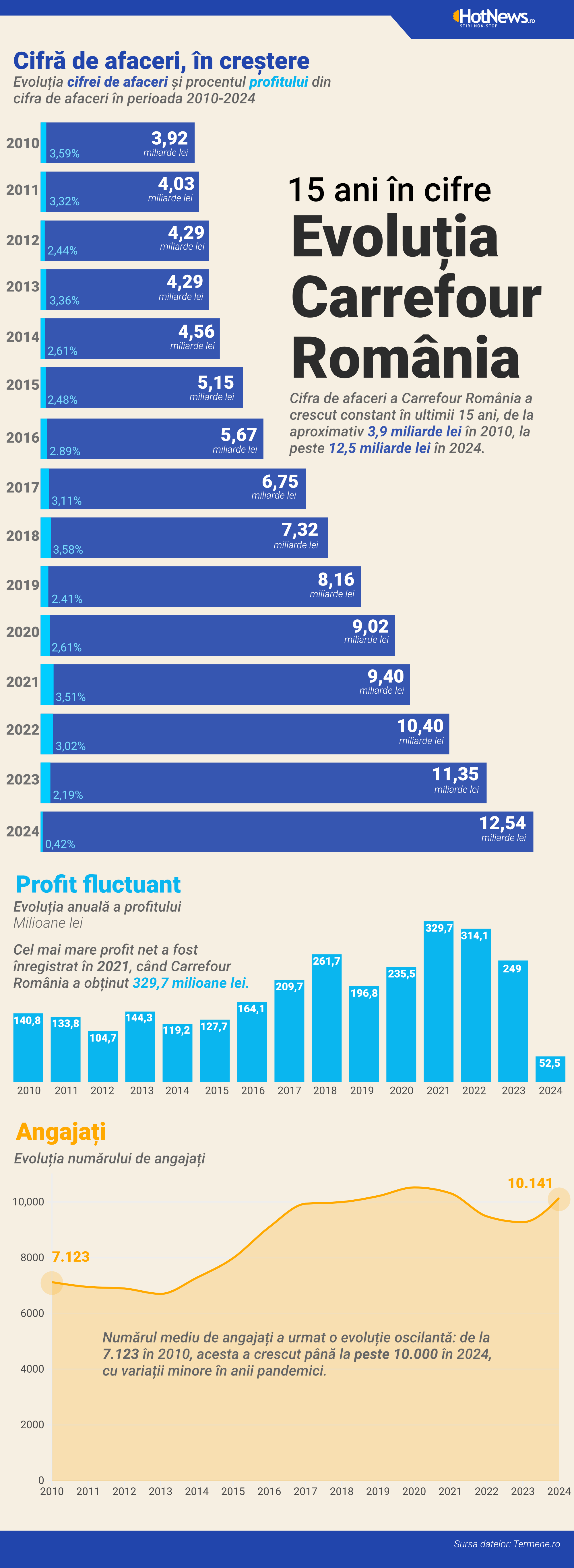
Perhaps most significant is the evolution of the workforce. From 7,123 employees in 2010, Carrefour Romania has grown to more than 10,000 employees by 2024, reaching a peak of 10,523 employees in 2020. This expansion reflects not only store openings, but also the retailer's commitment to becoming a major employer and an important economic contributor in Romania.
Cora acquisition
The acquisition of Romania Hypermarche SA (Cora operations) at the end of 2023 marked a crucial moment. This strategic move brought 10 hypermarkets and 9 convenience stores to the Carrefour portfolio, along with more than 2,000 employees. By 2024, Carrefour was operating approximately 450 stores in 113 Romanian cities, consolidating its position as one of the top three retailers in the country.
The integration process, while challenging, was methodical. During 2024, Carrefour rebranded the former Cora locations and integrated them into its ecosystem.
The proximity revolution
One of the most important strategic moves of Carrefour Romania was entering the convenience sector. Express format has emerged as the company's fastest growing segment. In 2024 alone, Carrefour opened 22 new Express stores—16 integrated and 6 franchises—bringing the total to 178 Express units nationwide by the end of the year.
This focus on smaller, neighborhood-oriented stores reflects changing consumer preferences. Romanian shoppers increasingly value comfort, accessibility and saving time over the traditional hypermarket experience. Carrefour's 2025 strategy is even more ambitious, targeting more than 40 new Express and Market stores, with a particular focus on small-format locations below 100 square meters in busy pedestrian areas and residential developments.
Although Carrefour has faced challenges in its European markets, Romania has been a notable success story. In 2024, Romania was the only European market where Carrefour reported positive organic growth (1.2%), even as its home market, France, was facing sales declines in hypermarkets. The Romanian operation recorded revenues of 3.19 billion euros in 2024, an increase of 3.2% from one year to the next.
This performance is particularly impressive given the wider context: Carrefour France posted a 2.3% decline in organic revenue, with hypermarkets down 4.2%. Romania's success demonstrates the effectiveness of the local team's adaptation to market conditions and consumer preferences.
Innovation and digitization
Carrefour Romania didn't just expand physically, the digital transformation accelerated. The company has invested heavily in e-commerce, partnering with delivery platforms while maintaining its own website and mobile app. Online sales have shown particularly strong growth, with e-grocery representing one of the fastest growing channels.
Sustainability and local partnerships
The retailer has committed to reducing energy consumption by 20% by 2026 and achieving carbon neutrality by 2040. The company has installed 3.4 MWh of renewable energy capacity, which now powers 28% of three hypermarkets and is expected to save over 42,000 tonnes of CO2.
Local supply was also taken into account. Over 93% of suppliers are Romanian, and the company maintains partnerships with more than 1,300 local and ultra-local producers. Specifically for own brand products, 90% of sales come from Romanian partners, involving approximately 260 local suppliers.
Despite the increase in revenues, Carrefour Romania faced pressures on profitability.
Net profit fluctuated significantly, peaking at 329.7 million lei in 2021, but falling to 52.5 million lei in 2024. This volatility reflects the challenges of operating in a highly competitive market with tight margins, significant integration costs from the Cora acquisition, and investments in expansion and modernization.
The 2024 profit decline is particularly notable given the revenue growth, suggesting that integration costs, competitive pricing pressures and operational investments have temporarily compressed margins. However, the company's management is confident that these investments will generate improved performance as the integration is completed and the new stores mature.
Ambitious plans for 2025
Carrefour Romania entered 2025 with aggressive growth objectives. The company plans to open more stores than in 2024, focusing on Express and Market formats.
The retailer is also working on optimizing its logistics model for small format stores and improving service levels in its proximity network. This operational excellence will be crucial to maintaining profitable growth as the number of stores expands.