Sarkozy, greeted with cheers from the inmates. The former French president has already applied for release from prison


Former French President Nicolas Sarkozy was greeted with cheers upon arrival at La Santé prison in Paris, Tuesday morning, around 9:30 local time (10:30 Romanian time). Sarkozy immediately submitted a request for release, one of his lawyers, Christophe Ingrain, told the press.
“Oh, welcome, Sarkozy!”, “Here's Sarkozy!”, shouted the prisoners from the cells, according to AFP.
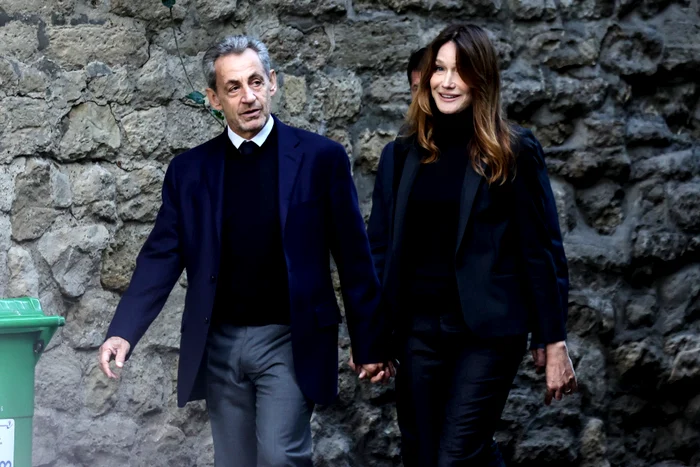
Accompanied by his wife, Carla, Nicolas Sarkozy left his residence on Tuesday morning, greeting the crowd that had gathered in front of the gates. He then got into the car which headed towards the 14th arrondissement of Paris, where La Santé prison is located. “Nicolas, we love you!” chanted the supporters present, according to news.ro.
Less than thirty minutes later, he arrived at La Santé prison for his first day of detention. A sea of journalists were gathered in front of the prison walls. The foreign press was also present in large numbers. Dozens of policemen were mobilized and blocked most of the streets around the prison, to the displeasure of those who had to get to work.
“I am not afraid of prison. I will keep my head up, including at the prison gates,” Sarkozy had declared to the newspaper La Tribune Dimanche, before his incarceration.
In a text published Tuesday morning on his X account, the former president once again denounced “a judicial scandal” and “an ordeal” that he says he has endured “for more than ten years.” Nicolas Sarkozy assures that he “is not asking for any advantage, any favor” and says that he is not complaining: “My voice is heard”.
He says he is facing this trial “with the unwavering strength” that characterizes him: “It is not a former president of the Republic who is imprisoned this morning, but an innocent man,” Sarkozy wrote, before ending on a serious note: “I feel deep pain for France, which is humiliated by the expression of revenge that has taken hatred to an unprecedented level. I have no doubt. The truth will triumph. But the price which we will have to pay will be crushing”, says the former president.
The former French president submitted a request for release
Sarkozy's imprisonment is a “shame”, the lawyer said.
The judiciary will have two months to decide on the request of the former head of state, although the term would be shorter. “Whatever happens,” it will be “three weeks, one month of detention,” Ingrain said on Europe 1 radio station.
While waiting for his possible release, Nicolas Sarkozy will face loneliness.
The isolation regime under which he will be placed provides for a walk a day, alone, in a small yard of a few square meters. He will have access, according to a schedule, to one of the three small gyms in the penitentiary or to the room that serves as a library.
What life will be like in prison
Sebastien Cauwel, who runs the country's prison system, including La Santé prison, said the former president would be kept in solitary confinement for security reasons. “He will have access to the exercise yard, alone, twice a day, he will have access to an activity room and he will be alone in the cell,” Cauwel told RTL Radio.
The conditions are similar to those in the rest of the prison: the cells measure between 9 and 12 square meters and, following renovations, have private showers.
Sarkozy will have access to television – against a monthly fee of 14 euros – and to a fixed telephone, but not to a mobile one.
Sarkozy's lawyer, Jean-Michel Darrois, told Franceinfo radio station that Sarkozy prepared for prison by bringing sweaters and earplugs with him. “He prepared some bags in which he put some sweaters because prisons can be cold, and earplugs because there could be a lot of noise,” Darrois said.
On September 25, the criminal court in Paris sentenced the former right-wing French president to five years in prison. He was found guilty of knowingly allowing associates Claude Guéant and Brice Hortefeux to meet in Tripoli with an official of Muammar Gaddafi's regime to discuss the secret financing of his 2007 presidential campaign
He was acquitted of the charge of having personally received or used the funds.
The former president appealed the decision, but the nature of his sentence requires him to go to prison during the trial.
The decision to imprison the former president caused the indignation of Sarkozy's political allies and the extreme right.
France has toughened penalties for economic sanctions
However, the ruling reflects a change in France's approach to economic crime following reforms introduced by the previous socialist government.
In the 1990s and 2000s, many convicted politicians avoided prison altogether. To counter the perception of impunity, French judges are increasingly issuing “provisional execution” orders – which require the execution of sentences to begin immediately, even if appeals are pending – legal experts and politicians told Reuters.
Far-right leader Marine Le Pen has been banned from running for public office under the same “provisional enforcement” provision, pending an appeal early next year.
According to an Elabe survey carried out on October 1 for BFM TV, 58% of the French believe that the verdict was impartial, and 61% support the decision to send Sarkozy to prison without waiting for the appeal.
President Emmanuel Macron, who had cordial relations with Sarkozy and his wife, Carla Bruni, confirmed on Monday that he had met with Sarkozy before his incarceration.