Rodrigo Paz won the presidential elections in Bolivia. The first center-right president after 20 years of socialism


Center-right Senator Rodrigo Paz won the second round of Bolivia's presidential election on Sunday, October 19, defeating his right-wing rival Jorge “Tuto” Quiroga.
It is happening in a country that has fallen prey to a deep economic crisis after two decades of left-wing governments, comments AFP, quoted by Agerpres.
Although the last polls showed him as a loser, Rodrigo Paz obtained 54.6% of the votes, after counting 97.8% of the votes, the Supreme Electoral Tribunal announced. His opponent obtained 45.4% of the votes.
After the announcement of the results, the streets of La Paz, which had been practically deserted until then, were filled with supporters of the winner, to the sound of firecrackers, shouts of joy and music.
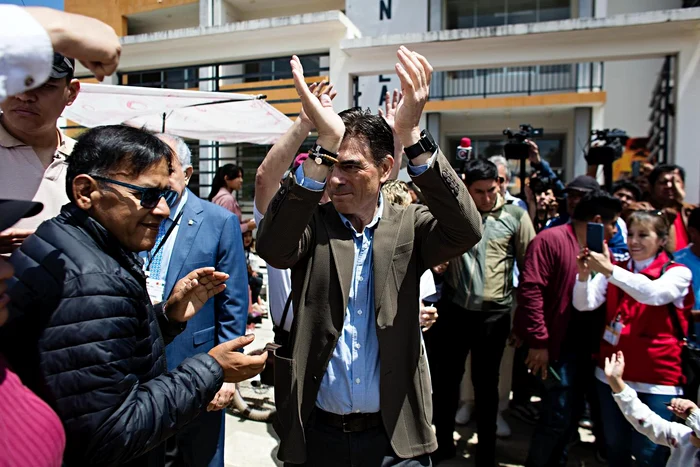
“We came to celebrate the victory with the great hope of giving Bolivia a new direction””testified Julio Andrey, a 40-year-old lawyer, appreciating that this 58-year-old economist is “closer to popular demands” than his rival.
A man of consensus
Rodrigo Paz is the heir to an influential political dynasty and a moderate politician who presents himself as a man of consensus.
“I called Rodrigo Paz Pereira to congratulate him”stated Jorge “Tuto” Quiroga, admitting defeat in a hotel in La Paz.
“This is a provisional count, we will wait for the official results, we will have the minutes and compare them,” he added.
Call for “unity and reconciliation between Bolivians”
In front of the press, the popular vice-president-elect, Edmand Lara, launched an appeal “to unity and reconciliation between Bolivians”.
Paz comes to power in a country that, under Evo Morales, has turned very much to the left: nationalization of energy resources, break with Washington, alliances with Hugo Chavez's Venezuela, Cuba, China, Russia and even Iran.
On November 8, Rodrigo Paz will succeed the unpopular Luis Arce, who has given up running and will leave power after a five-year mandate marked by the worst economic crisis the country has experienced in the last 40 years.
The decrease in gas exports, caused by the lack of investment, depleted the dollar reserves and made the expensive fuel subsidy policy unsustainable. Without foreign currency to import them, the shortage of gasoline and diesel is getting worse, and prices are skyrocketing.
American Republican Senator Maria Elvira Salazar congratulated X on the newly elected president, welcoming a Bolivia that, in her opinion, “is rising after years of socialism, corruption and broken promises”.
In Bolivia, annual inflation currently exceeds 23%, and long lines of vehicles waiting for a hypothetical refill at gas stations have become commonplace in this country, almost twice the size of France, but with 11.3 million inhabitants.
The two candidates presented similar policies, based on a drastic reduction in public spending – especially fuel subsidies – and greater openness to the private sector.
Paz defended, however, a “capitalism for all” based on decentralization and fiscal rigor before any new debt. His rival, more radical, pleaded for a complete opening to international markets and the use of new credits.
“My approach is to reach a consensus, an agreement and move things forward,” said Rodrigo Paz shortly before voting in Tarija, in the south of the country.
However, he will not have a majority in parliament, which will force him to form alliances. Victorious in the first round in August, he nevertheless has the largest parliamentary group, with 49 deputies and 16 senators, in front of Jorge Quiroga (39 and 12).
“Paz kept a very calm, very centrist tone. He connects well with the population, he feels that people love him, he has reached those who want change, but not a radical change”, pointed out the political scientist Daniela Keseberg, at the request of AFP.
“Morales remains a destabilizing factor”
The collapse of the Movement for Socialism (MAS), of the former president Evo Morales (2006-2019), marked the campaign: his candidate obtained only 3.1% of the votes in the first round.
Targeted by an arrest warrant in a child-trafficking case he is contesting, Evo Morales could not run because of term limits. He encouraged the null vote in the first round.
After voting in his stronghold of Chapare (center), the former head of state, the country's first indigenous president, declared that the proposals of the two candidates show a “lack of respect” for the Bolivian people. “The loans from the IMF and the World Bank are conditional on the privatization of natural resources”, he denounced.
“Morales remains a destabilizing factor,” warns Daniela Osorio, a political scientist at the German Institute of Global and Area Studies (GIGA).