As it turns out from the Colliers report “ExCEEding Borders – Retail Parks: Diverse Growth, Shared Momentum”, Poland is currently the undisputed leader of Central and Eastern Europe in terms of the number and area of retail parks. There are already over 710 of them, offering a total of over 4.4 million square meters of space, of which nearly 3 million square meters are facilities with an area of over 5,000. sq m. Importantly, as many as 318 of them operate in cities with fewer than 50,000 inhabitants. inhabitants, which clearly confirms the shift of development activity away from large agglomerations.
— In Poland, retail parks are becoming the main shopping points in cities with fewer than 100,000 inhabitants. inhabitants, where traditional galleries are often missing. However, their role is growing. Due to their functionality, accessibility and attractive commercial, catering and service offer, they are transformed into local centers of social life – emphasizes Marta Cegielnik, director of the Retail Agency at Colliers.
The dynamic development of this segment is driven by the expansion of discount brands – both food and non-food. The most active tenants include the Pepco, Action, TEDi, Dealz, KiK chains, as well as Mr., which is debuting on the Polish market. DIY and Woolworth. – For many tenants, a retail park is the preferred format today – lower operating costs, flexible space and direct access to the customer make it extremely attractive – adds Cegielnik.
As he notes Grzegorz Sielewicz, chief economist at Colliers for the CEE regionthe strong growth of retail parks in Poland is supported by solid macroeconomic foundations. — Poland maintains a strong position in the region thanks to the stable growth of domestic consumption, which is the main driver of the development of this format. The increase in sales of durable goods, such as electronics and furniture, proves the growing confidence of households in the improvement of their financial situation. Combined with the shift in consumer preferences towards value purchases and the growing role of discount stores, retail parks are becoming an increasingly important element of the retail landscape, he explains.
According to Colliers data, over 470,000 units are currently under construction in Poland. sq m of new retail parks – this is the largest volume among all the analyzed countries in the region. For comparison, in the Czech Republic there are approximately 43,000 projects under construction. m, and in Slovakia just over 70 thousand. m. Poland not only maintains its leading position, but also sets the pace of development of this segment in Central and Eastern Europe.
Traditional shopping malls are still struggling
At the same time, as JLL analysts point out, construction activity in the traditional shopping mall segment has fallen to a historic low – no new centers have been opened this year, and emerging projects are limited to modernization and expansion of existing facilities. — Rumors about the decline of traditional galleries are premature. In many cases we see their rebirth in a new form. However, it is retail parks that generate the largest part of new supply today and best respond to the expectations of modern consumers, he comments Maciej Kotowski, director of the JLL market research department.
There are more and more retail parks
Nowadays, new investments in the format of retail parks are implemented not only in large agglomerations, as clearly indicated by the above expert analyses, but more and more often in smaller district cities. This is where developers see the greatest purchasing potential and space for the development of a modern commercial offer. Only in recent weeks, the construction of several projects of this type has been announced.
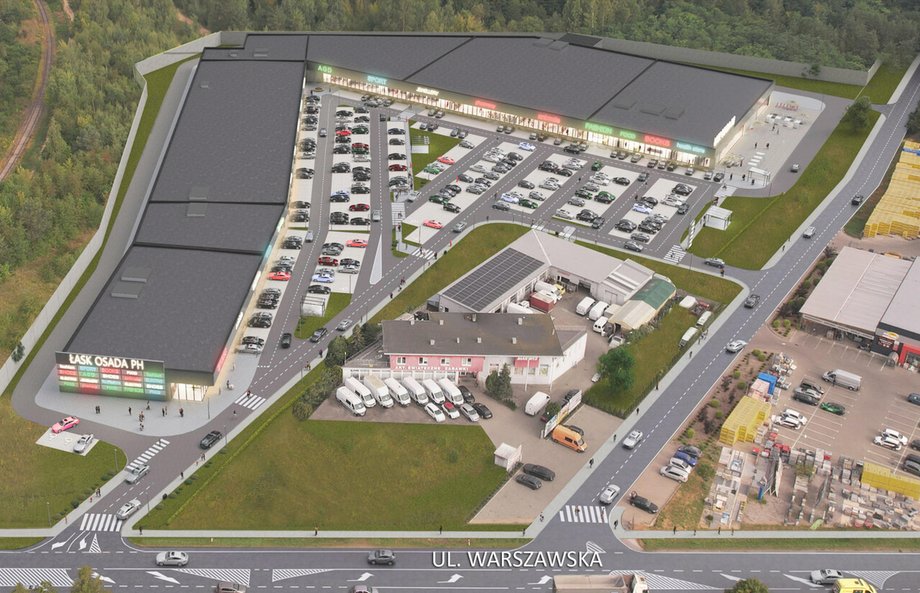
The retail park in Łask is to be ready in 2027
|
Mallson
It is being built in Łask, Łódź Voivodeship Osada retail park with an area of over 12 thousand sq m He is an investor Mabrok K. Kuran companyand is responsible for the concept and commercialization process Mallson. The facility will include a grocery operator, a DIY market and over 20 stores from the fashion, sports, drugstore, footwear, consumer electronics and home furnishings industries, as well as service and catering outlets. The opening is scheduled for 2027.
A similar project is being developed in Darłowo, where the company Sigmawhose majority shareholder is entrepreneur Jerzy Olszewski, is building Sigma retail park with a similar area – 12 thousand m. Due to the tourist character of the city, investors count not only on residents, but also on seasonal customers. The facility will include approximately 20 shops and a drive-thru restaurant. The opening is scheduled for the turn of 2026 and 2027, and Mallson is responsible for the commercialization of the project – similarly to Łask.
There is also a growing interest in this format in Podkarpacie. A Polish developer in Leżajsk Refield is implementing Pasaż Leżajski — an investment with an area of over 11,000 m, covering four buildings. There will be a grocery market, over 20 shops and service outlets, and a restaurant with drive-thru service. Construction completion is planned for 2027.
Investors specializing in creating networks of retail parks are gaining an increasingly stronger position on the market. Trei Real Estate, owner of the Vendo Park brandalready has a portfolio of over 40 facilities in small and medium-sized cities, and LCP Properties is developing the M Park chaincovering approximately 90 locations throughout the country. On the other hand Budrem, owner of the Multibox brandrecently announced the implementation of three further investments – in Ostrów Wielkopolski, Milicz and Sochaczew. — The mixed-use retail park format is gaining popularity and is starting to play a key role in attracting new brands. Their dynamic development in smaller cities is a natural response to the evolution of consumer needs and changes in purchasing behavior, he comments Bogdan Szombara with Budr.
Trade likes smaller cities
Maciej Kotowski from JLL emphasizes that new projects in the analyzed formats are actually appearing in increasingly smaller towns, but their area and offer are adapted by investors to this economic environment, he explains. The expert indicates that the average area of parks and convenience centers currently being built is approximately 6.8 thousand square meters. sq m – Of course, there are larger and smaller investments, but in most cases the size of the park and the range of tenants meet local possibilities and needs – he argues.
The numbers speak for themselves. — On the supply side, almost 60 percent park format facilities (in terms of the number of investments) are being built in cities with fewer than 50,000 inhabitants. inhabitants. Moreover, over 83 percent There are fewer than 10,000 facilities under construction. sq m GLA – indicates an expert from JLL.
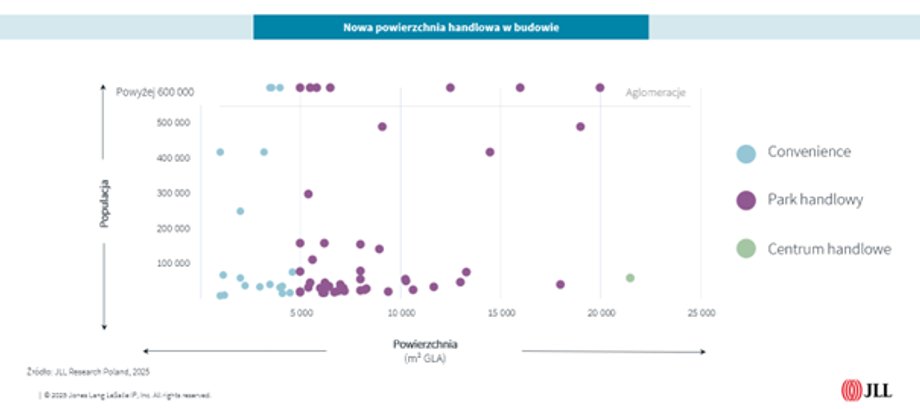
Where are the commercial facilities under construction concentrated and what are their sizes?
|
JLL
Everything seems to indicate that retail parks will remain one of the most active investment segments in the region. Their flexibility, resistance to economic fluctuations and stable demand from tenants make them one of the most reliable formats of commercial real estate today.. They are also increasingly designed with sustainable development in mind – with energy-saving solutions, green infrastructure and access to public transport, which further increases their attractiveness to investors.