Israel attacks Gaza, accusing Hamas of “ceasefire violation”: 11 dead. The one-week truce called into question


Israel's military launched airstrikes in the southern Gaza Strip on Sunday after the military accused Hamas of attacking its soldiers, with the two sides accusing each other of violating a US-brokered truce. The incident has so far claimed 11 lives in the enclave and deepens uncertainty over the stability of the peace deal.
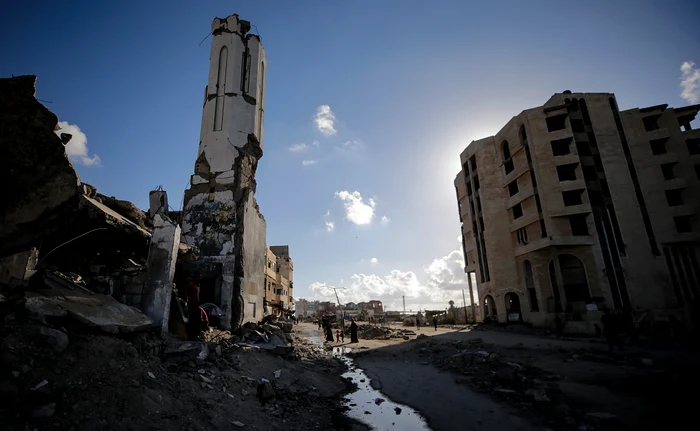
The Israeli army launched new attacks on the Gaza Strip PHOTO: EPA EFE
Gaza authorities have so far reported 11 casualties following Israeli army attacks carried out during the day in the towns of Zawayda, Nuseirat (center) and Jabaliya (north). According to Reuters, the attacks came after Hamas violated the ceasefire in three armed incidents in Rafah, including anti-tank and sniper fire.
Israel renames military campaign
The Israeli military stated that, on Sunday morning, “terrorists launched an anti-tank missile and fired gunfire at troops operating in the Rafah area of southern Gaza to destroy terrorist infrastructure in accordance with the ceasefire agreementAccording to the IDF, the attacks were launched “to eliminate the threat and destroy tunnels and military structures used for terrorist activities“.
Israeli forces described the actions as just “a flagrant violation of the ceasefire agreement” and announced that they would respond firmly.
Prime Minister Benjamin Netanyahu, Defense Minister Israel Katz and the military secretary left the weekly cabinet meeting for an urgent assessment of the security situation. During the meeting, the government approved renaming the military campaign to “Renaissance War”. Netanyahu stressed that Israel would respond forcefully to Hamas attacks on its forces.
Hamas, for its part, stated that “he had no role” in the clashes in Rafah and that it remains “engaged in ceasefire”.
Strict employment rules for Israeli troops
Since the start of the truce, IDF troops in the buffer zones have followed strict rules: they can only open fire to drive away suspects or for precise strikes on armed terrorists who pose an immediate threat. In all other situations, including when Hamas militants are observed from a distance by drones or aircraft, fire is prohibited.
Despite those restrictions, security officials say about 7,000 Hamas members have redeployed across the Gaza Strip, reasserting control over neighborhoods and towns as civilians return after Israel's partial withdrawal. To date, there are no plans to resume large-scale ground operations.
Mutual accusations
An Israeli military official stated that “Hamas has carried out several attacks on Israeli forces inside Gaza, including an anti-tank rocket launcher attack and a sniper attack against Israeli soldiers. Both incidents took place in an area under Israeli control… This is a serious violation of the ceasefire“.
For his part, Izzat al-Risheq, a high-ranking representative of Hamas, stated that the movement “remains committed to the ceasefire agreement” and accused Israel of repeatedly violating the deal.
The Gaza government's press office announced that as of Saturday, Israel had committed 47 ceasefire violations, resulting in 38 deaths and 143 injuries.
Obstacles to peace
Sunday's attacks represent the most serious test of the ceasefire since it came into effect on October 11. The dispute over the return of the bodies of the dead hostages continues: Israel is demanding the handover of 28 bodies, of which Hamas has returned 12 so far, and the rest are under rubble, requiring time and special equipment to recover.
US President Donald Trump's proposed peace deal remains blocked by major hurdles, including disarming Hamas, governing Gaza, creating a possible international stabilization force and steps towards a Palestinian state. The US Embassy in Jerusalem did not comment on the incident.