The report of the State Construction Inspectorate after the explosion in Rahova: Portions of the block must be demolished immediately. “Continued use of the building is not possible”


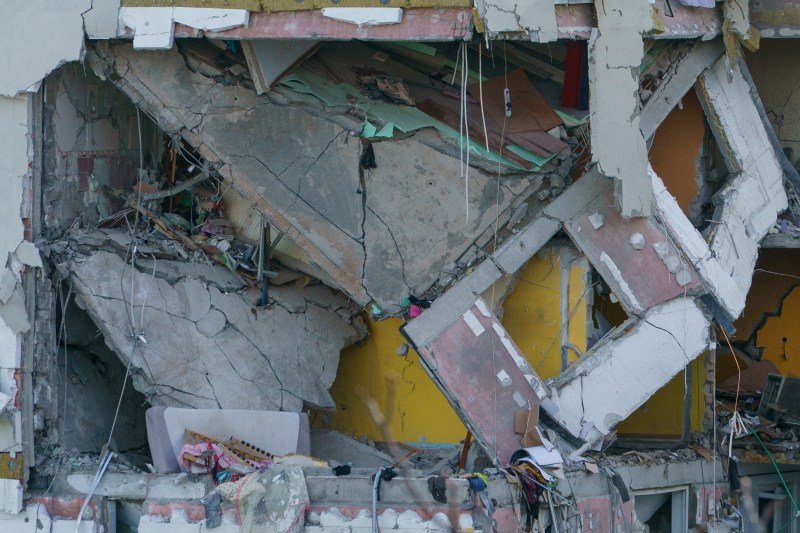
The aftermath of the explosion caused by an accumulation of gas in an apartment block in the Rahova district, Bucharest, October 17, 2025. Inquam Photos / Tudor Pană
The conclusions of the report of the State Construction Inspectorate (ISC) show that the 2nd staircase of block 32 in Rahova, where the explosion occurred on Friday morning, can no longer be used in any form and must be decommissioned and replaced. Experts believe that a consolidation is not technically and economically justified.
“It is appreciated that the observed situation has an evolutionary character, the building not being in a state of permanent equilibrium, and there is a risk of progressive collapse”, noted the ISC experts.
The report points out that the entire building “no longer meets the fundamental requirement of mechanical resistance and stability” provided by law and is “unsuitable for access and use”.
“Taking into account the observed state of decay of the building, it is found that the building as a whole no longer meets the fundamental quality requirement “mechanical resistance and stability”, provided by law 10/1995, presenting a risk of collapse and being unsuitable for access and use,” the report states.
The full report can be read below:
Consolidation of the building, a major risk for workers
The ISC warns that possible consolidation work would require interventions “quasi-total on all structural elements”, would take a long time and involve major risks for the intervention teams.
“Taking into account the severe degradations found affecting most of the building, including the state of partial collapse, and the structural system of the building made of large prefabricated panels, the following is observed:
- the continued use of the affected building, the 2nd staircase of block 32 in its entirety, is strictly conditional on the performance of consolidation and safety works and can only be resumed after their full implementation;
- the portion of the building above the area directly affected by the explosion, floors 7 and 8, and immediately below it, floor 4, requires urgent decommissioning;
- the strengthening of the building requires a quasi-total intervention on all vertical structural elements, foundations, and on the slabs in the vicinity of the northeast and northwest facades;
- the implementation of intervention measures for consolidation is long-lasting due to their specificity and the existing structural system;
- the works of technical expertise, design and implementation of intervention measures for consolidation require the access of workers to the building, without their safety being ensured;
- interventions for consolidation are likely to functionally affect the building, in the common spaces and in the apartments;
- it is stated that it is possible that the condition of the building before the explosion cannot be reconstructed due to large vertical displacements at the floor level which will not be able to be repositioned; in this situation the respective floors will not be able to be used;
- according to the law, in the case of consolidation, a level of safety compatible with the provisions of the current technical regulations must be reached, which will determine the need to carry out a generalized intervention;
- carrying out consolidation works on the damaged building requires the creation of auxiliary support structures, with their own foundations and developed in the plan;
- since the consolidation works are highly invasive and long-lasting, there is a possibility that during their development the location will be affected by a moderate or large earthquake that would immediately endanger the stability of the building and could cause its partial or total collapse.
Consolidation of the building is not justified
ISC appreciates that, given the current state of the building, the consolidation of the building is not justified from a technical and economic point of view, the consolidation works may exceed the replacement value of the building, take a long time and present high risk in execution”.
“Continued use of the building is not possible”
Under these conditions, the ISC recommends the demolition of the affected staircase in its entirety and the establishment of a safety perimeter, which also includes the section of the “Dimitrie Bolintineanu” High School located in the immediate vicinity.
The conclusions of the report:
- “From the analysis of the collected information, of the applicable legal and regulatory framework, regarding the possibility of further use of the building, the team of experts determines that the further use of the building, in the state in which it is at the time of drawing up the technical report, is not possible, presenting a high risk for users and for the people in the immediate vicinity, and recommends its decommissioning and replacement. This conclusion refers to the 2nd staircase of block 32, in its entirety them.
- Components of the building that show serious damage can collapse, endangering people located in its vicinity.
- In this sense, a safety perimeter must be established around the building by the competent authorities, and the access of people to this perimeter must be restricted.
- Taking into account the proximity of the serious damage and probable instability of the 7th and 8th floors in the northern corner of the building, it is estimated that the section of the Dimitrie Bolintineanu high school building located in the vicinity of the building should also be included in the safety perimeter.
- It is considered that the lifting of access restrictions can only be achieved after demolishing the affected part of the building or making it safe by any means”.
The Rahova explosion
Three people died as a result of the explosion in the Capital and 20 were injured as a result of the explosion that occurred on Friday in an apartment block in Sector 5 of the Capital.
Prime Minister Ilie Bolojan informed that, according to the first estimates of the State Construction Inspectorate, this block will most likely not be rehabilitated and will have to be demolished.
The block had 108 apartments, in which about 400 people lived. The authorities have ordered the total evacuation of the building as there is a risk of collapse.