After years of frozen conflict and latent tensions, a historical approach between Armenia, Azerbaijan and Turkey seems to take shape, with possible radical implications for the Security architecture in the South Caucas. This time, Moscow is no longer the central actor, but rather an irritated and weak spectator, caught in his own military adventure in Ukraine, writes in Kyiv Post, Timothy Ash, main strategist for emerging sovereign markets at BlueBay Asse Management Company, based in London.
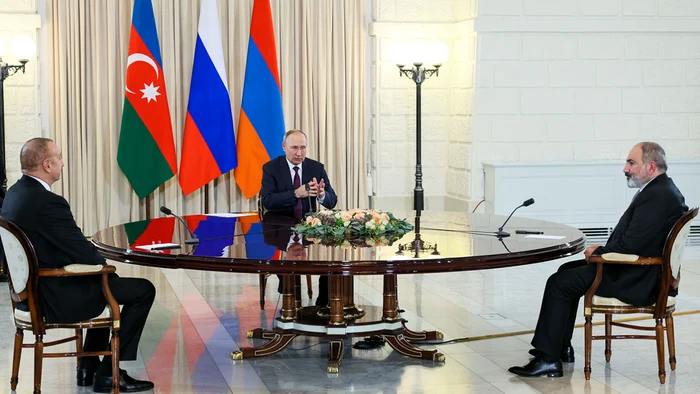
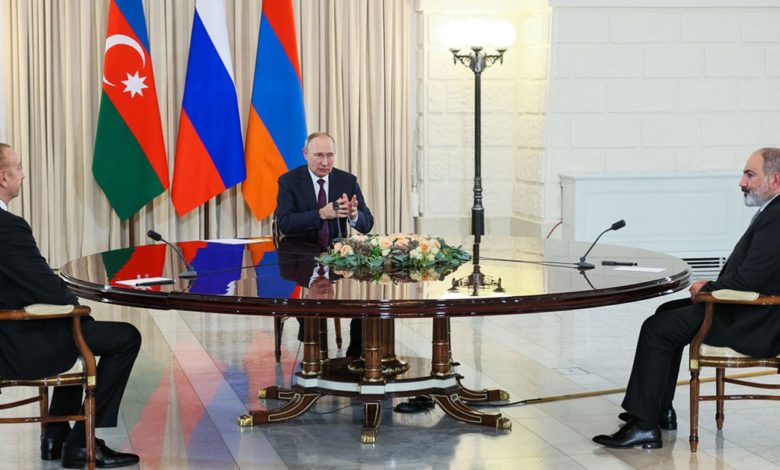
Ilham Aliev, Vladimir Putin and Nikol Pașinian/ Photo: Moskow Times
According to diplomatic sources and reports from the regional press, the three states negotiate intensely on the Zangzur corridor – a strategic route that would link Azerbaijan to Exclava SA Nahicevan, through the south of Armenia, and further to Turkey. The recent visit of the Armenian Prime Minister Nikol Pașinian to Ankara seems to have accelerated a reconciliation process that until recently seemed impossible.
The beginning of a peace and the end of a hegemony
A possible agreement on the corridor would be a decisive step towards normalizing relations between Erevan, Baku and Ankara, ending a painful history, marked by identity conflicts and territorial claims. It would also be a symbolic victory of diplomacy over the old war narratives.
For Armenia, commercial gates would open to Europe and Central Asia. For Azerbaijan and Turkey, an axis of East-West influence would be strengthened, without the intermediation of Moscow. For Russia, on the other hand, this could be one of the most significant strategic defeats since the destruction of the Soviet Union.
The price of an absence: Russia, in defensive
The war in Ukraine consumed not only the military resources of the Kremlin, but also its ability to arbitrate the conflicts in the former Soviet space. In 2023, when Azerbaijan-actively supported by Turkey-resumed the offensive in Nagorno-Karabah, Russia did not intervene. His obligations to Armenia, as an ally within the CSTO, remained on paper, and Baku won a clear victory.
The Pasinian Prime Minister, although in a fragile political position, quickly understood the reality of the new regional context. He started the steps to normalize relations with the old neighbors and has approached visibly to the European Union, especially to France. The Kremlin responded with hostility, trying to destabilize the government of Erevan by supporting coup attempts, according to recent reports.
Zangezur corridor, an open gate and a heavy concession
For Azerbaijan, the key to a final peace agreement remains the modification of the Armenian Constitution, so that the Herevan officially recognizes the Baku sovereignty on Nagorno-Karabah. Pasinian, aware of the lack of popularity of such a measure, delayed the decision, relying on economic benefits that could alleviate internal resistance.
However, the acceptance of the Zangezur corridor could be the exchange currency that causes Azerbaijan to relax the constitutional claims – and, implicitly, to sign a treaty of historical peace.
Russia loses the Caucasus, but does Georgia win?
In a geopolitical irony not at all subtle, while Armenia and Azerbaijan detach from the orbit of Moscow, neighbor Georgia-once the “favorite of the West”-takes steps back, approaching Russia under the leadership of the Georgian Dream, controlled by the billionaire Bidzina Ivanișvili.
Despite the pro-European protests repressed brutally, Tbilisi seems to tilt the balance in the opposite direction to the rest of the region. An important piece on this geopolitical board remains the port of Anaklia, played between the Chinese and American interests. The project irritates the Trump administration, which supports sanctions against the Tbilisi regime in Congress.
Iran, on the edge
Another regional actor affected by the current evolution is Iran, who opposed the opening of Corridor Zangezur. However, weakened after the recent hits of the US and Israel, Tehran no longer has the same pressure capacity. Thus, the Azero-Turkish initiative has taken shape at a time when Iran is, for the first time, without the real ability to block it.
Caucasus, on the threshold of a historical resettlement
If this agreement is signed, we will attend one of the most spectacular geopolitical repositions in the post-Soviet space. Russia, which for three decades has controlled the balance in the Caucas by military presence and economic dependencies, now sees its influence by its own strategic mistakes.
Zangzur corridor is not only a transport route – but also a demarcation line between the past dominated by Moscow and a future that, at least in the vision of Armenia and Azerbaijan, is built closer to Ankara, Brussels and, perhaps, Washington.