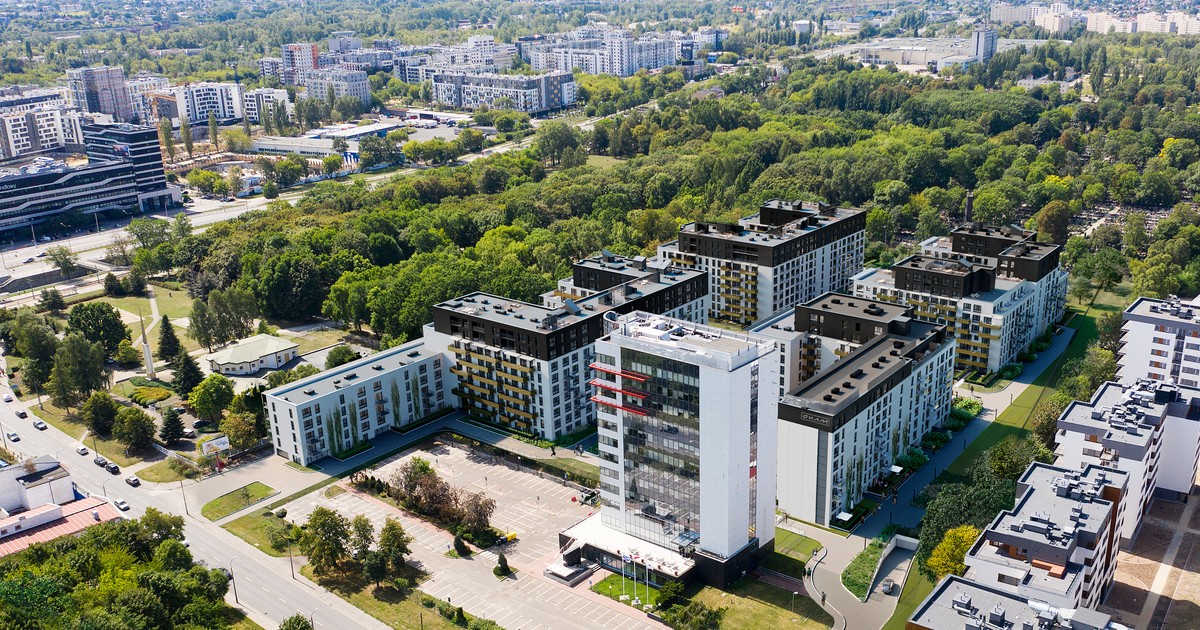
This is a trend that has been gaining momentum in recent years both in Poland and on Western markets. Investors see it as a chance for a second life for older, often energy-inefficient office buildings from the 1990s and early 2000s. At the same time, cities benefit – because such projects can revitalize centers where vacant office spaces were beginning to create “dead zones” after working hours.
However, can every office building be transformed into an attractive place to live? What challenges – technical, legal and financial – face investors? And is this really a new chance to solve the housing crisis?
Reconstruction of an office building from an expert's perspective
Michał Rokosz, director, real estate repositioning advisor at the Colliers consulting companyemphasizes that changing the use of a building is a complex process that requires technical and legal knowledge and the ability to assess the market potential of a given facility.
— The first step in analyzing the possibility of such a change is to check the provisions of the local development plan for a given location. It should be determined whether multi-family housing development or a collective residence function (similar to a hotel function) is permitted, he explains.
It happens, as the expert points out, that the plan very precisely defines the permissible functions, making any change impossible. – In such a case, the only solution is ZPI, i.e. Integrated Investment Plan – it is a special form of local spatial development plan, adopted by the commune council at the investor's request – explains Rokosz.
The next stage is the analysis of the building's technical parameters, including: sunlight, the required number of parking spaces, as well as requirements for escape routes, which vary depending on the purpose: different for office buildings and hotels, different for multi-family residential buildings. — It is worth noting that office buildings are designed with other user needs in mind – e.g. large, open areas, limited access to openable windows (in the case of air conditioning, they are not required), or storey height enabling air conditioning and telecommunications installations. In apartments, these installations are carried out differently and to a smaller extent. Therefore, it can be argued that transforming an unrented office building into a residential block with premises for sale is a suboptimal solution – explains the director of Colliers.
The expert draws attention to the fact that the situation is different in the case of converting an office building into a collective residence. These can be both “apartments” for long-term rental, as well as hotel or student rooms. — This function greatly facilitates the arrangement of office space – especially since student dormitories and hotels require many common areas that can be located in less sunny parts of the building. Nevertheless, such a conversion also requires a detailed analysis – says Michał Rokosz and adds that changing the function of the building involves numerous challenges – both planning and technical. — For example, you should consider how to run the sewage system to bathrooms and toilets, which in office buildings are usually located close to the core of the building, he says.
Rokosz notices that despite numerous challenges, a growing interest in this type of projects has recently been observed. — This results, on the one hand, from the changing needs of office space tenants, and on the other hand, from unmet housing needs in cities. In our opinion, this is an attractive direction that allows us to provide modern residential space in a shorter time and in a more environmentally friendly process – he argues. — Changing the function of a building – compared to demolition and construction from scratch – allows not only to shorten the implementation time (usually by half, to about 12 months, not including the planning period), but also is a pro-ecological activity, reducing the carbon footprint associated with concrete – he emphasizes and draws attention to the fact that not every office building is suitable for conversion into a collective housing function.
— For example, recently information has emerged about PHN's plans to change the function of the office building at Al. John Paul II in Warsaw for a residential function. Zeitgeist and Zeitraum, in turn, have recently completed several such adaptations, including: at ul. Solec 22, where a student dormitory was built in a former office building. Another example is the conversion of two of the four buildings of the Lipowy Office Park complex, the former headquarters of Pekao SA, into student rooms. This project was carried out by Colliers on behalf of the 1AM fund, says Michał Rokosz. Experts assume that there will be more such projects in the future, although they emphasize that each building requires an individual approach.
Case study: former Danone office building
Another example of such conversion, this time into apartments, is the former Danone office building, located at ul. Redutowa in Warsaw's Wola district. Marcin Michalec, COO, Okam Capitalexplains that the company was considering three ideas for using this property. — One of them is to continue using this building as an office building. But offices will not survive in this location. The second is to demolish the office building and build a residential building in its place. But this is a waste of the advantage of the building's exposure and the view from its upper floors. That's why we decided to keep the structure of the office building, but change its function to residential. This also means reducing carbon dioxide emissions, because demolishing and building in the same place means a double carbon footprint, argues Michalec. The Okam representative argues that the office building is in good condition, its structure is suitable for use, and the floors are high enough to accommodate apartments almost three meters high. — The building does not have an underground parking lot. Therefore, in front of it, from the side of the street. We want to build a lower wing with a service function on Redutowa Street, under which there would be a two-story underground parking lot, serving services and apartments in the adapted building – he explains and adds that in this lower wing, the ground floor would be occupied by shops, and above there could be a gym or fitness club, a medical center and a catering facility. – These services would create added value and would be used by the residents of our estate and neighbors – he assures. — The floors of the office building can be easily converted into apartments – four apartments per floor can be arranged there, and two larger penthouse-type premises are possible on the top floors. This means that there would be a total of about 40 apartments in the building. These would be high-end apartments. Especially those from the seventh or eighth floor upwards: their key advantage is the view of the neighboring park, which will never be covered by anything, says Marcin Michalec.
Case study: Focus Hotel Premium Wrocław
The Focus Hotel Premium Wrocław project can undoubtedly be cited as an example of reconstruction. The new Focus hotel, along with the catering section, was created as a result of the reconstruction of the layout and renovation of nearly 4,000 square meters. sq m existing usable space. The change in the function of the facility included the transformation of the existing office space into a hotel with 87 rooms and the adaptation of part of the lobby and ground floor for the needs of a hotel, as well as the creation of a restaurant. The hotel has been awarded a 4-star standard. Construction works lasted 14 months – from January 2024 to May 2025. The hotel began its operations in July 2025. The 3KTR studio, cooperating with Neo Świat, is responsible for the architectural design. The facility will also be subject to BREEAM ecological certification.
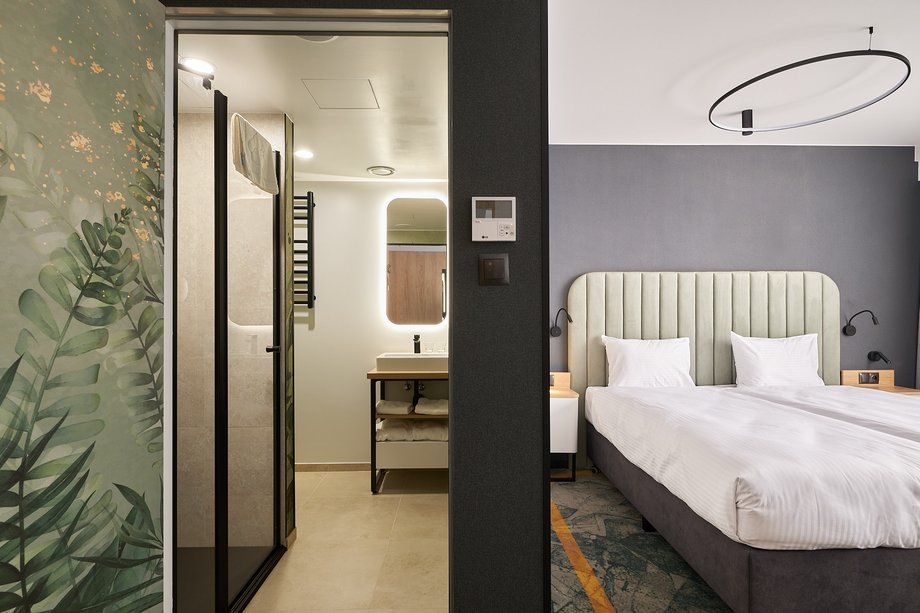
Hotel room at Focus Hotel Premium Wrocław
|
Neo World
– This is a comprehensive transformation of an office building into a modern four-star hotel – he assures Paweł Brodzik, managing partner of Neo Świat. — Our challenge was not only to change the function of the Wratislavia Tower facility, but also to fully adapt the existing structure, installation layout and technical standard to the requirements of the hotel facility, he says. — Additionally, the hotel floors are located directly above the New Horizons cinema, whose evening screenings did not interfere with the existing office space, which works until 17. For the comfort of hotel guests, specialized sound intensity measurements and non-standard acoustic solutions were necessary to ensure that the cinema and the hotel could operate at the same time – he explains. The expert argues that from the perspective of a fit-out contractor, it was a project that went far beyond classic arrangement work. — It was necessary to design and carry out structural reconstruction, install much more efficient ventilation units, develop new sewage and installation lines, and ensure full acoustic comfort. An additional interesting fact is that each of the 87 rooms required an individual approach and different finishing elements, because the oval shape of the front glass façade meant that no two room layouts were identical – assures Brodzik and adds that the complexity of the Focus Hotel Premium Wrocław project required close cooperation between the design team, architects and the investor.
Rajmund Węgrzynek, managing partner of Neo Światadds that rising construction costs, limited land availability and increasing attention to environmental issues mean that the commercial real estate market is increasingly moving towards revitalization and changes in the functions of existing facilities. — Reconstruction of office buildings into hotels or apartments is becoming a real alternative to new investments – both economically and ecologically. This type of transformation allows you to use the structure of the building, reduce the carbon footprint and shorten the investment process compared to building from scratch, he explains.
Conversion of office buildings into residential and hotel functions is becoming one of the most interesting directions of development of the real estate market. This is not only a response to the changing needs of users and the housing shortage, but also a way to manage urban resources more sustainably. Although the adaptation process requires extensive technical and legal knowledge, and each building poses a separate challenge, more and more examples show that it is worth making this effort. Instead of falling into oblivion, old office buildings are gaining new life – joining the trend of people- and environment-friendly cities.