Many gardeners have appreciated winter sowing of vegetable and flower crops in order to obtain earlier products. Agrochemist, soil scientist and plant grower Victoria Karelina spoke in detail about the pros and cons of this method in her Zen channel “Seeds of Altai. Summer tips from Victoria Karelina” (16+).
This method is most effective in regions with moderate winters, without sudden temperature changes. In the regions of Siberia and the Urals, sowing should be approached with caution, carrying it out on already frozen ground, Victoria noted.
As a rule, spring sowing is postponed until the soil dries out, which is necessary for processing and preparing the beds. This usually happens in mid-April – early May. At this time, in areas sown in late autumn, plants are already actively developing, making full use of the moisture remaining from the melted snow.
These plants are more resistant to unfavorable conditions and are less likely to be affected by pests, since they are not yet active. The harvest from winter plantings ripens 2-3 weeks earlier than during spring planting.
What can be sown:
- Leafy vegetables: various types of lettuce, watercress, arugula, mustard greens.
- A variety of greens: dill, parsley, cilantro, sorrel.
- Root vegetables: parsley (root), parsnips, carrots, beets, radishes, daikon.
- Bulbous: onion seeds, spring onion, chives, wild garlic.
- Perennial flowers.
- Green manure: winter rye, oats, vetch, white mustard, phacelia.
Sowing dates and technology:
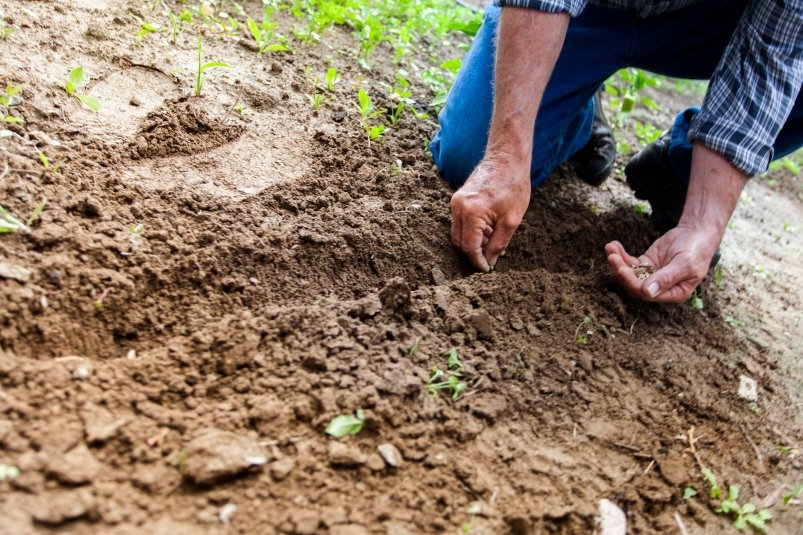
It is necessary to sow into already frozen soil. When stable daytime temperatures of about 0…+3 degrees and slight night frosts within -1…-3 degrees are established. Typically, this period is from late October to mid-November, but the exact dates depend on the climate in your region.
Preparing the beds:
- Prepare the bed a few days before the frost, while the ground is still wet.
- Dig up the soil and apply fertilizers containing potassium and phosphorus.
- Form grooves and cover the prepared area to avoid erosion by precipitation.
- Prepare dry soil in advance for sprinkling the seeds.
- Use only dry seeds and do not water after sowing.
- Mulch the bed with a layer of about 2-4 cm of peat, humus or fallen leaves.