The Amerindians have stories in their folklore that talk about a bizarre population of giants, with white skin and red hair, who lived in caves. These stories are numerous and specialists, following research, have come to the conclusion that they start from a historical truth.
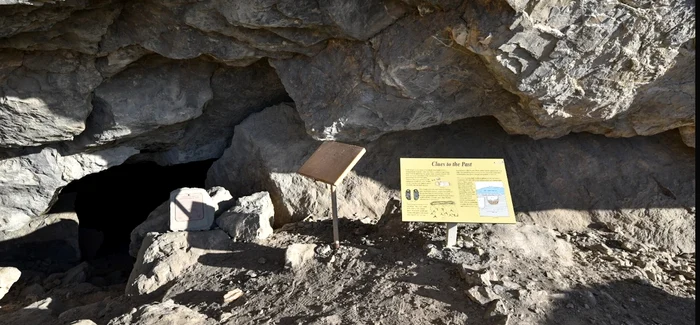
Lovelock Cave PHOTO inkedwithwanderlust
Giants, human-like creatures but of gigantic stature, have invaded legends on all continents since time immemorial. These creatures, mostly unwieldy, aggressive and extremely damaging to human communities, have fired the imaginations of thousands of generations, across all cultures, for at least 3000 years. Most fairy tales and legends with giants remain what they are, that is, fairy tales. Lovers of pseudo-history, conspiracy or paranormal theories still believe today that the giants really existed on the face of the Earth, and even that they were discovered, but the research results are kept secret.
One of the most bizarre stories of giants comes from the North American continent, where the Native American tribes of the Nevada desert area speak of a race of giants with white skin and red hair who lived for a long time in their territories alongside humans. On the principle that there is no smoke without fire, scientists were curious to see if the legend was true and if giant-sized, red-haired individuals ever worked among the Oaches of the West. The results were truly amazing.
The cave where the giant red-haired “barbarians” lived
In the American state of Nevada, in the Great Basin region, there is a legendary and at the same time amazing place, a survivor of prehistoric times. This is Lovelock Cave, one of the most important geological and archaeological sites in the western United States. The cave is 46 meters long and 11 meters wide. It was originally an underwater cave, because in the Pleistocene, that is, 2.5 million years ago, today's Nevada desert was mostly covered with water. It was part of the huge Lahontan Lake. With the passage of time, several hundreds of thousands of years ago, the region became more and more arid, the lake dried up giving way to the desert.
From that huge expanse of water, several small lakes remain, such as Humboldt, Pyramid or Carson. And underwater caves like Lovelock remained on the surface. Because of its extraordinary archaeological potential, Lovelock Cave was placed on the National Register of Historic Places on May 24, 1984. It was the first major cave in the Great Basin to be excavated and archaeologically surveyed. Why Lovelock Cave is so important. Well, thanks to the giants in the stories. The Paiute nations, Native Americans who have lived for millennia in the Nevada desert area, have many legends about giant men with white skin and red hair who lived in Lovelock Cave. Their ancestors called them Si-Te-Cah and their stories are contained in the book “Life Among the Paiutes”, written at the end of the 19th century by Sarah Winnemucca Hopkins, the daughter of a Paiute Indian chief.
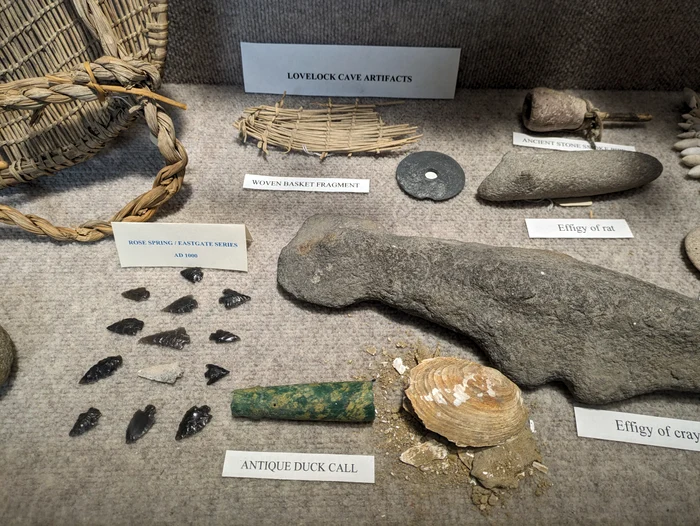
Lovelock Cave Artifacts PHOTO wikipedia
The giants, described by the Native Americans of Nevada, were predatory, murderous and, on top of that, cannibals. Or rather, they ate human flesh. Even between them they would have eaten. Characteristics of giants in all cultures. The Paiute Indians felt threatened by these giants, so all the tribes united to drive them out. After years and years of war, the Paiute tribes would have managed to thin their ranks. One day, while the tribes were chasing the last remaining red giants, they took refuge in a cave. The Paiutes asked them to come out and fight, but the giants refused. The Native Americans then built a fire at the mouth of Lovelock Cave and forced them out. The last red giants were met and killed with a volley of arrows. However, a few families of giants are said to have managed to escape by making rafts out of “tulle”, a fibrous aquatic plant which, legend has it, the giants used for braiding. With these rafts the giants fled across Lake Lahontan, which still contained part of Nevada. That is, the event would have taken place, sometime 10,000 years ago.
From legend to guano business and sensational
Lovelock Cave, also known as Bat Cave, is located 20 miles south of Lovelock, Nevada. Despite the legends of the Native Americans, who refused to approach it, the American settlers who conquered the West in the 19th century did not care too much about the stories of the “redskins” and the giants. In the cave they found a very precious resource, guano. This guano is the excrement of the bats that have made their home in Lovelock Cave for thousands of years. It is especially valuable as a natural fertilizer due to its rich content of phosphorus, nitrogen and potassium, but also in the manufacture of gunpowder.
Two miners, James Hart and David Pugh, realized the value of guano as an ingredient in gunpowder and formed a company to begin excavations in 1911. They removed a layer of guano from the cave, about two meters deep, using a shovel and a pick. Then suddenly all kinds of old and strange artifacts started to appear as well. Obviously, the miners didn't pay much attention to them. But it was the sign that the Native American legends had a grain of truth. Someone had inhabited that cave in ancient times. What is certain is that the two miners sold 250 tons of guano to the Hawaiian Fertilizer Company in San Francisco. After closing the deal, however, they made an effort and notified Alfred Kroeber, the founder of the Department of Anthropology at the University of California.
He began the first archaeological excavations at Lovelock. In 1924, the second excavation campaign already took place at the cave in Nevada. The results were incredible: more than 10,000 artifacts, including tools, bones, baskets and weapons. Including some mummified human remains. The era of speculation also began. Many sensationalists have stated that the people whose remains were found in Lovelock Cave were over 2.40, even 3 meters tall. In an article published in the Nevada Review-Miner in 1931, journalists wrote that two very large skeletons had been discovered in the bed of dried Humboldt Lake near Lovelock, Nevada. One of the skeletons at Lovelock was said to be 2.59m tall and was later described as being wrapped in gum-covered fabric similar to Egyptian mummies and the other was, sensationalists said, almost 3.05m tall. Obviously, they were all mere exaggerations.
The Mystery of the Red-Haired Giants of Lovelock
Archaeologists have analyzed the many artifacts discovered in the cave at Lovelock. The most impressive are the weapons, such as spear and arrowheads, made of stone, duck decoys made of wicker, with phenomenal precision and dexterity, but also the mummified remains of more than 60 individuals who once lived in that area. The way in which the approximately 4000-year-old baskets have been preserved is also impressive. Also in the cave at Lovelock was found an intact sanda, which brings incredible input regarding the port of the populations that lived in the area 4000 years ago. The donut-shaped stone is also extraordinary, with 365 notches carved along the outside and 52 notches inside. Scientists believe it was a calendar.
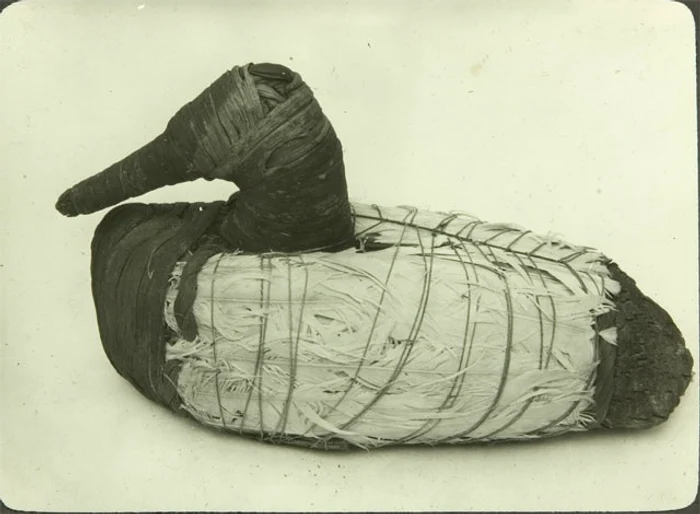
Bait about 3000 years old found at Lovelock PHOTO wikipedia
Those people belonged to a civilization, probably hunter-gatherers who hunted in the Lake Lahontan area. In any case, they were extremely skilled at making stone tools and weapons. The presence of weapons shows intensive warlike preoccupations, which brings to mind the aggressive nature of the giants in Paiute stories. But were the cavemen at Lovelock giants? To humans today, they were by no means giants. Possibly medium or tall people. To the Amerindian tribes of a few thousand years ago, they were certainly giants. As a result of the measurements and tests carried out, it was concluded that the people of Lovelock, especially the men, had a height that varied between 1.80 meters and 1.90 meters.
And this despite the fact that many Amerindians had an average height of 1.65 meters. The tallest Amerindians were those from the Great Plains tribes, standing around 1.72 meters. The populations at Lovelock, American specialists say, are part of the Lovelock culture, and the area is considered protected. Specialists believe that indeed those tall and red-haired people, who mysteriously appeared in the Nevada area, were replaced, probably brutally, by the cultures of the Paiute Indians.