The years of communism left a special architectural legacy in the cities of Romania, hard to overlook due to the massiveness of its buildings. “Socialist-modernist” constructions continue to gather controversy, even if some are regarded as historical monuments.
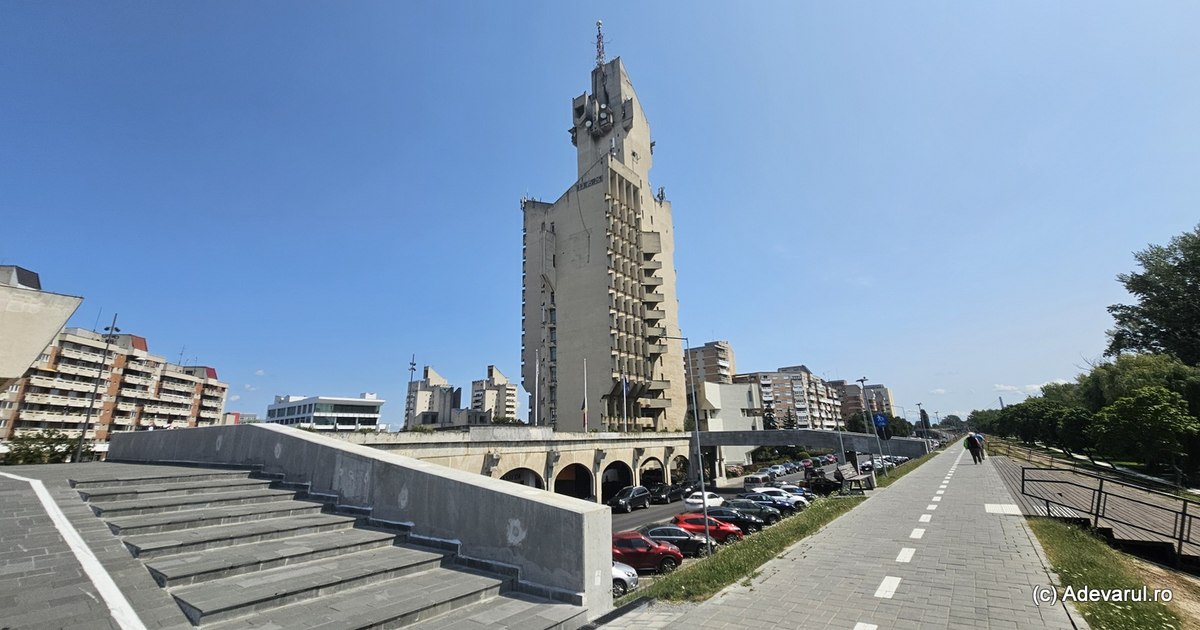
The palace from Satu Mare. Photo: Daniel Guță THE TRUTH
Almost every city in Romania has preserved massive concrete buildings, built in the middle of the communist era, with an appearance that can cause controversy. In some places, the old buildings seem to have lost their former importance.
Numerous houses of culture remained empty, while other administrative buildings, past emblems of “civic centers” could no longer be restored, due to the high costs of the works.
They are often viewed with interest by tourists, and their images spark reactions on social media, while some locals feel nostalgic. The story of most of them begins in the mid-1950s, with the sunset of the “Stalinist era” and is connected with brutalism.
Brutalism, an architectural style that appeared in the early 1950s in Great Britain, as part of the city reconstruction projects after the Second World War, would conquer, in the next two decades, the socialist countries of Eastern Europe.
Brutalist buildings were characterized by massive and geometric forms, using exposed concrete, raw materials and exposed structures, relying on functionality and abandoning ornamentation and other decorative elements.
The architecture of apparent concrete
In socialist and communist countries, brutalism became popular because traditional styles were associated with the bourgeoisie and the past, while concrete symbolized equality and was perceived as an accessible and unpretentious material.
The well-known architects of Romania in the 60s and 70s, such as Nicolae Porumbescu or Octav Alifanti, reinterpreted the brutalist current, adding a local specificity, marked by their experience and the demands of the socialist regime.
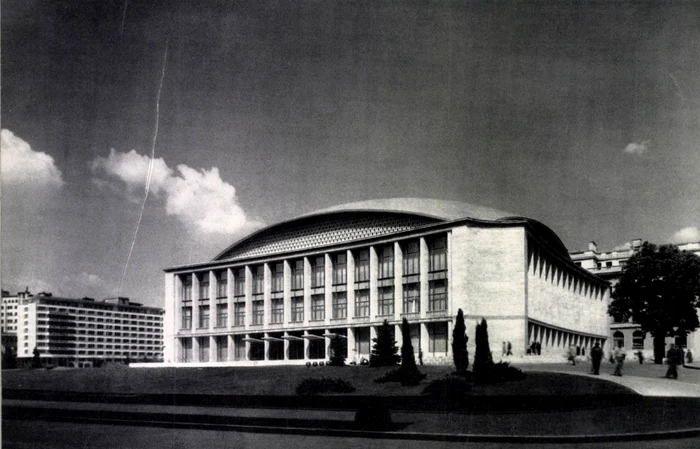
The Palace Hall, in the 60s. Architecture.
Numerous public buildings from that period, built in the socialist-modernist style inspired by brutalism, impressed by their size, but also by their composition, the abundantly used concrete being the representative material of the era, both in construction and decoration.
“Concrete solves the artistic problems of constructions only when it is possible to make its surface a visible expression of the internal homogenous texture and the concrete becomes visible, known as exposed concrete. Today, through its new use, exposed concrete replaces expensive finishing materials, which required highly skilled labor and a long time for their installation. The exposed concrete elements are resistant and less vulnerable, easier to clean and wash. The apparent concrete allows to obtain very varied artistic effects, if all the possibilities it offers through the modeling of the surfaces are exploited”showed the construction specialists of the Polytechnic Institute of Iasi, in 1975.
Concrete factories were almost indispensable in Romanian cities, and the use of concrete had the role of expressing the strength, durability and collective spirit that the regime wanted to convey. Numerous performance halls, administrative buildings, universities, cultural centers and hotels built in the 60s and 70s have preserved the imprint of socialist-modernist architecture, a trend that has prevailed in all corners of Romania.
The most famous socialist buildings
The Hall of the Capital Palace was inaugurated in 1960 and was described by the specialists of the era as one of the most representative pieces of socialist Bucharest. The architects Horia Maicu, Tiberiu Ricci and Ignace Șerban, together with the engineers Alexandru Anton Necșulea and Nicolae A. Băilescu, received the State Prize for the design and construction of the “RPR Palace Hall”.
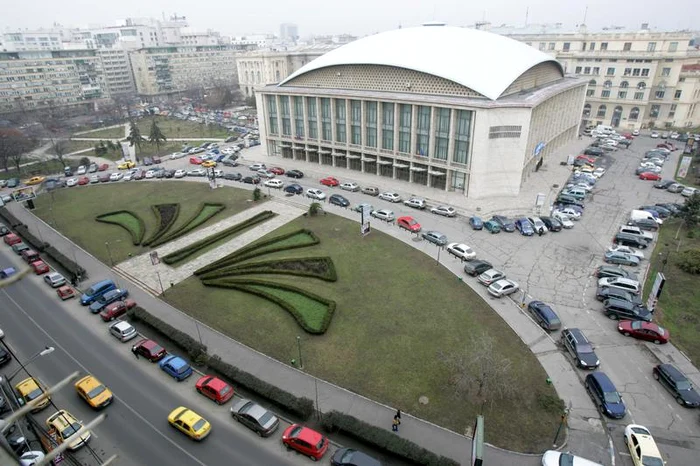
The Hall of the Palace in Bucharest. Photo: Hall of the Facebook palace
“The hall of the RPR Palace is the first achievement of monumental architecture which, although it still preserves features of some classical procedures in details, is courageously oriented towards the future. And the mastery of detailing, both exterior and interior, gives these spaces, which you feel generous, a warmth that manages to eliminate the danger of severe impersonality”. showed Architecture magazine in 1962.
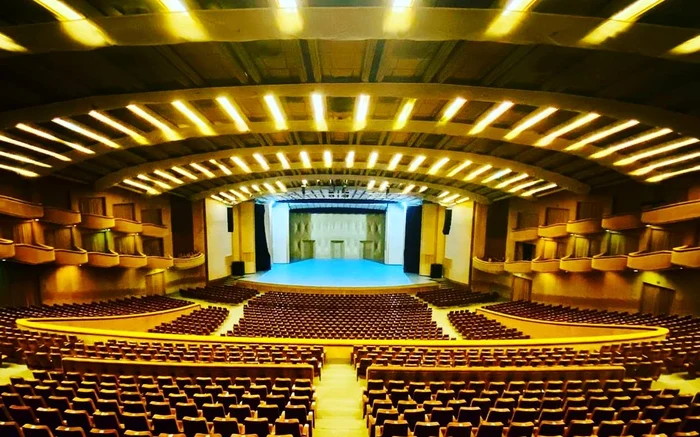
The Hall of the Palace in Bucharest. Photo: Hall of the Facebook palace
In Cluj-Napoca, the “Palatul Telefoanelor”, built in the 60s, in the same style of Brutalist inspiration, was recently declared a historical monument.
“Notable for its glazed facade, travertine elements and precast concrete panels with geometric motifs, the edifice is an emblematic example of socialist modernist architecture in Romania. Located in the historic center of Cluj, between the Ion Luca Caragiale Park and the National Post office, it is distinguished by its harmonious proportions and refined choice of materials. The ranking initiative was initiated and developed by the Office for Art and Urban Research Association (BACU)”, informed the representatives of the BACU association.
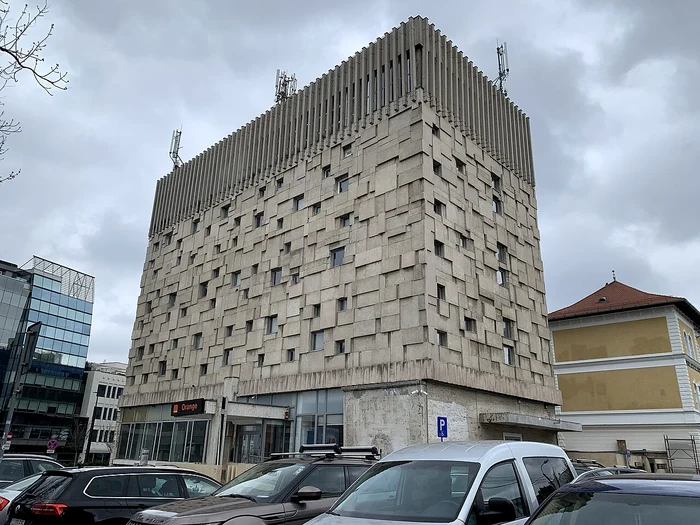
Palatul Telefoanelor Cluj Chainwit Wikipedia
In Satu Mare, the new civic center of the city was designed in the 70s by the architect Nicolae Porumbescu-Vaida and has remained an emblem of socialism-modernism.
The ensemble included a house of culture with 800 seats, an open-air amphitheater, commercial spaces and new blocks with over 1,000 apartments, being dominated by the 15-story and almost 100-meter high building of the “political-administrative headquarters” of the county, today known as the Administrative Palace.
“I had to “plaster” the surrounding space, think of it in metaphors, calculate its voids, which it must inevitably contain, to be filled by the future. Life should not be wasted, the profession of architect is a continuous plea for efficiency and form. Man must stand straight, let no one and nothing bend him. Then comes the vertical of the construction, the vertical of the lark. By the way, I would like the lark to build its nest up on the city tower. I reserved a little place for him there, have you seen him?”declared architect Nicolae Porumbescu-Vaida, in 1986.
The Student House of Culture, the Multipurpose Hall, the Intercontinental Hotel and the “IL Caragiale” National Theater in the Capital, the Romexpo complex, the House of Culture in Suceava, the Administrative Palace in Botoșani and the House of Culture in Baia Mare are also among the representative buildings of the popular architectural style in the past.
After 1990, some buildings were associated with the Ceaușescu regime. Many Romanians considered them “communist concrete”, and often the authorities did not show interest in their rehabilitation, or did not find funds to restore them. They were left to decay and sometimes vandalized, even though their appearance continued to fascinate many visitors.