When US President Donald Trump first met then-German Chancellor Angela Merkel after the start of his first term, he told her that Germany's lack of defense spending was a problem. This meant that the United States had to bear too high costs. “Angela, you owe me a trillion dollars. [3 bln 686 mld zł według obecnego kursu]”- he said then.
In the end, Germany did not pay a penny. But the exchange set the tone for Trump's approach to the presidency in his second term.
Whether it's an individual, a company, a university, a law firm, a media company or a country, Trump uses the power of the presidency to extort payment, often in dollars, from anyone he has dealt with. This is the leitmotif of his leadership and approach to the world.
Donald Trump is a “protection racketeer president.”
It started even before winning the election [prezydenckich w listopadzie 2024 r.].
At a Mar-a-Lago dinner with about 20 top oil company executives in April 2024, Trump told attendees to raise $1 billion. [3 mld 686 mln zł] for his re-election campaign, which he promised would be a great “deal” because he would cut red tape and cut taxes on “day one” of his presidency – and that was just the beginning.
Since returning to the White House, Trump has turned the Oval Office into a place where you have to pay to play [ang. pay to play room]: it was there that he met the managing director of the renowned New York law firm Paul, Weiss and forced him to agree to work pro bono worth USD 40 million. [147 mln 510 tys. zł] annually for causes that [Trump] finds it interesting. Instead, he rescinded an executive order he had signed that banned the law firm from entering into federal contracts and its employees from having security clearances.
Seeing what was coming, eight other renowned law firms followed in the footsteps of Paul, Weiss and signed contracts with the administration, which in total guaranteed over USD 1 billion. services pro bono in favor of Trump's priorities.
The article continues below the video
No mercy
Sensing victory, the president soon turned his attention to other industries, starting with big media: sued ABC and CBS News when they aired interviews he didn't like, forcing them to pay $15 million respectively [55 mln 312 tys. zł] and 16 million [58 mln 989 tys. zł] hole. The president also reached multimillion-dollar settlements with technology companies Meta and X. And although his multibillion-dollar lawsuit against the New York Times was dismissed, the Wall Street Journal case is still pending.
In addition to the high costs, these extortions have also made media companies more reluctant to publish critical information about the president and his administration's actions.
Then it was the turn of universities: those that have long been the foundation of America's scientific and technological supremacy, Trump has cut off federal research funding to force them to adopt policies favored by his administration. Some institutions, such as Columbia University, Brown University and the University of Pennsylvania, have agreed to pay “penalties” in amounts ranging from eight to nine figures. Others, such as Harvard University, resisted and came under financial pressure, losing research grants.
Corporations also did not escape Trump's attention, even though most American companies supported him in the last election. He approved U.S. Steel's takeover of Nippon Steel, but only after demanding a “golden share” in the company, which gives his administration extraordinary control and veto power over operations and decisions. He also converted a government subsidy to Intel into a 10 percent stake in the company – with an option for another five percent. in the future — and approved the sale of chips to China by Nvidia and AMD in exchange for a 15 percent fee on all sales.
Then there are America's trading partners, who are, it is worth noting, some of its closest allies. In this case, Trump negotiated remarkably similar and extremely one-sided deals with the EU, Japan and South Korea after threatening to impose tariffs of 25%. or more on all imported goods from America's largest trading partners in Europe and Asia. Ultimately, he “reconciled” himself to the 15 percent fee, which was still six times higher than before [obowiązująca]and his victory meant that the real losers turned out to be Americans, who have to struggle with higher prices for many different goods.
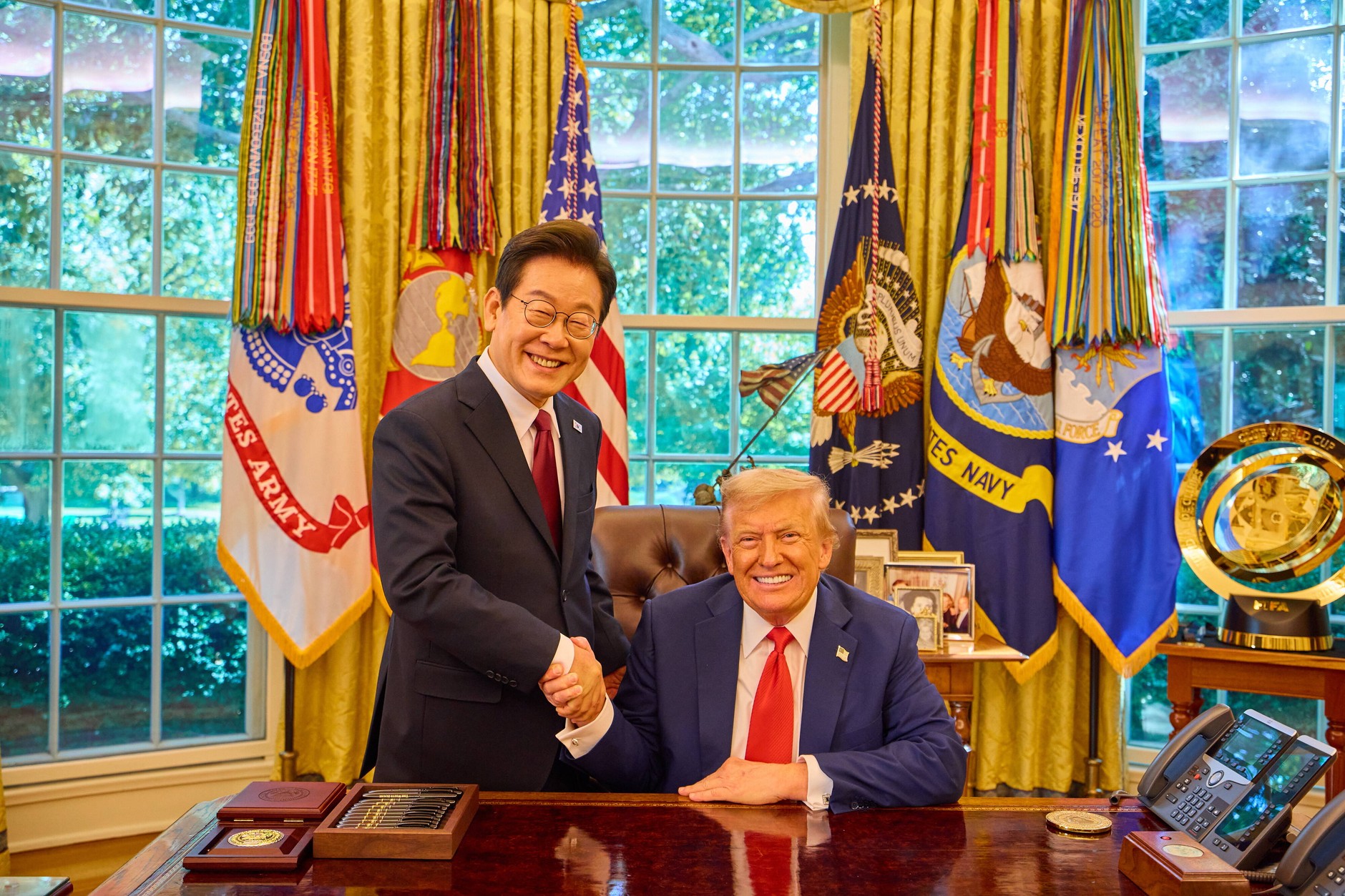
South Korean President Lee Jae Myung (L) and United States President Donald Trump after talks in the Oval Office of the White House in Washington, DC, USA, August 25, 2025.YONHAP / POOL / PAP
But that's not all. Trump also won commitments from these governments to make large investments in the United States – $350 billion. [1 bln 292 mld zł] by South Korea, $550 billion. [2 bln 30 mld zł] by Japan and up to USD 600 billion. [2 bln 215 mld zł] by European companies. Europe also agreed to purchase gas and other energy products worth $750 billion from the US. [2 bln 769 mld zł] within four years. And now the most important thing: in most cases, Trump will control where the investments go, and the United States will receive most of the profits – up to 90%. in the case of Japanese investments.
Doomed to failure
In the short term, an extortionist presidency works. Individuals, law firms, media companies, universities and even countries recognize that it is better to pay a little than to lose much more in the fight. And when one does so, others follow suit. Soon it will be a billion here, a few hundred billion there, and all this will add up to a specific amount of money.
But – and this is key – it is doomed to failure in the long term.
Such extortions cause enormous resentment among those who suffer the consequences. Customers, partners and colleagues are looking for other companies with which they can cooperate; readers, listeners and viewers give up media they can no longer trust; and countries are beginning to move to markets and partners that do not use their connections to advance the narrow, selfish goals of one man and his administration.
So far, Trump has been able to extort money from many people and has been successful in taking down companies and countries one by one. But soon everyone will get smarter and realize they have an alternative — and that once they unite, Trump won't be able to continue his extortions.
Find out more:
**
Ivo Daalder, former U.S. ambassador to NATO, is a senior fellow at Harvard University's Belfer Center and host of the weekly podcast “World Review with Ivo Daalder.” He writes the “From Across the Pond” column for POLITICO.
I’m Ashley Davis as an editor, I’m committed to upholding the highest standards of integrity and accuracy in every piece we publish. My work is driven by curiosity, a passion for truth, and a belief that journalism plays a crucial role in shaping public discourse. I strive to tell stories that not only inform but also inspire action and conversation.