publication
2025-10-10 22:16
The escalation of the trade dispute between Beijing and Washington has scared stock market investors. Wall Street indexes recorded their sharpest declines since April, plunging from historic highs. There is a realization that the US-China trade war is not over.

– Very strange things are happening in China! “They are becoming very hostile and sending letters to countries around the world saying they want to impose export controls on every element of production related to rare earth metals and virtually everything else they can think of, even if it is not produced in China,” Trump wrote on Truth Social.
This was the US president's response to Beijing's controls on the export of rare earth metals, announced a day earlier. In this way, the PRC authorities threatened to suspend deliveries of these critical components to the West, in turn retaliating against American restrictions on semiconductors. “A Cossack caught a Tatarzyn, and the Tatarzyn holds the head” – this Sienkiewicz's saying fits the current US-China relations perfectly. Beijing is taking advantage of the fact that China provides 90% of the extraction of rare earth metals, necessary in modern electronics.
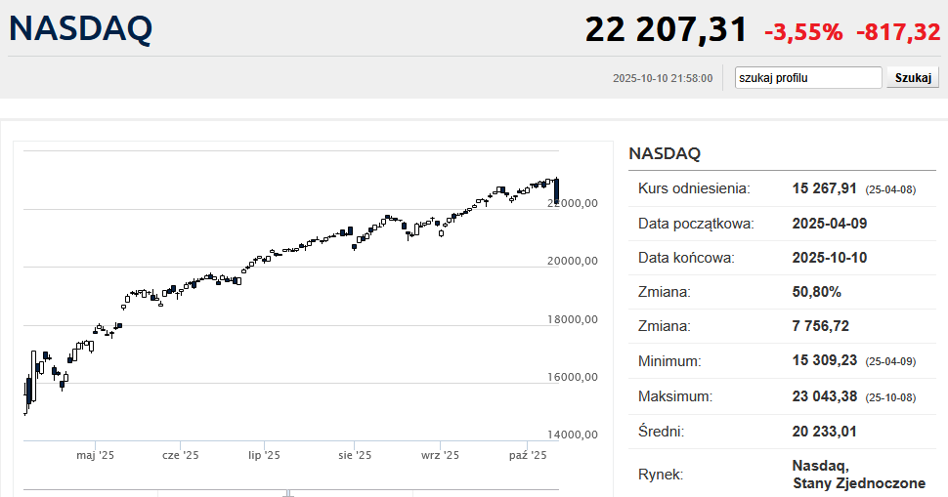
President Trump's harsh speech therefore means an escalation of the already dormant economic war between the world's two largest economies. On the other hand, for Wall Street it could simply be a convenient excuse to take profits after a wave of slightly crazy increases that lasted for half a year. Let us recall that since the April lows and the October highs, the S&P500 and Nasdaq have gained 40-50% each. So they have something to fall from.
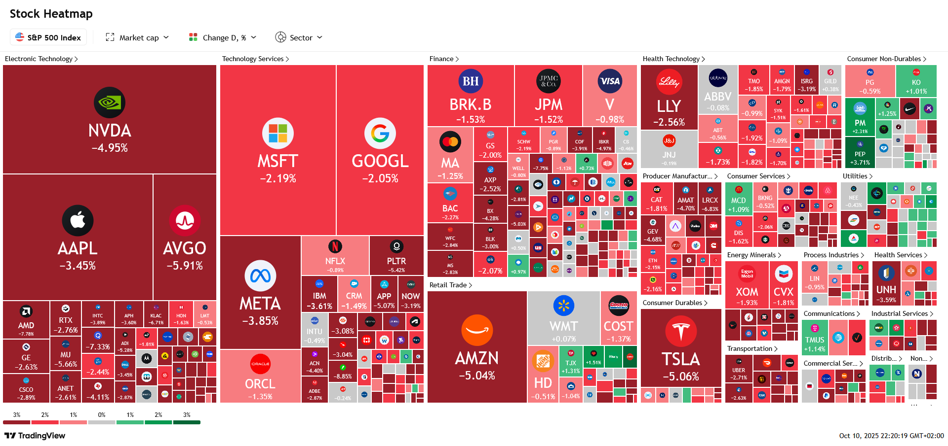
And they started falling. On Friday, the S&P500 gave up 2.71%, falling to 6,552.50 points. It was the strongest daily decline since April. The Nasdaq Composite declined by as much as 3.56% and ended the week at 22,204.43 points. Also in this case it was the worst session in almost half a year. Dow Jones dropped by 1.88%, stopping at 45,787.09 points.
– It was unexpected. The lack of news in recent months seemed to suggest that we were seeing some kind of de-escalation with China. Now it is clear that this was not the case, said Ross Mayfield, investment strategist at Baird, quoted by Reuters.
The first victims of the new version of Washington's economic war with Beijing were technology companies so cherished by investors. Shares of Nvidia fell by 3.7%, Apple by 3.2%, Broadcom by 5.2%, and Meta and IBM by over 3%. Bigtechs are a hostage in this conflict and a natural target for all governments in conflict with the current White House administration. Beijing may prohibit them (or at least make it very difficult) to conduct business in its territory, which will have a very negative impact on their revenues and profits.
Meanwhile, America is on its 10th day of shutdown, during which federal offices are closed. This is the result of the lack of agreement in Congress regarding the provisional budget, as well as the budget itself for the new fiscal year that started in October. This also results in an “economic blackout” – investors are deprived of macroeconomic data prepared by government agencies.
So only reports from private analytical companies remain. On this front, the University of Michigan's October report was a positive surprise. The household sentiment index remained almost at the same level as in September (55 points compared to 55.1 points), although economists expected it to drop to 54.2 points. Consumers' inflation expectations were still very high and they expect inflation of 4.6% in the short term and 3.7% in the long term. Both indications are well above the Federal Reserve's 2 percent inflation target.
Moreover, the third quarter earnings reporting season begins on Wall Street next week. Analysts assume that companies from the S&P500 index increased earnings per share (EPS) by 8.8% year on year. This would be clearly less than in the previous quarter (+13.8% y/y), but stock market experts' forecasts are usually lowered so that we can then witness a whole lot of “positive surprises”.