Prosumers accuse the Minister of Energy of not knowing the European Legislation: There is no 5 kW limit imposed by the EU for prosumers' ability

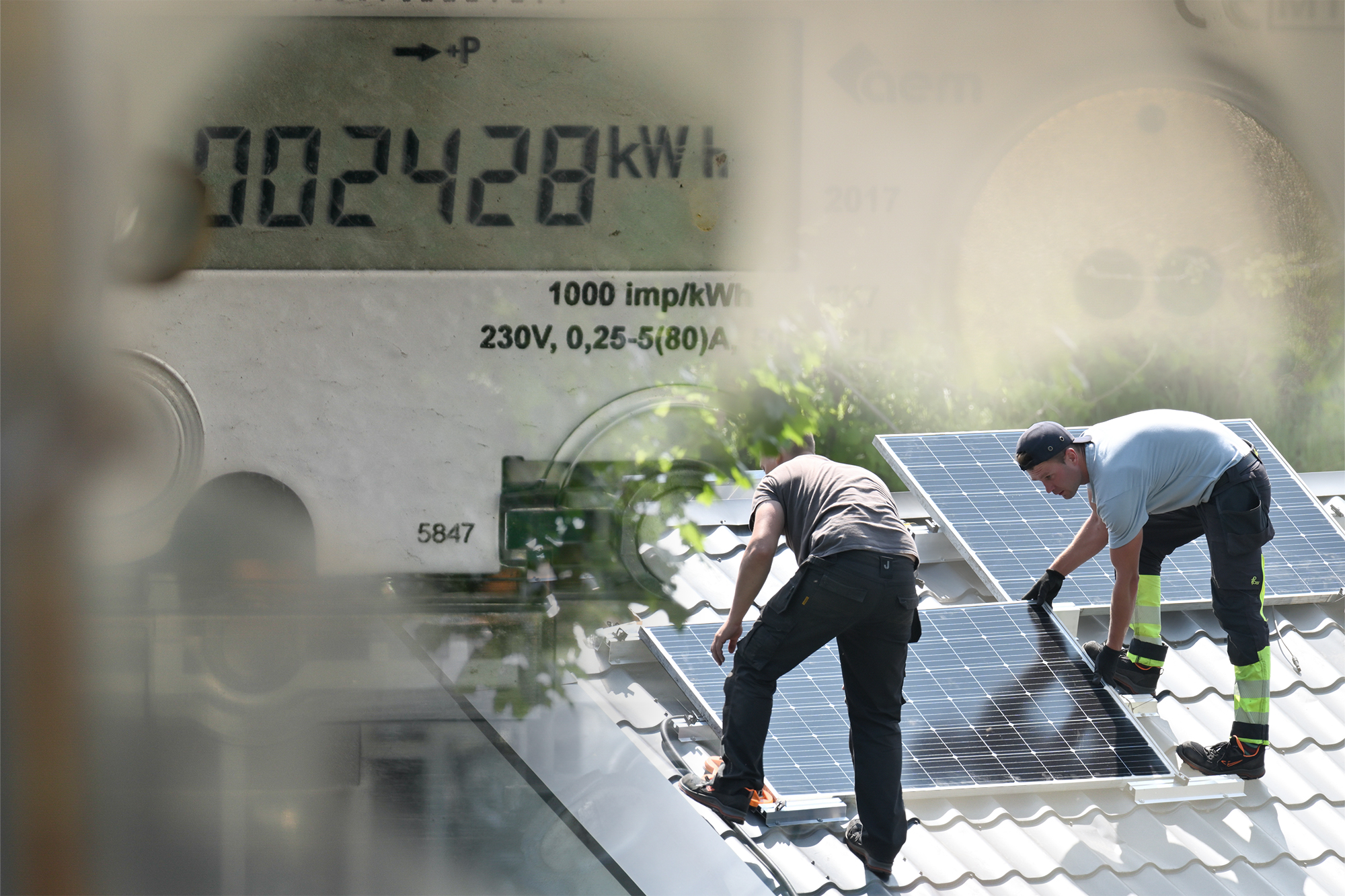
Solar panels on the roof of a home. Collage: Ion Mateș / Hotnews. Photo: Inquam Photos, Dreamstime
The statements of the Minister of Energy, Bogdan Ivan, according to which prosumers should be limited to 5 kW “as in all European states”, shows that it does not know European law, it is stated in a statement of the Association of Provumers. This is when there is no such limitation in the EU, and prosumers have frequently installed capacities of 30 kWh.
“The Association of prosumers and energy communities in Romania (APCE) publicly rejects the statements recently formulated by the Minister of Energy, Mr. Bogdan Ivan, on limiting domestic prosumers to 5 kW” as in all European states “and the idea that” to us the limit is 400 kW for domestic prosumers “, as well as the anti-prosumators rhetoric manifested in a television interview. We believe that these statements distort the legal framework, escape the structural problems of the networks and risk affecting the Romania's strategy regarding the energy transition, even in the context of liberalizing the energy market started on July 1, 2025 ”.
What did the minister say and why is it wrong, in the APCE opinion?
The minister claimed that domestic prosumers should be limited to 5 kW, invoking a alleged European practice, subsequently accusing prosumers that they will “bind on networks and put pressure on it.
“The limit in Europe is 5 kWh for domestic prosumers. It is 400,” Ivan had said, in an interview at Digi24.
“In European practice, for domestic prosumers it is frequently operated with thresholds of about 30 kW. In Romania, a household prosumerator cannot have a connection to the distribution network over 27 kW only in exceptional conditions,” the association representatives say.
- The limit 400 kW refers to the threshold until the prosumers are exempted from the payment of the imbalances on the network, and this according to the European Regulation Regulation (EU) 2019/943.
According to prosumers, Regulation (EU) 2019/943, Law no. 123/2012, Law no. 184/2018 and ANRE Order no. 15/2022 clearly establish the connection rights and market rules.
- “These elements contradict the minister's statements and show a wrong understanding of the normative framework.
- Instead of an investment agenda in current networks, with outdated infrastructure, high losses, lack of digitization and storage – the official discourse indicates prosumers as a cause of system problems. “
APC reminds that, by the end of 2025, the power installed in prosumers will reach 3,000 MW, and about 20% of the domestic consumption will be covered by the energy injected into the network by them, ie about 2.2 billion kWh at the level of 2025.
In conclusion, prosumers are not the problem, they are part of the solution. Not limiting and stopping the production of green energy solves the problem of unstable networks, it is shown in the organization's statement.
The prosumers remind Ivan that Marcel Ciolacu's nephew has accessed European money for photovoltaic investments
The minister also stated that “hundreds of millions of euros European money” went to photovoltaic parks that “put pressure” to inject on the network.
- “We remind information that appeared in the public space according to which a relative (nephew) of the former prime minister Marcel Ciolacu would have traded two large photovoltaic parks to the Premier Energy supplier, projects financed from European funds. We did not find the same public vehement at that time, when the current minister was leading the Ministry of Economy.
- We remind the minister that much of the European money went to UATs, in investments of photovoltaic parks-a correct and normal thing, but at the same time, the investments that energy distributors had to make, to support these parks, were not checked, ”the statement said.
If the correct energy price is 1 leu/kWh, why do we now pay more?
At the same time, APCE welcomes the goal of the Ministry of Energy to discuss the reduction of energy price for the population to 1 leu/kWh, “but we do not understand why it has not been done until today. In the absence of an immediate operational plan, the hopes of implementation are reduced.”
If, however, it will succeed in lowering the price of energy, it would raise legitimate questions about the correctness of current prices (at present, many offers are between 1.45–1.70 lei/kWh), as the population would have paid a significant price above the level considered now “correct”.
“Regardless of the minister's options, the only palpable and immediate measure to reduce invoices is the production of his own energy in homes, blocks/condominiums, public buildings and companies, which can produce part of the energy through the photovoltaic. This is in line with the global tendency, where in the first six months of the year the energy from the renewable sources has surpassed.”