Balance at DNA. Marius Voineag blames the Parliament for prescribing hundreds of corruption cases / “The public debate on justice is excessively politicized and partisan”


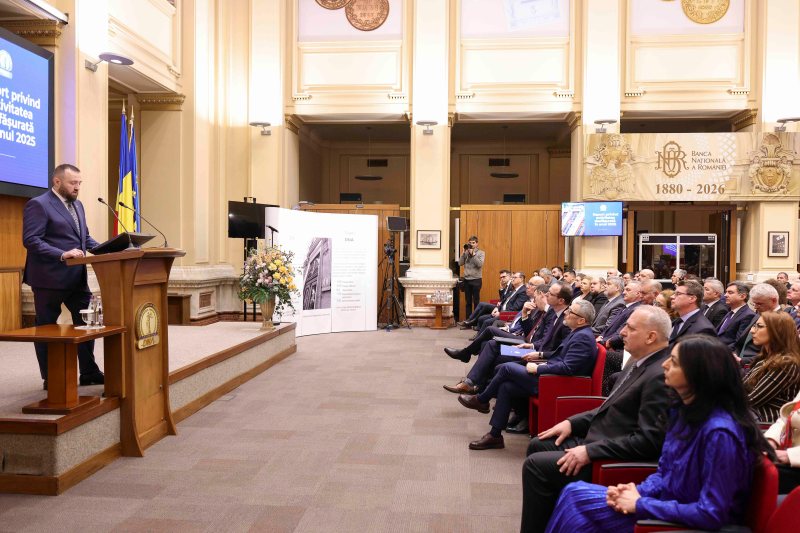
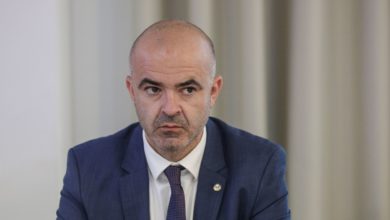
Marius Voineag, at the DNA balance sheet. PHOTO: Inquam Photos / Octav Ganea
The chief prosecutor of the DNA, Marius Voineag, claims that legislative instability continues to be the most serious threat to the effectiveness of the work of anti-corruption prosecutors, and the lack of a prompt reaction by the Parliament following the decisions of the Constitutional Court has led to the prescription of hundreds of corruption cases.
Marius Voineag is no longer running for a new term at the head of the DNA, but he is the only candidate for the post of deputy prosecutor general, in the competition that is ongoing and the results of which will be announced on March 2.
“The lack of a prompt reaction of the Legislature led to the prescription of hundreds of files”
On Thursday, Marius Voineag presented an assessment of the three years at the head of the DNA, which also included “a moment of sincerity”, in which he complained about the “below expectations” collaboration with the state's control institutions.
“It would be dishonest to present only the successes without talking about the systemic obstacles we have faced. Legislative instability continues to be the most serious threat to the effectiveness of our work.
The lack of a prompt reaction of the Legislature following the decisions of the Constitutional Court led to the situation where hundreds of files became time-barred, and in 2025 the courts ordered the termination of the criminal process, including on grounds of prescription in 64 cases. Every such file means lost work and eroded trust.
Also in the register of sincerity, cooperation with state control institutions remains below expectations. Complaints are few, operational support is limited, and this reduces the DNA's ability to intervene preventively. Fighting corruption at a systemic level needs not only own resources, but also an institutional ecosystem that works in solidarity. Citizens need a concerted effort by the state to reduce this scourge, not just spectacular judicial cases,” said the head of DNA, quoted by Agerpres.
“The public debate on justice is excessively politicized and partisan”
The head of the DNA also complained about “the continuous politicization of justice, which risks bringing it to the same low level of trust as other political institutions”:
“I cannot help but notice that the public debate on the topic of justice is excessively politicized and partisan. Much is discussed about symbolic and conflicting topics, while the fundamental question – how does justice work as a public service, how organized is it and how much trust does it inspire citizens – remains marginal. In a situation where trust in institutions is already low, the continued politicization of justice risks bringing it to the same low level of trust as other political institutions. Problems in justice can be solved only by their direct assumption and by well-grounded solutions, discussed both within the judicial system and with society”.
The balance sheet of the mandate. Which Voineag says is “the most important achievement” at the head of DNA
He took stock of his tenure at the helm of DNA, claiming that:
- “The payment rate dropped from approximately 27% at the time of taking office to 9.59% in 2025;
- The rate of returns of files by the courts decreased from 6.42% to 1.63%;
- The value of non-disposable goods increased substantially year by year;
- We recruited and trained massively (464 people versus 185 people in the previous mandate 2020 – 2023); (…)
- We obtained, for the first time, through the amendment of GEO 43/2002, a special fund for operative expenses, in the amount of three million lei, complementary to the flagrant fund already existing at the level of the institution and of a novelty character for the specialized prosecutor's offices”.
Marius Voineag added that “the most important achievement” is the fact that he recruited and integrated 18 new prosecutors and 41 judicial police officers in 2025 alone, and in the three years of his mandate he brought about 100 prosecutors and 144 judicial police officers to the institution.
In terms of criminal prosecution, in 2025, DNA registered 2,599 newly entered files, out of a total stock of 5,556 files.
“We solved 1,592 cases, drew up 114 indictments and signed 253 plea agreements. 792 people were sent to court, which is 16% more than in 2024. Of these, 247 held positions of leadership, control or public dignity. Beyond the numbers, what matters is the investigative target. We targeted high-level corruption – dignitaries, ministers, state secretaries, county council presidents, high civil servants – and we penetrated areas where intervention was previously considered impossible, including in critical state infrastructures. We also took over the field of tax evasion, where we built files with damages of tens of millions of lei, applying seizures on concretely individualized assets to facilitate recovery in case of conviction,” Voineag added.