Jekaterina Szulman is one of the most famous Russian political science. He specializes in legislative processes in Russia and conducts research on decision -making processes in authoritarian regimes. Shortly after the start of the Russian invasion of Ukraine, she moved to Berlin. He lectures, among others At the Free Berlin University. Her YouTube channel has 1.2 million subscribers.
Welt: Three and a half years ago Russia attacked Ukraine. Economic consequences and human losses are huge. How is it possible that the Putin system is still functioning?
Jekaterina Szulman: Russia is so -called Personalistic autocracy. All power is focused in the hands of one leader and his immediate surroundings. There are no political institutions or clear rules – there are only private systems. Autocracies, especially in their personalistic form, are very primitive systems. Some political science even consider them to be a natural, primary state of political systems. If you do not take any action, the authorities are focused in the hands of a few. Other systems, for example democracy, are not “natural”. They require effort.
What are the advantages and disadvantages of such systems?
Curse hangs over personalistic autocrations. The stability and functioning of the system depend on one person. Not from the rules. Such concentration of power is both strength and weakness. When there are no control mechanisms, no one questions the leader's decision. The environment adapts and does not oppose. This makes the rule very flexible and can function even in times of crisis. The downside, however, is that stupid or even fatal decisions are made – and nobody questions them.
This makes Russian autocracy dangerous. There are no brakes.
And how do people work in such a system?
Regardless of what decision will be made, people only sigh, and then wonder how to adapt to it. They wonder how they can earn money and avoid personal consequences. The Russians are extremely flexible. Like the system itself, because it is not limited by any framework. Unlike the Soviet Union, he has neither ideology nor the principles nor responsibility towards voters, as in democracy. It's a nihilistic system and can say and do what he wants. Putin's autocracy has only one goal: maintaining power.
So why war?
The western press likes to repeat that Putin wants to restore the Soviet Union or that he is a madman. That's all not true. Putin begins wars when his popularity decreases. This was the case in Georgia in 2008 in Crimea in 2014 and also in 2022. In this way the system receives a new impulse, distracts attention. However, Putin's last foreign “adventure” turned out to be a typical incorrect decision of the autocracy. The war on such a scale has never been planned. It was supposed to be a “special military operation”. Hence the name. It was supposed to be like in 2014 in the Crimea: short, without bloodshed, triumphantly. This time, however, everything went the opposite.
Why do the Russians support this decision after all?
First reason: there is a belief that opposition or protest can have catastrophic or even deadly effects. In addition, they have absolutely no effect. The second reason: people can earn huge money for providing cannon meat.
Poor families understand that they can convert a potentially useless family father into a much better financial and social situation. In the event of death, huge amounts of money are paid. In this way, the poverty of Russia becomes a recipe for the success of the system.
Recognized as an independent Russian Institute of Public Opinion Research Lewada regularly indicates that 70-80 percent. Russians support Putin. How is this possible?
The war introduced a lot of money to circulation, which started and overheated the economy. At the same time, the machine of repression and censorship works at full speed – this factor is often underestimated. When people ask if they support Putin, many answer “yes”. Yes, it is safer. The last reason is that many Russians simply no longer have their own opinion. If someone asks them a question, they don't even try to think about it. They only think about what answer is correct. The system took away their ability to have their own opinion.

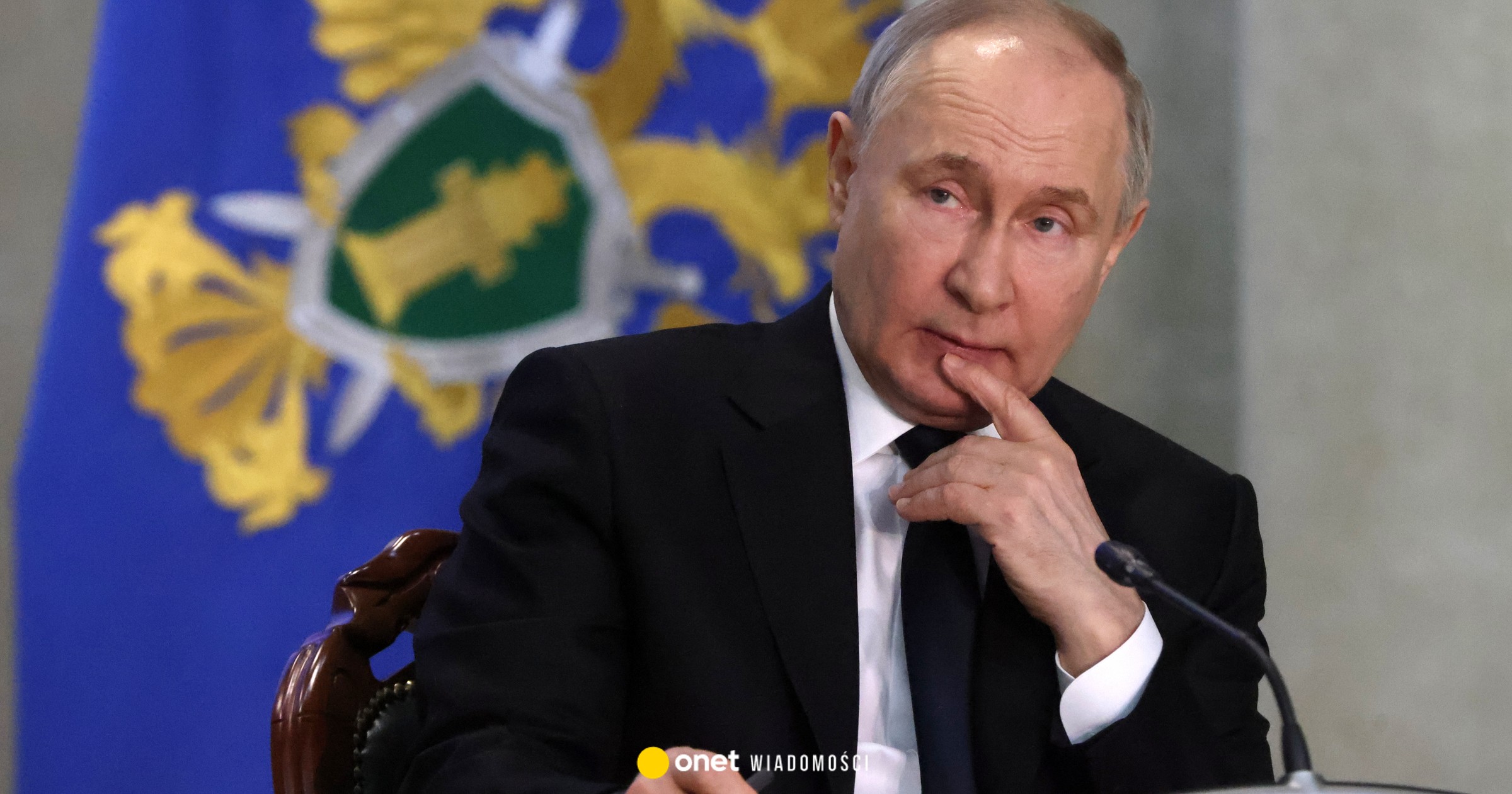
Members of the Russian delegation led by Vladimir Putin, Moscow, Russia, September 16, 2025.Ramil Sitdikov / Pool / PAP
Putin is currently 72 years old. He can use all the achievements of modern medicine to extend his life, but he is still not immortal. What will happen after Putin?
Many think that after Putin's departure, his successor will simply appear. But the second Putin is unlikely. The scope of power at the current president cannot be transferred to one person. The longer it rules, the less it is possible.
After Putin, his rules will disappear and the country will sink into uncertainty.
The fighting inside FSB is likely – the Russian secret police has enormous power, is under Putin's control and is the only political institution that has not been completely hollowed out. In addition, local elites can take power and in some circuits of armed groups. Russia is a multinational state, which makes it unstable. Autonomous circuits such as Tatarstan, Yakuja or Chechnya can regain the rights that they should be entitled to in the federal system. It is worth adding that changes in power often also meant the end of wars – this was the case with Afghanistan or Korea.
Putin tries to indoctrify the young generation – [takimi metodami jak] Education in the spirit of patriotism in kindergartens and schools or military holiday camps. What if he manages to raise the whole generation in his similarity?
Putin has no ideology, although he tries to give the impression that it is so. Ideology limits power. If there are standards, they are in a sense mandatory. The Putin system wants to be flexible. Currently, however, it has become even invertebrate. What really instilled in children in kindergartens and schools is not militarism, hatred of Ukraine or anti -volume slogans. It's just a surface. In fact, they are taught boundless cynicity. It sticks to their heads that adults lie, that the truth does not matter, that there are no rules or values.
It resembles the 1980s. Soviet society was very sick: family ties have broken up, the number of abortion and divorces reached a record level.
To some extent and today there are similar atomization and anomy [brak norm i wartości]: authoritarianism does not want bond, so it destroys it. In the face of you, man is to be lonely.
Continued article under video material
Putin is old, just like his surroundings. What shaped their generation?
These people were born after the end of World War II. They grew up in an atmosphere of apathy and cynicism. Communist ideals ceased to exist, the authorities collapsed. They experienced the USSR in its fall, in a state of pathetic gerontocracy [czyli systemie, w którym władzę sprawują osoby w podeszłym wieku]. Today they rule Russia. Not only do they have no beliefs themselves, but they also do not believe that others may have them. They lived in an information vacuum for 40 years. They are terrible cynics who think they know how the world works. However, they do not believe in anything, even in Marxist dogmatics. These people perceive the world as zero-one-there is only a victory or failure. And you only win by receiving something to others.
What did the end of the USSR mean for them?
In 1991 they were about 40 years old, they already had specific paths of life, and began their careers. The 1990s were a tragedy for them. They had families, children, they arranged their lives – and suddenly everything collapsed. With few exceptions, this generation did not feel luck because of the newly gained freedom.
How do you see Russia's future?
This may look like after Stalin's death in 1953. The Korean war came to an end. Chaos was avoided, a reformed Soviet authorities were created, which was beneficial to the ruling class, and at least for citizens it was no longer so deadly. Some analogies are possible after Putin. However, it is necessary to ensure that the people responsible for this historical chance are understood that they need not privileges, but the rules. Not exceptions, but standards. Not systems, but institutions. They must understand that they must also give them to citizens in order to have rights themselves.