The tip of the bull, the forbidden place of uranium and iron mines in the Poiana Ruscă Mountains. The secrets of the former abandoned


Located in the heart of the Poiana Ruscă Mountains, the peak of the bull, the place of the largest iron deposits in Romania, but also of some uranium mines that worked without knowing them, remained hidden in the forests on the outskirts of the former mining settlements Rusca and Rusca Montană.
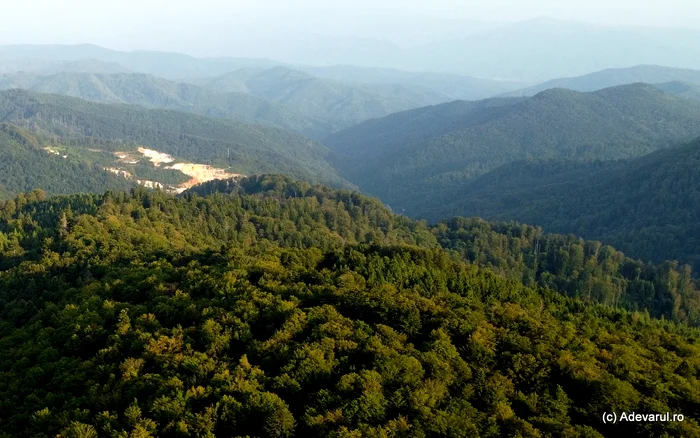
The tip of the bull, on the right, near the career from Ruschița. Photo: Daniel Guță. TRUTH
The Poiana Ruscă Mountains are known since ancient times for valuable natural resources. The iron mines in the mountains in western Romania, between the Southern and Apuseni Carpathians, have been exploited since ancient times.
The former land of haiduks
From the eighteenth century, the deposits became more and more attractive to the industrialists of the Austrian Empire, but the hard-to-reach land, then covered by secular forests, meant a great challenge for those who wanted to live here. Forests untouched for centuries included tens of thousands of hectares and were extremely dangerous. Here they were sheltered by the dreaded cars, but also countless wild animals.
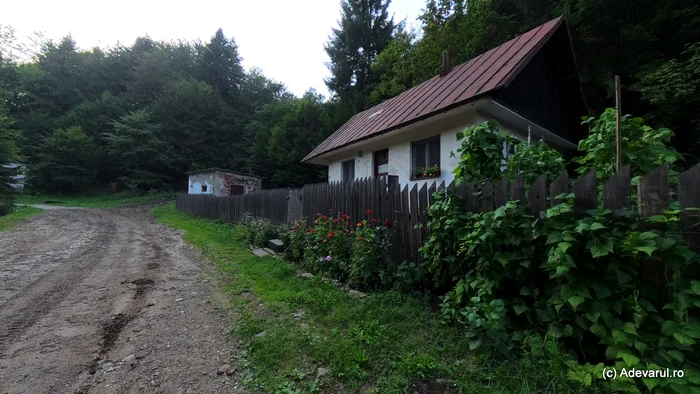
On the Rusciței Valley, at the foot of the Buli Peak. Photo: Daniel Guță
In the deep valleys of the mountains, a few human settlements, inhabited by shepherds, forests and, later, workers in the melts, iron mines, lead, gold and silver and in stone and marble careers, which started at the end of the eighteenth century, they were trying to face them.
A special place in this landscape was the peak of the bull in the Poiana Ruscă Mountains, an now wooded peak, which rises 1,245 meters on the outskirts of Ruschița in Caraș-Severin, known from the beginning of the 19th century for its huge marble career, still in work.
The mountain of Boului is on the other side of the Russian Valley, in opposition to the marble career. Here, at the beginning of the 19th century, some of the largest iron deposits in Romania were to be discovered. And then, they were opened near me by lead and silver. But in the middle of the twentieth century, the peak of the ox would be the place of an uranium secret, whose remains make the area remain a place where travelers do not have to stain too much.
The story of the tip of the ox
The tip of the bull would have its name from the incident lived by a local from Voislova, at the beginning of the 19th century, who was grazing the cattle in one of the meadows at its foot.
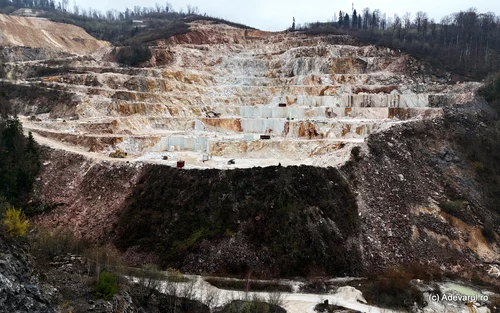
Image 1/10:
Marble Career Ruschita Photo Daniel Guță Adevărul (16) JPG
One evening, one of the calves was lost, and the peasant left to look for him reaching the wooded peak, near a deep gap in the mountain, the remnant of mining potholes. He had decided to stay overnight, at the shelter of a secular oak, so that the next day to research the ramp. But as he gathered for fire, he had noticed that a man was approaching, climbing the slope and moaning because of the cumbersome fate he was pulling after him.
“” I quickly put the security at the belt and crossed in the oak, hiding in a shadowed branch. It didn't pass long and, indeed, a man went out in the meadow, jerked under the burden he was wearing. Down the opinions and from the traitor he removed pieces of bacon wrapped in the skin, which he warmed up a little and anointed his feet with them.The shepherd later elated.
As the haiduc was sleeping, a bear was approaching him and began to lick his feet. The man, in his sleep, pulled a kick with his foot. “In the next moment the bear is already over him. The man rises, a frightening clash burst: the bear tightens it with his paws, the man screams, he is shot again; he beats, he rolls … Then a torn scream and they both disappear in the rock!”
Trembling in all the wrists, the man descended from his hiding place and raised the haiduc. He resumed the fire and opened the bag, which was full of silver workshops. He took the weapon of the killed and buried it with the money, which would gradually change his life.
The iron mine at the top of the bull
A few years later, the bones of the haiduc and bear remained in the ravine on the tip of the bull, and the places continued to be wandered by the haiduci. At the end of the 19th century, the fog of the Sumanka haiduc had found his hiding place here, and her robberies had become famous throughout the land. They used to kidnap rich people, whom to rob or release them in exchange for rewards.
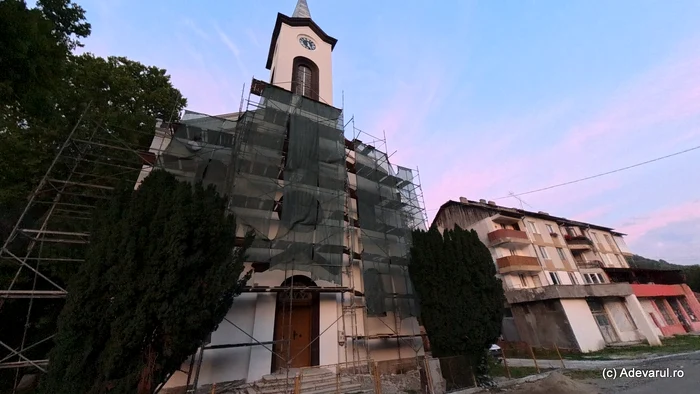
The old church in Rusca Montană. Photo: Daniel Guță Adevărul
One of them, Szájhely, administrator of some toppings on the Iron Valley, was carried through the wild of the mountains and brought to the area of the former ancient mines. Here, the prisoner accidentally discovered the deposits of iron and lead ore deposits at the top of the bull. After being released by the haiduci, the mining engineer did not hesitate to return to the places of his captivity, and soon an iron mine would be opened here.
At the beginning of the 19th century, the exploitation was expanded thanks to Maderspach Károly, a chemist and metallurg, who had heard of the deposits from Rusca and, together with another rich family of those times, bought by auction the domain Ruszkabánya (Rusca Montană) and set up the company “Brothers Hofmann and Maderspach Károly”.
The new owners of the mines raised until the middle of the 19th century the first furnaces from Rusca Montană, but also a melting at the Red Otel, nearby. The factories in the Poiana Ruscă Mountains have expanded quickly, becoming an important industrial center. Near them, from the beginning of the 19th century, the marble career from Ruschița would operate.
Iron and lead melted in Rusca were the basis of technical premieres for the time. Here were built the arc bridges designed by Maderspach Károly in the 1830s, in Lugoj, Băile Herculane and Caransebeș.
During the revolution of 1848–1849, the same factories poured cannons, thieves and over 20,000 lanes for the Hungarian revolutionary army, especially for General Józef Bem troops. After the Hungarian troops were defeated in 1849, Károly was accused of betrayal, and his wife was whipped by imperials in the center of Rusca. The owner of the factory suicide, with a pitch drawn from the cannon he had designed.
Uranium mine at the top of the bull
Shortly after the end of the Second World War, the fate of Rusca Montană and Ruschița would change. The communist regime built the first working blocks and homes and transformed the old settlements inhabited by Romanians, Swabians, Hungarians and Serbs into a typical mining locality for the socialist economy.
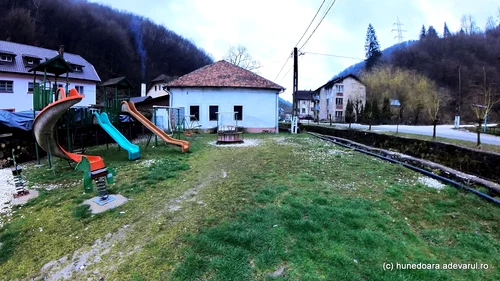
Image 1/19:
PHOTO RUSCHIA Daniel Guță Adevărul (81) JPG
In 1947, the geological prospects under the leadership of the Soviet geologist Kosareva, who came to the area, were resumed in Rușchița to highlight the potential mining of the Poiana Ruscăi Mountains. In 1950, the exploitation of the magnetite in the Boul Massif, said the engineer Mircea Goloșie, in the study “The quality of the environment in the Rusca – Rusca Montană” study.
However, the Soviets also discovered some uranium and thorium deposits, in small quantities, at the 1,053 quota of the tip of the bull.
On the mountain, above the town of Rușchița, a mineral colony, consisting of eight wagon buildings, where 100 people were crammed.
“There is even a colony at the top of the mountain. But geologists realize that something is not clear, and the doctor then in the area finds anomalies in the health of the workers. In 1963, at the radiometric revision there were radioactive rocks, caused by the presence of radioactive ores. Vertical prospecting ”, shows the study by Mircea Goloșie.
Radiations from the former me on the top of the bull
From the first decades of operation, there are little data on how the workers have been exposed to the radiation caused by the work in the mines on the tip of the bull.
Radioactive rocks and inhaled dust during underground works, initially performed by primitive means, endangered the health of the workers, and many of them were affected by silicosis. The mine worked with several years of interruption until 1963. The reopening works were then resumed in 1969, when about 50 workers were sent here. Around 1973, the mine was closed due to wrong works that led to it.
“Many of those who worked on the uranium left the area. At that mine it was, anyway, a continuous come. Come on. No one was too much to work there. I saw the trucks with black ore-as I said, covered with tarpaulins, passing through the village to Voislova station. Maria reported, a pensioner from Ruschița.
The miners were permanently rotated from different sectors of the exploitations, or from the leadership decision not to expose them too much time, or from their desire to look for bigger winnings, or because of the departures in the area. Thoron, a radioactive gas emitted by Thorium, would have caused the biggest health problems to the locals, informs the study published by Mircea Goloșie.
The measurements made by the engineer in the 2000s showed that in some places where uranium mines worked, the level of radiation has remained high, but the places now covered by forests and several kilometers from the human settlements are rarely wandered by humans.
Iron, lead and zinc deposits received greater importance. Around 1978, the Mines from Rusca Montană had reached the height of the expansion, with the opening of new exploits at the stream with Raci and Valea Boului, the latter being outlined as the largest iron deposit of Romania. Immediately after the Revolution of December 1989, the mines entered the process of restructuring.
Mines closed in the 1990s
The iron mine was closed in 1991, and in the coming years many of the more than 2,000 employees gradually left the villages Rusca Montană and Ruschița. In 1997, the last nearly 500 miners were made available from complex ore operation.
“The magnetite mines have been opened here from the Soviets, from the early 1950s. There were two iron sectors – a sector and one of magnetite, which were transported to be processed in the Hunedoara steel company, and a complex ore sector (lead, zinc, copper). 4,800 people worked at one point here, before 1990. Most were coming from Moldova and Oltenia.reported Gheorghe Ploscaru, a former miner, coming from Vrancea and remained in Raschița, after the closing of the mines.
The old colony on the tip of the ox had long been decommissioned, and the forest swallowed its remains. In the valley, most of the blocks raised in the past for the Romanians brought to work in the shame and careers of the Russian were also abandoned.