Secret nuclear disaster in the heart of Russia. One of the first and most serious nuclear accidents missed for three decades of Soviets


Chernobyl nuclear disaster was not unique in the history of Eastern Europe. It was preceded by a catastrophe produced in 1957 at a secret nuclear power plant in the Ural Mountains. Although contaminated an area of 17,000 hectares, the Soviet authorities secreted everything.
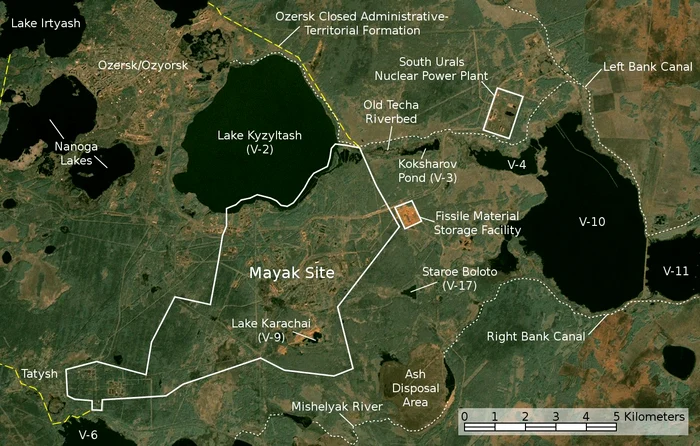
Location of the nuclear power plant from Mayak Photo Wikipedia
On April 26, 1986, at 1:23 at night, at the Chernobyl nuclear power plant there was a strong explosion, followed by a radioactive contamination of the surrounding area. Clouds with radioactive rainfall have turned to the western parts of the Soviet Union, Europe, but also to the eastern parties of North America. Large surfaces in Ukraine, Russia and Belarus have been seriously contaminated with radioactive materials. It was considered the worst accident in the history of nuclear energy use. Little known is that what happened in Chernobyl was just an accident with rehearsal. In 1957, in the area of South Urals, there was another nuclear tragedy that the Soviet authorities denied for more than three decades. This is the explosion of a nuclear residue deposit from a secret power plant. The disaster was comparable to the one from Cernobîl being classified by level 6 (the nuclear incident from Chernobyl was classified by level 7). The extremely serious effects have been disguised by the Soviet authorities.
The false lights of the North, the death that floated in the air
On the afternoon of September 29, 1957, the inhabitants of the Celiabinsk District of the South Urals observed unusual colors in the sky. It was a twilight atmosphere on which blue-violet lights were profiled. People believed it was Aurora Boreală, but they wondered how they could be seen from such a distant region. Only a few days, people saw a lump. The military, authorities, scientists came and left the area that housed a secret surface of the Soviet Union.
It was about Maiak nuclear installations, the first power station that could produce nuclear material in the history of the Soviet Union. Immediately, people were forced to sacrifice their animals, destroy their crops, bury harvests and have agricultural land. Over 20 villages with 11,000 inhabitants were evacuated and all the homes and all the dependencies, together with the public buildings, were completely demolished. People did not receive any explanation and the authorities did not give any official statement. It was a total secret. But people knew that Maiak had taken place a disaster. The effects would feel later, as did those who lived on the banks of the water around the nuclear facilities in the South Ural.
The secret of the Soviets of the South Ural
The story of this disaster begins at the dawn of the Cold War, that struggle for post -war power and domination between the USSR and the USA, which has marked and shaped the political, economic and social landscape at the global level. After the Second World War, the Soviets realized that they are behind the United States in the development of nuclear weapons. In order to recover the lost land, they built a secret, militarized area, with nuclear material production facilities, known as the Maiak nuclear power plant, which is known today as the Maiak nuclear power plant. It was near the Russian city of Kistim, in a secret, closed town, called Celiabinsk-40. Today is called Oșorsk, being located in the Celiabinsk region of Russia.
The Maiak nuclear power plant was established in 1946 and had the mission to process the necessary plutonation for the manufacture of nuclear weapons. In 1949, in Maiak, the first Soviet nuclear bomb was produced. For the Russians it was an extraordinary success, especially in the context of the competition on nuclear weapons with American rivals. After this initial success, the Soviet authorities have been asking for more and more bombs and have been granting less and less time for their manufacture. As in communism no one contradicted the party and those at its leadership, the Maiak nuclear power plant delivered on a treadmill. However, the plant was hurriedly assembled, precisely to try to keep up with the Americans, and many risks related to the safety of the installations were not taken into account or simply have been overlooked. Production was the most important aspect. And the price was paid.
A disaster that affected thousands of people
Without respected the safety standards, the Maiak nuclear power plant was a constant source of radiation. Over 17,000 workers who worked in those facilities suffered radiation overdoses between 1948 and 1958. In addition, the employees of the boiler used to discharge radioactive waste in the nearby Techa River. The peak, that river was used as a drinking water source by the inhabitants of the villages in the area.
More and more began to accuse health problems. Until 1952, several outbreaks of diseases caused by radioactivity were encountered in the villagers from the localities downstream. After 1952 measures were taken and the radioactive waste were no longer discharged in the Techa River. Maiak staff later decided to store waste in an underground compartment of the boiler. It was about 14 stainless steel containers, located on a concrete foundation. There was a cooling system to keep waste at a constant temperature and avoid overheating. In 1957, the cooling system of one of the waste tanks began to give failures, and then it was damaged.
No one noticed. The result was catastrophic. The radioactive waste overheated and, finally, on September 29, 1957, the disaster occurred. A container exploded, causing a chain reaction. The strength of the explosion threw radioactive material into the air, at a distance of one kilometer. The wind increased the extent of the disaster by spreading the radioactive particles on an area of approximately 20,000 square kilometers. It was an area inhabited by over 270,000 people. The most affected area was the one located northeast of Celiabinsk-40, which was in the opposite direction of the Maiak power plant.
“The Kiștim disaster, which took place at the Maiak Production Association in 1957, was one of the first and most serious nuclear accidents. This event precipitated an extended contamination of the environment, especially by dispersing SR-90 and CS-137, leading to an ecological impact and on the significant health. Plutonium in the Soviet Union has suffered a catastrophic malfunction when a waste storage tank exploded. (EURT).said Ali Taobe in “Kyshtym Disaster Consequences”, for Stanford University. The Soviet authorities have missed the incident. Nearly 17,000 hectares in the contaminated area were transformed into the East Ural Nature Reserve in 1968. The public was banned. Only after 1989 the Kiștim disaster was recognized.