The intrusions in NATO's airspace, attributed to Russia, have achieved unprecedented extent this month, arguing about Moscow's motivation and what would be different this time, in the context of the Russian invasion and evolutions on the battlefield, accelerated by Russian efforts to obtain a strong position at the negotiation.
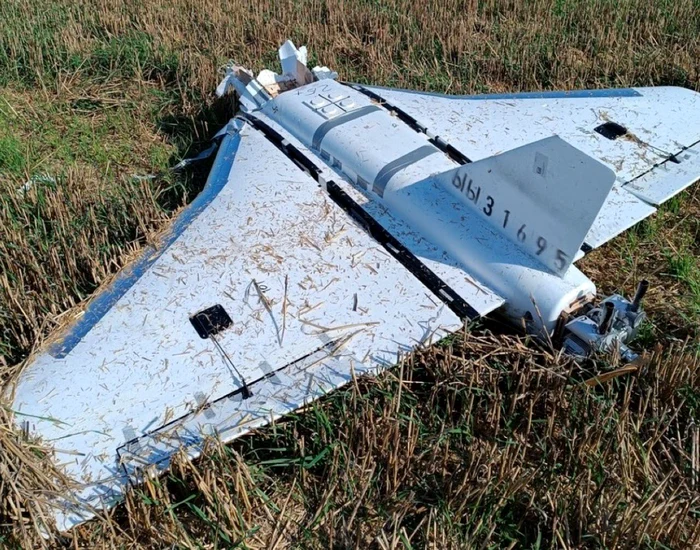
Russian drone in Poland Photo X
No recent intrusion into NATO's air space was the magnitude of Poland, on September 10, when, according to the authorities, about 20 Russian drones flew to great depth above the rural areas before being shot down by NATO planes or collapsed. The incident has marked the first direct military commitment between the Alliance and Russia since the beginning of its large -scale invasion in Ukraine, reports AP.
Russia denied that he was targeting Poland, and his ally, Belarus, claimed that the drone signals were bruised by the neighboring Ukraine. But the European leaders presented things as a deliberate challenge, invoking the violation of the Estonian airspace last week, but also other recent incidents as additional evidence indicating a larger plane orchestrated by Moscow.
Possible reasons of Russia
Before invading Ukraine in 2022, the Kremlin demanded that NATO give up any plan to give Kiev the opportunity to join the Alliance, as well as to reduce the troops near the borders of Russia, including in the Baltic Estonia, Latvia and Lithuania, former Soviet republic and the EU and the EU requests.
Russian President Vladimir Putin also warned NATO not to allow Kiev to attack the territory of Russia with long -range weapons provided by the West, threatening that Moscow could respond by targeting military installations in NATO countries that allow such attacks. Such an action would involve huge risks, including for Moscow, because it can trigger a direct conflict between Russia and NATO, which has a huge advantage in conventional weapons.
Some experts consider the recent increase in incursions into the NATO airspace (besides including Romania and Latvia) as an attempt to test the Alliance's reaction, so that they can exploit any cracks or rows that could occur. At the same time, some countries interpret these actions as attempts by Russia to direct NATO attention and resources from supporting Ukraine to defense of its own territory.
“It is because they have made the calculation that now European countries have to send something additional to Estonia in terms of air defense resources, and that means I can't send that thing to Ukraine. Russia is trying to break us from Ukraine.”said Estonian Minister of Defense, Hanno Pevkur.
In this regard, Mark Galeotti, an expert in Russian politics and director of the Consulting Company Mayak Intelligence, believes that air penetrations are part of a “coercive signal” meant to discourage NATO members to provide solid security guarantees to Kiev, including possible troops in Ukraine, as part of a peace agreement. In fact, Moscow has warned that he will not accept NATO troops in Ukraine.
“Moscow is trying to convey the message:” Look how dangerous things are and how dangerous they may become. Remember that we are bolder, stubborn, insane, determined – use any adjective you want, but the idea is that we are more of everything. “
Edward Lucas, a senior researcher at the Center for European Policies, believes that Russia could try to highlight NATO weaknesses to “plant a corrosive question in the minds of allies: are you willing to enter the war with Russia for the sake of Baltic states?”
“Russia does not have to win NATO from a military point of view if it can defeat it politically“He wrote in an analysis.” If the alliance members do not trust that other members will help them when they are attacked, they will feel isolated. “
It is possible that Russia has especially wanted to evaluate the reaction of the largest NATO member, the US, said Max Bergmann, the head of the Europe, Russia and Eurasia program at the Center for Strategic and International Studies.
“I think it was quite disappointing”he said about the US reaction to these incursions of Russia. “I think what we see is that the United States, under President Trump, does not feel responsible for European security, and this will be revealing for the Russians. He could further escalate the situation.”
NATO response and US role
After the incident with the drone roy, Poland has triggered Article 4 of NATO, which allows any member to request a meeting if he considers that his territorial integrity, political independence or security are threatened. As an immediate result, the Alliance has launched an operation to strengthen the air defense along the eastern flank.
NATO was discussing again on Tuesday in response to Russian hunting aircraft that entered the Estonian airspace and warned Moscow that it would take all measures to defend itself against new violations.
Prime Minister Donald Tusk said that Poland will break, “without discussion”, any object that would enter its territory.
But it is not clear whether all NATO allies would support such an aggressive approach, NATO Secretary General Mark Rutte, declaring on Tuesday that the decisions regarding the opening of fire on Russian appliances will be based on the “available information on the threat represented by the aircraft”.
US President Donald Trump, who in the first phase produced amazement among the Allies speculating that the intrusion of Russian drones into the Polish air space “could have been a mistake,” a sharp message said on Tuesday, answering the question whether NATO should break the Russian aircraft. But it is less clear if the US would intervene to support the alliance in such a case.
Kremlin's response
In an interview with the Russian state television, the Kremlin spokesman, Dmitri Peskov, denounced “irresponsible statements about the need to bring down Russian aircraft, which are, at least, irresponsible, and have dangerous consequences.”
Three incursions of Russian drones or fighter jets took place on the territory of the Alliance in less than two weeks, notes AFP.
In a statement issued after discussions on this topic, NATO warned Moscow that “climbing” must cease and ensured that it is ready to defend itself by all means.
French President Emmanuel Macron said on Wednesday that NATO countries must “intensify” their answer in the case “New challenges from Russia, especially in the airspace of Eastern Europe ”, adding though: “We will not open the fire.”
Last week, NATO announced that it had intercepted three Russian MIG-31 aircraft that entered Estonia's airspace.
Dmitri Peskov again rejected the charges on Friday: “No evidence was presented”
The EU is already taking action, planning to strengthen its security with an anti-Drone wall, which ten countries, more of which were victims of incursions, now consider it “a priority”.