The painting from the Poznań museum turned out to be a copy. “The project was accompanied by great emotions”

Picture “Jerzyna market at Iron Square in Warsaw” over the years hung at the National Museum in Poznań and was considered the original canvas of Józef Pankiewicz from 1888. Doubts about the authenticity of the work arose in 2017. After years of research, it was confirmed that the image is a copy.
Picture “Targ na Jarzyna at Żelazna Gate Square in Warsaw” It was purchased by the Greater Poland Museum – the current National Museum in Poznań – in 1948. For many years it was thought that the exposed work was the original canvas of Józef Pankiewicz from 1888, awarded a year later with a silver medal at the Paris Universal Exhibition. The picture was also widely included in the canon of Polish realistic painting.
Doubts about the authenticity of the work were sowed in 2017 by prof. UAM dr. hab. Michał Haake. He informed the MNP of his doubts, and this in turn became an impulse to start a research and conservation project, implemented by Agnieszka Rękawek in the Painting Conservation Laboratory and a wooden polychrome sculpture. Work was carried out in 2019–2025.
We started conservation in 2019 with step -by -step open -pitches, i.e. we revealed the work step by step. We tried to estimate the amount and place of the occurrence of secondary layers, i.e. the non -correctional ones that were in the picture – explained Agnieszka Rękawek.
She indicated that “The image was heavily repainted”; transformed during earlier restoration works. – One of the first difficulties at this first stage was the number of these secondary layers and their location. Then all those layers that were in the image were removed precisely under the microscope. It was a very long and complicated stage – she emphasized.
The next step – as she said – was the decision to remove the second canvas, which the image was glued. – We decided to peel off these canvases to see if there is, for example, some inscription, some inscription, a sign or a seal that would tell us more about the history of this picture – she pointed out.
As part of the project, they were also made, among others Technological tests covering each layer to thoroughly recognize how it is built, from what materials, pigments, whether the binder consists of, what kind of canvas is. These results, in turn, were compared with other works of Józef Pankiewicz. Technological tests were performed partly in the MNP, they were partly commissioned to external research institutions.
– At some stage of research, we also asked ourselves more questions; And what if this image was painted on the canvas of this original image, which has already been very damaged, for example? It was also one of such research clues that was undertaken, but could not be proved or found some elements that would indicate that this original image – even in some residual form – can be found on this canvas. This thesis could not be confirmed – the sleeves pointed out. Studies also confirmed that the reference number “J. Pankiewicz. 88.” It was applied secondary.
The conservator was asked by PAP whether during this years of work on one work she did not feel bored or doubt. She replied that she did not admit that the conservator must have something of a detective, explorer, doctor, but also – or perhaps above all – from the artist.
– This project was accompanied by great emotions. At the beginning I was hoping that maybe after maintenance, after cleaning these applied layers, but it would be possible to find a fragment of this preserved original in this picture. These were the hopes that accompanied the last moment of cleaning this canvas. There were also historical threads of course; This mysteriousness, which is associated with this object, with the past. For so many years, during these 70 years, no one noticed that this is not an original picture. Working on this work was a fantastic adventure – she emphasized sleeves.
She added that “of course every object, every picture is a new challenge.” “Each canvas is a new adventure, so this is not such a monotonous job as it may seem,” she noted. – The possibility of close contact with art is fascinating, but this manual factor is also of great importance. Quality of performed works, conservation procedures; It must be at the highest level – she pointed out.
She added that The image – although it is not the original canvas of Józef Pankiewicz – retains high artistic and historical valueand thanks to maintenance he regained his original splendor, which allows you to see the workshop of an unknown author, who “for decades misled both experts and art lovers.”
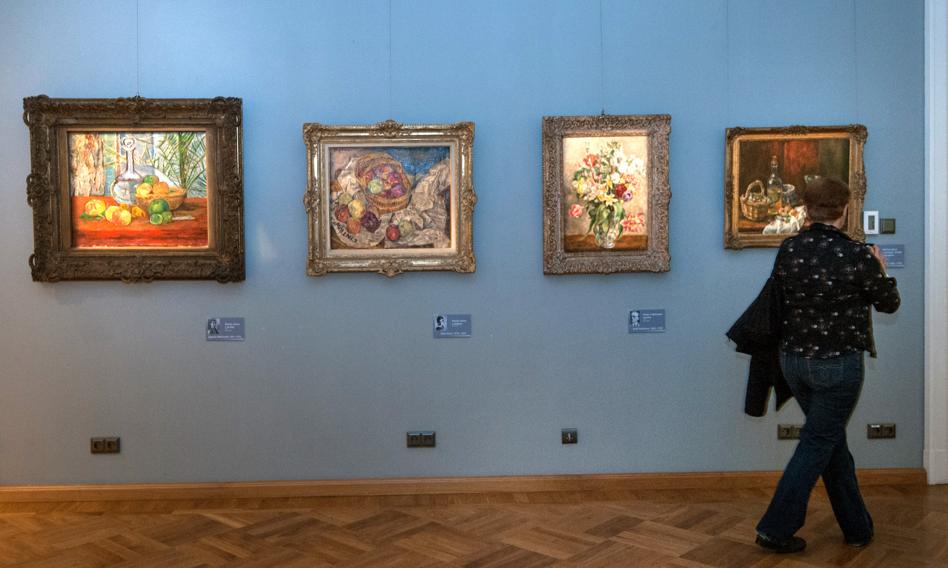
From Thursday at the National Museum in Poznań, the work can be seen. The effects of the project are presented by the show “Imaging. Research and image maintenance +vegetable market at Żelazna Gate Square in Warsaw +”, implemented as part of the series of the National Museum in Poznań “Understand. Meetings with maintenance”. The exhibition takes place in the space of the Polish Art Gallery of the 19th century.
In the center of the show there is a picture after maintenance, placed in a new frame and juxtaposed on a 1: 1 scale with a photograph of the lost original. The show complements the timeline, organizing the fate of the original and its copies, and the presentation of research results in four thematic blocks: a state of behavior before maintenance, course of work, signature analysis and technological differences. The whole is illustrated by photographs, short descriptions, a multimedia presentation and a film documenting the conservation process. The show is also accompanied by a publication that contains the essay of dr. Arkadiusz Krawczyk dedicated to the history of reception and interpretation of the work and the text of Agnieszka Rękawek summarizing the results of analyzes regarding authenticity and maintenance process.
The show will be available to the public from September 25 to December 7. After the show is completed, the image will remain in the gallery space; It will be presented with the appropriate commentary and signature – not as the work of Józef Pankiewicz – only a copy of his picture.
– Of course, I hope that one day I can see the original of this work, that it is somewhere, that it was not destroyed. What happened to him, unfortunately we do not know – said Pope Sleeve. (PAP)
AJW/ ASZW/