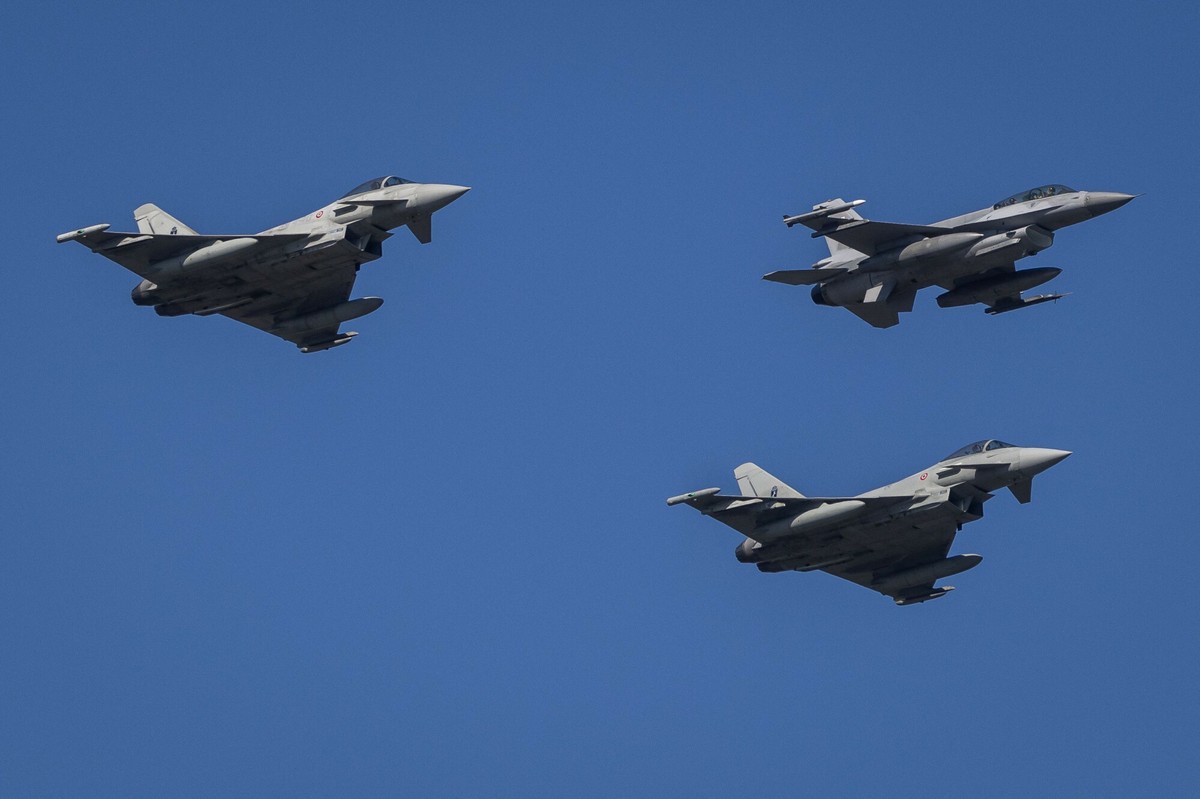
The head of the Polish government emphasized that in the event of a violation of the territory of the country by flying objects, Poland would decide to shoot down them. Donald Tusk pointed out that there is no place for compromises here.
The prime minister's statement, as Bloomberg's agency reminds, appeared after a series of invadings of Russian aircraft to the airspace of NATO countries, including an incident involving three MiG-31 fighters, which on Friday violated the airspace of Estonia on the Gulf of Finnish.
Poland has already taken action against drones, which at the beginning of the month flew into its territory. Together with Estonia, she referred to Article 4 of the North Atlantic Treaty, launching consultations within the Alliance and opening the possibility of the coordinated reaction of the Member States.
At the same time, when Tusk spoke to the media, in New York an extraordinary meeting of the UN Security Council took place, devoted to violation of the airspace of Estonia. The government in Tallinn described this incident as part of the wider strategy of Russia, aimed at testing NATO's readiness for territorial defense.
Russian provocations under the magnifying glass of NATO
Foreign Minister Radosław Sikorski, during a meeting of the UN Security Council in New York, He turned to the representative of Russia, emphasizing that Poland would not undergo pressure from Moscow.
In his speech, he stated that “if another missile or plane goes into our airspace without permission, intentionally or by mistake, and will be shot down, and the wreck will fall on NATO territory, please, do not come to complain here. You were warned.”
In recent days, NATO has noted an increase in the number of airspace violations by Russian forces.
The war led by the Kremlin against Ukraine has been going on for almost four years, and tensions in the region do not weaken. On Sunday morning, the German Air Force reported that the alliance again picked up aircraft in response to a Russian military plane, which moved in a neutral airspace on the Baltic Sea.