The capital of Germany turns into the capital of poverty. “The situation is catastrophic”


Before the “house” of Peter B. stands a burgundy BMW, the evening light has an orange shade, the music of Enrique Iglesias is eager from the smartphone. The 40-year-old-with briefly trimmed hair, with a naked torso, in worn sweatpants-closes his eyes, stretches with a cigarette, which he holds between the middle and warm finger.
The five -minute terrine is pairing, it is a Hungarian stew. A man carries a chain with a pendant depicting the Mother of God around his neck. What Peter B. calls “my home” is Stary mattress under the bridge highway in the southwestern part of Berlin. An empty cucumber jar serves a Slovak as an ashtray. Madalina Antonesco social worker attached a cell phone to his walker, then smeared his back with a thick layer of zinc ointment. Against wounds from asphalt, weather, falls.
Peter B. is one of the above 6,000 homeless people living on the streets of the German capital.
According to the Federal Government report on homelessness in 2024, at least 47 thousand 270 people lived on the street. Ok Two -thirds of them have German citizenship. They are mainly middle -aged men.
In addition, there are 439.5 thousand homeless people who lived in shelters or other help outlets as of February 1. Current data is only available to this group. The Federal Statistical Office recorded an increase of 8 percent during the year. up to 474.7 thousand people. Homelessness in Germany is clearly growing.
As a margins of society
-The situation on the streets is catastrophic, which can be seen more and more-says the 28-year-old volci. He manages Obdachbus [Autobus dla bezdomnych]with the Red Cross help program in the Berlin district of Steglitz-Zehlendorf. Even there – deep in the west of Berlin, between the villa districts and Lake Wannsee – extreme poverty is growing.
Continued article under video material
In the project office near the Steglitz station, a 39-year-old social worker Dana Kerth reports: “Among the homeless people there is a gentrification.” – The more people come to the city center, the more competitive the space becomes, and many of them are pushed out on the periphery – he explains.
Five days a week, the Lagidy team travels the district, talks to the homeless, offers them rolls, creams with sunscreen or water. With some, such as Peter B., employees keep in touch almost every day, organize visits to a doctor, help in dealing with official mattersalso to re -obtain state benefits. Helpers support in search of a job or apartment, if necessary, they provide their office as a postal address or explain how to reach the shelter – which, however, many homeless people reject: too tight, too crowded, too much alcohol intake in the environment.
Social employees speak German, English, Romanian, Spanish – and “on an equal footing”, as they emphasize. The EU supports this project, but its implementation depends on the donations: sleeping bags, jackets, shoes.
People living on the street are mostly on itself. They have to take care of safety, food and sleeping place themselves. Often, the help of individual people fill large gaps. “Many people live on the margins of society,” says mild. – People depend on helpers, parishes or fast food booths – he adds. Peter B. For example, he regularly gets a kebab from a take -out food bar around the corner, sometimes a pizza from an Italian restaurant, sometimes a shower in the parish.
Road to homelessness
“We have everything in excess,” says Kerth's social worker. “And at the same time many have nothing,” he adds. Roads to homelessness are different for individual people, many are difficult to compare – explains the expert. Often, history begins with blows of fate, breakthroughs in life. In many cases, addiction or mental illness also play a role. All this consists of huge overload: A pile of unopened bills and admonitions is growing – after all, the termination of the lease agreement lands in the mailbox, state aid disappears, contacts with offices break up.
“It can meet each of us, although it sounds brutal,” Kerth believes.
Employees also talk about people from Eastern Europe who were lured by criminals to work in agriculture or construction in Germany. “Great promises are made, which then disappear in the air,” he says mild.
This August afternoon, the Obdachbus team goes along Schlossstrasse, a busy shopping street. The end of the work day begins, pensioners sit in front of the confectionery over coffee and cake, families leave the department store. The crowd also attracts those who hope for a meal or small money. On the section, only 900 m social worker Antonesco and her colleague Marco Luna turn to five people.
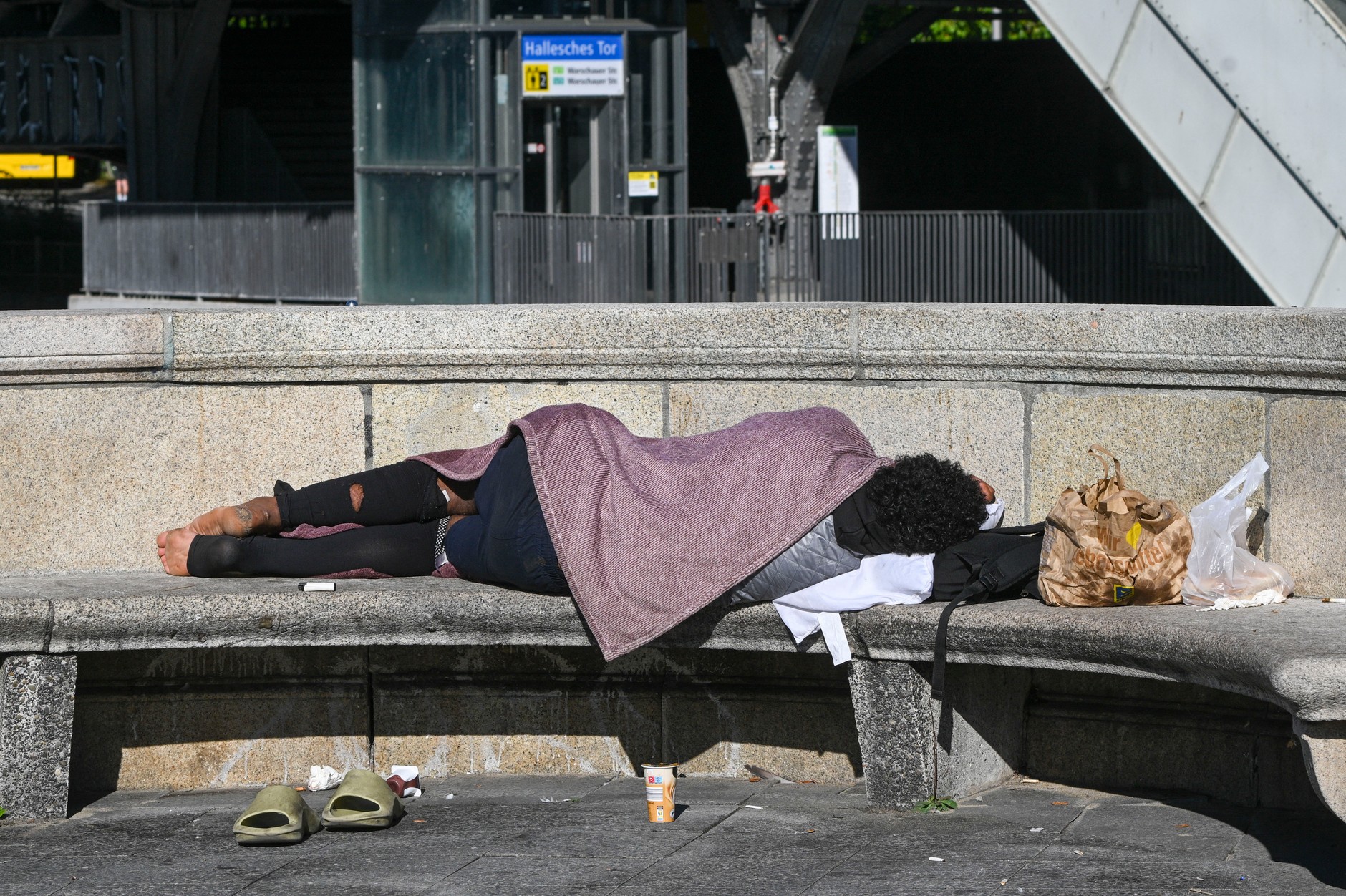
A person in the crisis of homelessness on Berlin Street (illustrative photo)Jens Kalaene / AFP
A young man with a mohawk sits on the ground next to his dog and hopes that the paper mug in front of him will fill with coins. He gets a roll with sausage and a bottle of water.
A desperate man in a green tracksuit wants to go to the hospital to his wife. In his hand he only holds a card with the address, he doesn't know the way. Luna saves him the route.
Adrian K. sits in front of the cinema-I sleep here-says a 44-year-old with a dense black and gray beard in Romanian and points to his lair over the ventilation shaft. Wooden chair for the day, night cartons. “I am asking for a small coin or workplace. I am good in many professions. Thank you,” says the inscription on his turquoise suitcase.
You need to help
K. has been living here for a year. Earlier he lived nearby, he was in Italy and Finland. However, in Germany life is better, you can collect bottles, people are nice. Only sometimes there are problems with people under the influence of alcohol.
K. says that He hopes for a different life, for home. “I don't have a wife, I'm always alone,” he says. His chest hurts when he breathes. A hematoma is visible on the man's face, he forms a shell around the ear to hear. K. points to posters on the Optics website. – They have all their teeth. I don't have any – he says. Obdachbus recently contacted him with a dentist, who pulled out a few other teeth and is now doing a prosthesis. At your own expense.
There is a huge demand for medical assistance. Social employees inform that The condition of many people living on the street is getting worse. The healthcare system does not reach many of them. People affected by this problem often lack health insurance, but also knowledge about assistance offers, clinics and contact points. Healthcare is not provided, chronic diseases such as diabetes and even cancer often remain undetected and untreated. Even in the case of surgery, recovery without a roof over your head is almost impossible. – Life on the street leaves traces on the body – says Kerth. – Addictions are often a consequence of a difficult life on the street: chronic pain, hard asphalt, cold.
Social mark
Added to this is the hatred of others. According to a homelessness report Over two -thirds of the homeless experienced violenceand the Federal Criminal Office was recorded in 2024. 2194 crimes against them, including murders, severe bodily damage and sexual offenses.
Example: In April, four still unknown perpetrators threw the homeless in Berlin in Berlin. “Many do not close the sleeping bags even at night for fear of setting up,” says mild.
Peter B. now has health insurance, mild and his team bring him a letter from the insurer. He should also receive identity documents soon, social workers are in contact with the Slovak embassy. Even before winter, the man is to be directed to the shelter. This is the plan for the near future.
B. smiles. When social workers are packing, he raises its chain with a pendant depicting the Mother of God. – There are no problems at the moment. At the moment – he says.