

People on the street in the old center in Bucharest. Photo: Masezdromaderi | Dreamstime.com
The highest share of people who have experienced severe material and social deprivation was registered in Romania (17.2%), followed by Bulgaria (16.6%) and Greece (14%), sends Eurostat.
In contrast, the lowest rates were recorded in Slovenia (1.8%), Croatia (2.0%) and Poland (2.3%).
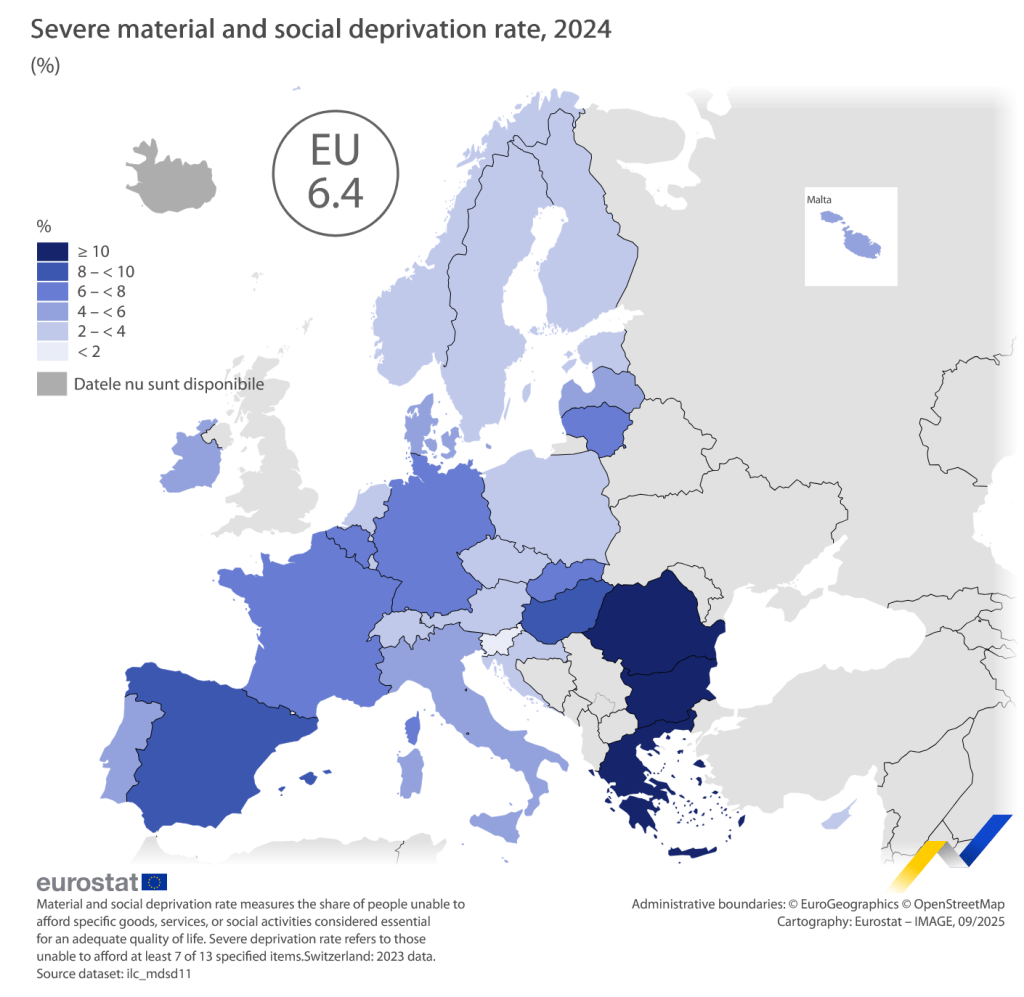
Material and social deprivations refer to the inability to allow a set of specific goods, services or social activities, considered by most people essential for an adequate quality. The rate of severe material and social deprivations is defined as the share of the population that cannot afford 7 or more of these 13 articles.
In 2024, 6.4% of EU people were facing severe material and social deprivation, indicating a slight decrease compared to 2023 (6.8%).
The young people under the age of 18 were the most affected by severe material and social deprivations (7.9%), followed by those between the ages of 18 and 64 (6.4%) and those aged 65 and over (5.1%).
Women had higher rates of severe material and social deprivation than men (6.6% compared to 6.2%). This higher rates model for women has been consistent in all observed age groups, except for those under 18 years.
Material and social deprivations refer to the inability to allow a set of specific goods, services or social activities, considered by most people essential for an adequate quality. The rate of severe material and social deprivations is defined as the share of the population that cannot afford 7 or more of these 13 articles.