How did Tiktok and Instagram cause revolution in Nepal. The luxurious life of the beizades lit the spark of protests


The Revolution of the Z generation in Nepal, which protested after the government forbade several social networks, started from the viral campaign “Niece Kids”. On platforms such as Tiktok and Instagram have circulated numerous videos with the beaches of high dignitaries who epate a luxurious lifestyle.
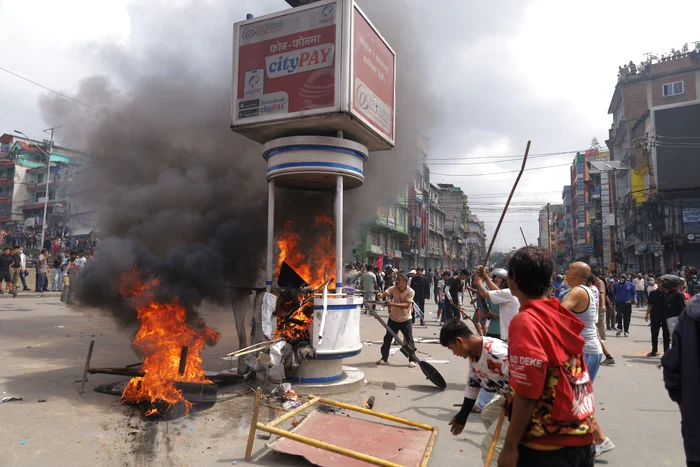
Protests large in Nepal. Photo: Profimedia
After two days of violent protests, the army was brought to the streets of Nepal on Wednesday to restore the order, after tens of thousands of protesters stormed and set on fire and attacked politicians.
The armed military guarding on Wednesday, the main areas of Kathmandu seemed to bring some sense of control in an overwhelmed city, in previous days, violence and chaos, titled Politico.
The army warned on Tuesday evening, in a statement, that the security forces are determined to maintain the law and order. The army is rarely mobilized and, until now, remained in the barracks, but the police have not been able to keep the situation under control.
The soldiers told Kathmandu people that traffic restrictions are in force and have checked vehicles and people. In a statement, the army announced the arrest of 21 people suspected of robbery.
The protests started from the Government's decision to block 26 media sites, including WhatsApp, Facebook, Instagram, LinkedIn and YouTube, in an attempt to combat misinformation, fraud and instigator speech.
On Monday, the demonstrations led by young people, angry due to blocking several social networks, included the capital. The police opened the fire on the crowd, killing 19 people.
The prohibition of social networks was raised on Tuesday, but the protests continued, fueled by the anger caused by the victims and the accusations of political corruption.
The protests became more and more violent: the protesters set fire to government buildings and politicians and attacked some leaders. The prime minister resigned against the background of the growing critics to the political elite, although the gesture seemed to have a small effect on the wave of dissatisfaction.
Tens of thousands of protesters remained on the streets until late, blocking roads and assaulting government institutions. Military helicopters transported some ministers to safe places.
President RAM Chandra Piuudel, the head of state with more ceremonial role, appealed to protesters to look for a peaceful solution and stop climbing. He accepted the resignation of Prime Minister Khadga Prasad Oli and appointed him the head of the interim government until the formation of a new one-without being clear what powers will have or even where he is.
Who are the “niece children” and why do I dissatisfy the Nepalese young people?
A key factor of protests, say activists and experts, was the increasing perception that the families of the leading elite lead luxury lives in a poor country, revealing deep inequalities, the television of Jazerra reported.
On Nepalese social networks, the term “niece Kids” – derived from nepotism – has become viral in the weeks of Monday protests. He generally refers to the children of high -ranking government officials and ministers.
For a long time, Nepal rulers and politicians are accused of generalized corruption, lack of transparency about spending public money and suspicions that some of the funds would be used to support the luxurious lifestyles that their families seem to benefit, despite the modest official wages.
On platforms such as Tiktok and Instagram are circulating numerous videos with relatives of dignitaries and ministers who travel or pose with expensive cars and wear designer clothes.
“Fury against” niece children “in Nepal reflects the frustration of the public”, explained Yog Raj Lamichhane, associate professor at the Business School of Pokhara University. “For the ordinary Nepalese, striking is the fact that the political leaders – the parents of these” grandson ” – who lived modestly when they were party activists,” now display their extravagant lives as consecrated figures“He told Al Jazeera.
Therefore, the protesters demand the formation of a special commission of inquiry to “Investigate the sources of the wealth of the politicians ”thoroughly investigating”which reflects the wider concerns related to corruption and economic inequalities.
Nepalul has been traditionally a deeply feudal society, with monarchy until less than two decades ago, said Dipesh Karki, associate professor at the Kathmandu University Management School.
Throughout the country's history, “Those who arrived in power controlled the resources and richness of the nation, resulting in what we can call the capture of the elite”, Karki explained.
The son of the president of the Supreme Court and luxury cars
Earlier this week, a video on Tiktok showed pictures with Sayuj Parajuli, the son of the former president of the Supreme Court, Gopal Parajuli, posing near luxury cars and in sophisticated restaurants. “They ostentatiously display their luxury cars and watches on social media. Didn't you get tired of them?”, Wrote the legend of the clip.
Another video presented similar images to Saigat Thapa, the son of the Minister for Legislative and Parliamentary Affairs, Bindu Kumar Thapa, from Oli's government.
Karki added that urban wealth, educational business and opportunities are largely focused on elite families, especially those with political connections.
“Politician children live from political dividends“He concluded.
How unequal is Nepal?
The annual income per capita of Nepal, of about $ 1,400, is the smallest in South Asia. The poverty rate has constantly maintained over 20% in recent years.
Unemployment among young people represents a great challenge, and the percentage of non -work -off young people who do not follow any educational program was 32.6% in 2024, compared to 23.5% in India, according to the World Bank data.
As a result, about 7.5% of the country's population lived abroad in 2021. By comparison, only about 1% of Indians and 3.2% of Pakistani lived abroad in 2022.
The economy of Nepal depends massively on the remittances sent by the citizens working abroad. “It is a tough reality that most of the poor are outside Nepal, sending money at home ”, Karki said.
In 2024, personal remittances represented 33.1%of the country (GDP) of the country – one of the highest percentages in the world, after Tonga (50%), Tadjikistan (47.9%) and Liban (33.3%).
By comparison, in the same year, the percentage was 3.5% in India and 9.4% in Pakistan.
Karki added that the distribution of land remains uneven, despite the land reforms. “The first 10% of households have over 40% of land, while most of the poor in the rural area are without land or almost without land.”
“What is happening today in Nepal can be considered … the sum of persistent inequalities that have affected the nation from immemorial times“He concluded.