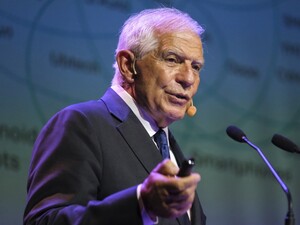
According to politicians, European leaders suffer from “the lack of long -term political vision, leadership and unity.”
“Our union looks dangerously fragmented and weak, stuck in an unfavorable internal and external environment. Europe, where only 5% of the world population lives and where an economic gap with other large powers is growing, not only encounters the world of continental empires, but also undergoes a real danger of becoming a vassal of America,” Burrel wrote together with Verkhofstadtt and Deveais.
This became obvious after unilateral concessions made by US President Donald Trump in the field of defense costs and trade, as well as after Europe agreed to play a secondary role in the settlement of war in Ukraine, politicians say.
They added that the predominant line in the EU began to flatter and pacify Trump “in the hope of minimizing damage”, which, in turn, “strengthens the political, strategic and even economic dependence of the” European Union on Washington, and “it is unlikely to work.”
Moreover, due to the “lack of unity and international authority,” the EU no longer plays a key role in resolving foreign conflicts, Borrel, Verkhofstadt and Devices emphasized.
“To date, it should be clear that Trump is not and will never be an ally. His America is a huge geopolitical, economic and cultural shock for Europe,” the column says.
But “transformation into a US protectorate is not inevitable,” European politicians pointed out.
As an alternative path, they proposed the “revival of the pro -European majority in three EU institutions – especially in the European Parliament.
“To begin with, the parliament could block a decrease in tariffs for American products,” the column said. “In addition, it is necessary to strengthen our political union, overcome the veth, which allows the prime minister of Hungary Viktor Orban to block the EU military assistance to Ukraine, and build our own defense system-one that will not depend on the Kremlin,” said the Kremlin, ”they said Borrel, Verkhofstadt and Devra.
In their opinion, if “do not take any measures and wait for the next crisis in order to improvise with difficult decisions,” then “Europe as a political project risks dying.”
Context
After taking office, Trump introduced duties for more than 60 trading partners, using them as a pressure lever in trade negotiations, Politico recalled. In particular, duties on goods from Ukraine were set at 10%.
For the countries of the European Union, Trump first introduced duties at 20%, and then announced plans to increase them to 50% from June 1, calling the EU “extremely complex partner.” I decided to postpone the introduction of the planned tariffs until August 1. But on July 12, he said that next month, 30 percent duties for EU countries will come into force. This decision, as noted by The Guardian, has become a shock for European countries, since Europeans and Americans spent months developing an acceptable agreement for both sides. In it, the tariff rate for EU countries should be 10%, which would have been five times higher than the tariff that acted before Trump arrived in the White House.
On July 23, Bloomberg wrote that the EU plans to quickly introduce 30 percent duties on goods worth about € 100 billion ($ 117 billion) against the United States if Trump fulfills its threat to a fee for most of the EU exports after August 1.
On July 27, the US President announced the conclusion of the agreement and called it “the most important of all.” According to him, in addition to the EU obligations to purchase energy from the United States by $ 750 billion, he undertook to invest $ 600 billion in excess of the previously planned sector of the defense industry. In the EC, a trade agreement with the United States was appreciated as “the best of what could be obtained.”
The media wrote that perhaps the “century of humiliation” of Europe is just beginning.