The prime minister announced a new policy and investments on Friday at the plane manufacturer's plant in the Toronto area. – Our relations with the United States, so important for many industries, were once one of our greatest advantages, and now in many cases, in some sectors, they have become a weakness – he said.
Policy “Buy Canadian” is to cover government institutions and agencies and force them to buy from domestic suppliers as part of projects financed by taxpayers, replacing “outdated” rules. And when it is not possible, Ottawa will press on foreign suppliers to use Canadian components in their products.
Carney's government follows in the footsteps of the protectiveist policy of the United States. This message, announced as the beginning of a new industrial strategy, It appears when Canada negotiates a double -sided trade agreement with Washington.
The government claims that the new public procurement rules to enter into force in November will cause $ 70 billion. Canadian (PLN 184 billion 527 million) from foreign enterprises to local.
The prime minister's ambitions are not limited to federal level. Government encourages provinces and municipalities to follow in his footstepsoffering them an action plan, thanks to which they will be able to accept similar standards of public procurement.
Continuation of the material under the video
To the south of the border, the “Buy American products” regulations have been in force since 1933. They were updated in 2021, when former President Joe Biden took action to eliminate legal gaps that allowed companies to transfer production and work places abroad, and at the same time continue to qualify for national preferences.
Canada did not receive full exemption from Biden's regulation, which caused the dissatisfaction of the then government Justin Trudeau.
The effects of Trump's trade war
Trump's global duties They hit the Canadian industry hard. The penalty duties led this spring to a 30 % decrease in production in the national steel industry.
Unemployment is also growing. The latest data published on Friday indicate an increase from 6.9 percent. In July to 7.1 percent in August, with most losses in the production and transport sectors.
Anticipating the difficulties in the labor market and the further effects of the trade war, the Canadian government announced the introduction of the strategic fund “on flexible conditions” to help “all sectors affected by the tutorials”.
Ludovic Marin / Pool / AFP / AFP
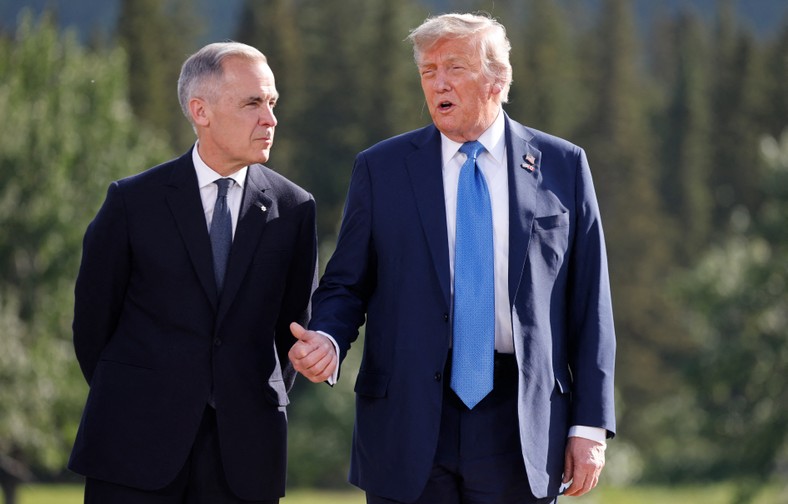
Prime Minister Canada Mark Carney and US president Donald Trump during the G7 summit in Kananaskis in the province of Albert in Canada, June 16, 2025.
Some small and medium -sized enterprises that have been seriously affected by the abolition of the exemption preventing them from sending packages of below $ 800. (PLN 2,000 909) to the United States without customs, they will be able to apply for “immediate” loans.
A new tranche of funds, in the amount of $ 1 billion Canadian (PLN 2 billion 636 million) for three years, will also be available on flexible and non -returnable conditions for eligible enterprises “affected by duties in all sectors, including agriculture and fishing.”
Climate policy goes to the side track
Along with Carney's arrival in power and the ongoing trade war of Trump, some significant climate policies introduced by the former prime minister Justin Trudeau.
Climate policies from the time of Trudeau They are currently under review In order to protect the sectors most exposed to Trump's customs threats. Carney announced that his government would refrain from introducing the obligation to sell non-emission vehicles and start a 60-day review of this policy.
Sensing a weak point, Trump called the Canadian automotive industry with a tender card during commercial talks during his first term. During the second term, Trump applied 25 % duties on cars, steel and aluminum, which caused exemptions in the automotive industry as well as suspending and limiting production on some assembly lines.
Canada responded to Trump's customs,Applying analogous tariffs on the import of American steel, aluminum and cars.
In addition to considering the idea of abolishing the obligation to sell electric vehicles, Carney also said that the government would introduce changes in the regulations regarding pure fuels introduced during Trudeau's rule to reduce greenhouse gas emissions by the transport sector.
Carney, whose long list of achievements in the field of ecology includes the function of a former special envoy of the UN for climate activities, emphasized that You should find a balance between ecology and capitalismbecause the Canadian economy undergoes restructuring to survive the shocks related to the trade war.
“Coping with climate change is a moral duty,” he said. – But at the same time it is commercial imperative – it is also an imperative of competitiveness.
I’m Ashley Davis as an editor, I’m committed to upholding the highest standards of integrity and accuracy in every piece we publish. My work is driven by curiosity, a passion for truth, and a belief that journalism plays a crucial role in shaping public discourse. I strive to tell stories that not only inform but also inspire action and conversation.