Bayraktar drones return to action. Cracks in Russian air defense after a series of Ukrainian attacks


Bayraktar TB-2 drones are experiencing a return to the Ukraine's battlefield as an attack weapons after a long break, reports the specialized publication “The War Zone”.
The Ukrainian forces made an attack with the famous Bayraktar Drone on Wednesday, targeting a boat in which troops were on the Black Sea coast.
Long limited to surveillance missions in areas where there are no intense struggles, due to their vulnerability to electronic war and to Russian air defenses, these drones have recently resumed at least in the challenged territories in the Herson region.
“Marina destroyed another high -speed boat of the Russian Black Sea fleet, which was trying to transport an aeroprated troop unit to the Istmul TiDrivska. 7 occupants were destroyed, and another 4 wounded,” the Ukrainian navy said, publishing images of the attack.
A few weeks ago, the Directorate of Information within the Ministry of Defense (GUR) publishes a video recording with an attack on another small-size Russian boat, this time near the port of Zalizni in the Herson region, about 48 km southeast of isthmus.
In June, the Ukrainian navy released a video record of a TB-2 drone attack on a Russian landing boat on the western coast of the Herson region.
These attacks come after a long period when no attacks with these drones have been recorded.
Ukraine began to use the drones made by the Turkish company Baykar before the large -scale war against Ukraine. The first reported attack took place in October 2021, and his target was a 122 mm caliber Ozus belonging to the separatist forces supported by Russia in the Eastern Donbas region.
After triggering the Russian invasion throughout Ukraine, TB-2 drones would play an important counterattack: for example, they were essential for stopping Russian mechanized columns to Kiev.
At the same time, Bayraktar drones helped Ukraine regain the island of snakes in the western Black Sea.
This success gave Ukraine a rare ray of hope in a period when its future as an independent nation was endangered. In February 2022, the Ukrainian artist Taras Borovok released a song about the Bayraktar drones, which went viral online.
In March 2022, at least 26 TB-2 drones had been destroyed, according to the Open-Source Oryx monitoring group. The real figures could be significantly higher, since Oryx only documents the losses for which there is visual evidence.
Vulnerable to Russian anti -aircraft defense
“Russia began to adapt to the threat represented by TB2,” the Ukrainian portal United24 wrote in June. “The improvement of the electronic war and the air defense stratified systems have made it more difficult to operate the slow, large drone. Ukrainian officials have admitted at that time that the Bayraktar drones have become extremely vulnerable to Russian anti-aircraft systems such as Panțir-S1, Buk and Tor.”
In 2023, the Ukrainian army had largely retired its Bayraktar drones from the first line, focusing on their use in “recognition, target design and rare blows in poorly defended areas,” said United24.
Bayraktar's return
The resumption of attacks with these drones was possible due to the constant attacks of Ukraine on Russian air defense in Crimea and Herson, they noted both Ukrainian and Russian sources.
The attack made on Wednesday “is particularly significant given that Ukraine's defense forces seem to have worked systematically to make such missions possible by suppressing Russian air defense systems – including using unmanned technologies,” the Defense Express publication noted.
“Previously,” Bayraktar “had already operated in the Istum area, but they were used exclusively in remote recognition mode, without the risk of approaching to perform an attack, as it would have inevitably become victims of air defense,” wrote the Russian Military Informer.
“Now, it seems that due to the regular attacks of Ukrainian drones [lansate de pe ambarcațiuni] With Starlink on air defense and radar on the coast of Herson and Crimea, the Ukrainian Bayraktar TB2 drones created a corridor to operate with more freedom. “
Campaign to suppress anti -aircraft defense
Ukraine has also been conducting a continuous campaign to suppress/destroy the air defense of the aggressor country for years (SEAD/Dead), including by using high-speed AGM-88 (HARM) and planar bombs.
At the same time, this campaign aims at the Russian anti -aircraft defense in the Crimea Peninsula.
Possible breaches in the Russian air defense system in the Peninsula and the northwest of the Black Sea could significantly contribute to the survival rate of Storm Shadow attack rockets, as well as other attacks, such as those with long-range Kamikaze drones, writes War Zone.
Battle for Herson region
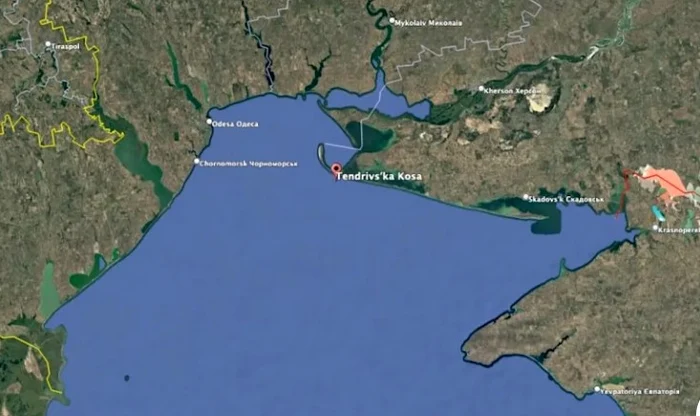
A factor for increasing the maneuver space of TB-2 drones could also be the confrontations for the control of the Tendrivska isthmus in the Herson region occupied by Russia, on the northern shore of the Black Sea.
It is the most western area where Russian troops have reached. The coastal nature of this area and its land would be likely to limit the development of Russian short -range air defense systems.
“The Russian military forces use the Istmul tendara as a fortress for observing and carrying out operations in the northern part of the Black Sea,” the militarnyi specialized Ukrainian publication said in this context. “In particular, the invaders carry out signal amplifiers there to expand the range of recognition devices and attack the drones.”
Another factor for the use of TB-2 missiles for a wide range of missions, including some risks, is that they are now produced internally. It is worth noting that Russia recently attacked the factory next to Kiev where they were to be produced, a fourth six -month attack on a facility that was soon functional, after tens of millions of dollars.
A few attacks with Done Bayraktar does not mean that they will now be a regular attack weapon. On the other hand, these attacks show the ability of Ukraine to quickly adapt to the conditions on the battlefield and to take advantage of the cracks and races in the Russian air defense. Also, I question the reliability of the Russia air defense system that, it seems, begins to have important cracks.