Army of parade? China displays its futuristic arsenal, but the questions remain. How real are Xi Jinping's weapons?


With hypersonic missiles, high power lasers, robot dogs and submarine drones, China organized a real military technological show. But behind the Beijing lavish parade, the essential questions remain unanswered: are these operational weapons or simple propaganda instruments?
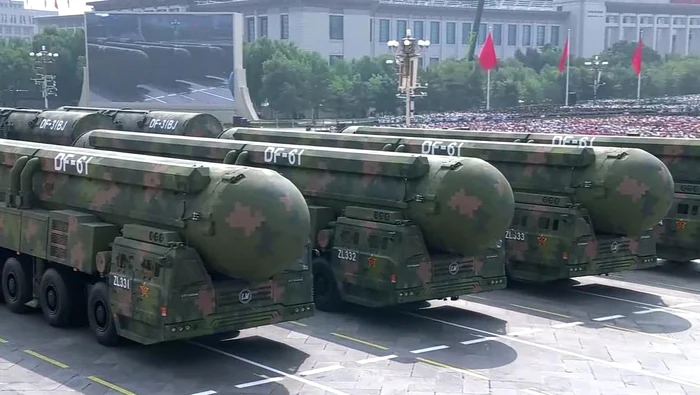
Chinese nuclear missiles, at parade/photo: x
On the 80th anniversary of the end of World War II, Chinese leader Xi Jinping used the opportunity to display his military power in front of the whole world. In a thoroughly directed demonstration, in the presence of allies Vladimir Putin and Kim Jong-un, Beijing presented an impressive inventory of fighter equipment: tanks, drones, ballistic missiles, planes and war vessels.
However, while China builds its image of an undeniable military superpower, international analysts look with caution. In the absence of evidence of efficiency in real fighting conditions, many of these technologies are considered only a form of dissection and symbolism.
“Exceptional weapons” – but it works?
Rob Peters, a researcher at Heritage Foundation, warned in a statement for The Telegraph that foreign officials look at China's new military “innovations”. According to him, the experts follow “technical indicators” to attest whether these weapons are truly functional or just “a façade scam”.
And the historical context offers an indication: the Chinese army has not participated in a major conflict from the failed intervention in the North Vietnam in 1979. XI Jinping would lead an unprecedented army in a possible modern war.
Nuclear missiles and strategic “triad”
One of the central parts of the parade was the presentation of a “nuclear triade” – the ability to launch nuclear weapons from land, air and sea. For the first time, China showed this type of combined arsenal to the public.
Among the weapons displayed were the long-range Jingle-1 air rocket, the intercontinental rocket launched from the Julang-3 submarine, as well as Dongfeng-31 and Dongfeng-61, launched from the ground.
Another element that drew attention was the DF-5C rocket, presented for the first time. Fled with liquid fuel, it can carry multiple independent nuclear focoa, having a declared radius of over 20,000 kilometers. The Chinese state claims that it can hit any military target in the world.
In the opinion of Alessandro Arduino, an expert in Chinese private security, the message is a clear one: China no longer accepts the status of second -hand nuclear power.
Supersonic and invisible: anti-nava rockets
The parade also included a diversified range of anti-ship missiles, including YJ-15 and YJ-20 models, capable of reaching mach 4 speeds and avoiding interceptions. The YJ-17, a glide hypersonic vehicle, is considered the most disruptive, being specially designed to hit war vessels.
Analysts note that these weapons are frequently tested against American aircrafts. In the case of a confrontation in the Taiwan Strait, this type of armament could play a decisive role.
Laser guns – from Science Fiction in the arsenal of the People's Army?
Another demonstration of strength: laser weapon systems. China presented its “triad” defensive anti-drone-microwave cannons, jamming systems and guided energy weapons.
The Hz-155 armored vehicle was mounted the LY-1 laser system, capable, according to the state press, to deactivate electronic equipment and even temporarily blind the opponents.
In an age when the war of drones is in full expansion, such weapons could become essential. Operating costs are also minimal compared to traditional missiles: a single fire can cost below $ 50.
Submarine drones and four -legged robots
Neither drones – both aerial and underwater were missing. China presented for the first time two large autonomous submarines (Xluuv), as well as the AJEX002 drone, about 18 meters long, intended for recognition and sabotage missions.
The UUV-300 is armed with light torpedoes and marine mines capable of disrupting the activity of enemies in the deep areas of the ocean.
Also, the public was able to see the CS-5000T air drone, with a “flying wing” design, reminiscent of stealth technology.
And perhaps the most unusual appearances were “robot dogs”, four-legged creations, trained by artificial intelligence algorithms to move on difficult soils-from snow to mountainous areas.
More show than power?
In total, over 100 aircraft and hundreds of armored vehicles have been presented. Xi Jinping smiled broadly against the backdrop of this arsenal, wanting to convey a clear message: China is ready for anything.
But behind the scenes, the questions persist: how much of this arsenal is functional, how pure image is? Although military parades are a traditional instrument of intimidation and self-promotion, the real fighting capacity of the Chinese army remains unclear.
And in the absence of fire tests under real conditions, the presented weapons remain, at least for the moment, in the category “possible, but unverified”.