

publication
2025-09-02 11:02
August brought only a minimal increase in HICP inflation in the euro area. It happened after the previous three months Euroinflation almost perfectly entered the 2 % goal of the European Central Bank.
The preliminary data of Eurostat shows that the harmonized consumer price index (HICP) in the euro area in August 2025 was about 2.1% higher than a year ago. This result is only slightly higher than in July and June, when results of 2.0% yard were recorded. Relative to July, the harmonized index of consumer goods prices (i.e. HICP) rose by 0.2%.
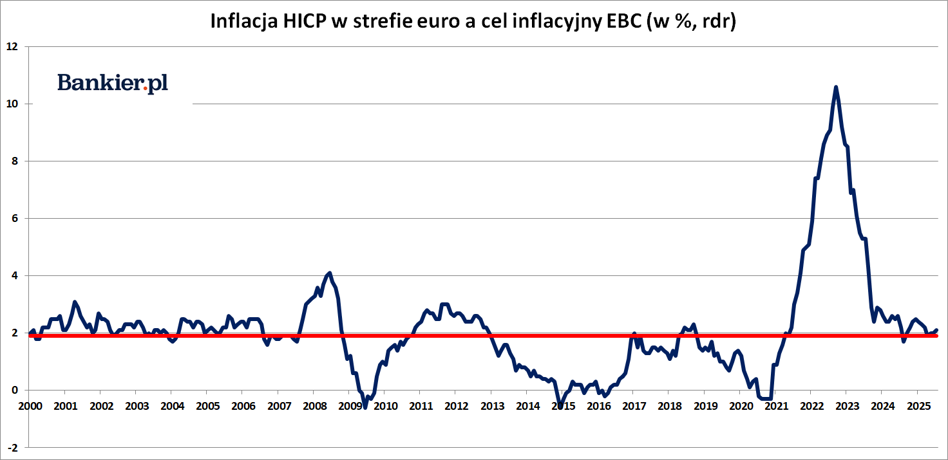
It was the fourth month in which the reading of HICP inflation remained very close to the 2 % goal of the European Central Bank. However, one cannot forget that Earlier, for over three years, EBC was unable to realize its mandate “stable prices” understood as inflation lower, but similar to 2%. Let us add that this goal was only pursued for two months between July 2021 and April 2025.
During the previous year, the European Central Bank has significantly loosened the monetary policy. As early as in June 2024, the first in the reduction cycle (-25 PB.) Interest rates in the euro area occurred. The process of reducing interest rates continued in September (-25 PB), October (-25 PB), December (-25 PB) and January this year (-25 PB.).
He gave us another 25-point reduction of EBC foot in March, bringing the reference rate close to the levels of current HICP inflation. The last cut took place in June, after which the deposit rate was reduced to 2.00% and practically razed with HICP inflation for the previous 12 months. After August The real interest rate in Euroland (calculated ex post) has become negative again.
The 2% EBC target still remains slightly in the dimension of base inflation, which in August for the fourth month in a row remained at the level of 2.3% per annum (and amounted to 0.3% MDM). The problem is rapidly rising food prices, which in Euroland in August was as much as 5.5% more expensive than last year. Thanks to cheaper fuels, prices in the “energy” category (by 1.9 yaws) fell. Inflation of industrial goods (0.8% yaws) and still too fast (3.1% yaws), services are still quite low.