Turtles crisis destroyed a holiday paradise. That is, the dark side of our tourism


Every summer, thousands of sea turtles climb to the beaches of Boa Vista on the Zielona Cape Verde Islands to lay eggs.
Currently, however, this process is threatened by several factors that expose one of the world's largest turtles Careretta turtles in the world.
Crunness, environmental pollution, mass tourism and climate change exert pressure on a delicate ecosystem, revealing how local challenges often result from global problems – a Europe curses a large shadow on them.
The biggest threat to turtles is pollution with artificial plastics. In this case, fishing contracts concluded between the islands of Zielony Cape Verde and the EU – allowing European industrial fleets, especially Spanish and Portuguese, to conduct business in the waters of these islands – have a significant impact on sea life.
The breeding beaches are buried tons of waste transferred by currentsderived mainly from fishing activities and screenshots along the coast of Europe and Africa. The accumulated rubbish not only chemically contaminate the nests, but also create physical barriers that prevent females from finding a safe place to lay eggs.
– It's like Searching for a house in the minefield – explains Franziska Haas, a German biologist and volunteer at Fundacao Tartaruga, one of the most active local non -governmental organizations.
We often have to help them find a safe place. Some get lost, wander for many hours until the morning and expose themselves to death due to dehydration.
Problem with tourists
Foundao Tartaruga is currently monitored by over 30 km of coast, having teams of guardians and international volunteers, many of whom have scientific education. Their work has crucial for identification of nests, egg protection, control of poaching and documenting growing damage caused by pollution.
Continued article under video material
Of course, the coast is much longer, but the organization's resources are limited.
Added to this is excessive tourism. Over the past two decades of the Cape Verde is the increasingly popular goal of tourists from Europe. Especially the islands of Sal and Boa Vista have been huge investments of European development groups. Along the beaches where the turtles lay eggs, hotels, resorts and housing complexes were created.
However, not only the land is a threat to turtles. He is also water. Each year, industrial fixed networks accidentally catch tens of thousands of turtles, both on the archipelago and during their migration by the Atlantic and the Mediterranean in search of food.
Turtles to help
Although European regulations impose the obligation to use devices that allow turtles run out of the networkthey are mandatory only for some fleets and areas, and the enforcement of the law is often inconsistent.
Added to this is the influence of climate change. In many cases, excessive heat causes embryos mortality. The gender of turtle embryos depends on the temperature of the sand in which they lay eggs, with higher temperatures favorable to females. This growing imbalance can threaten long -term reproduction.
In the face of all threats, the volunteer's night work became necessary.
The teams consist of three or four volunteers and an environmental guard. Patrols are organized in the rhythm of the metronome so that the time devoted to every female turtle is as short as possible. Some volunteers help kick deeper pits, others implant microchips for the purposes of the census, others write GPS coordinates of the nest, and some return to assess the age, size, health and presence of wounds in turtles.
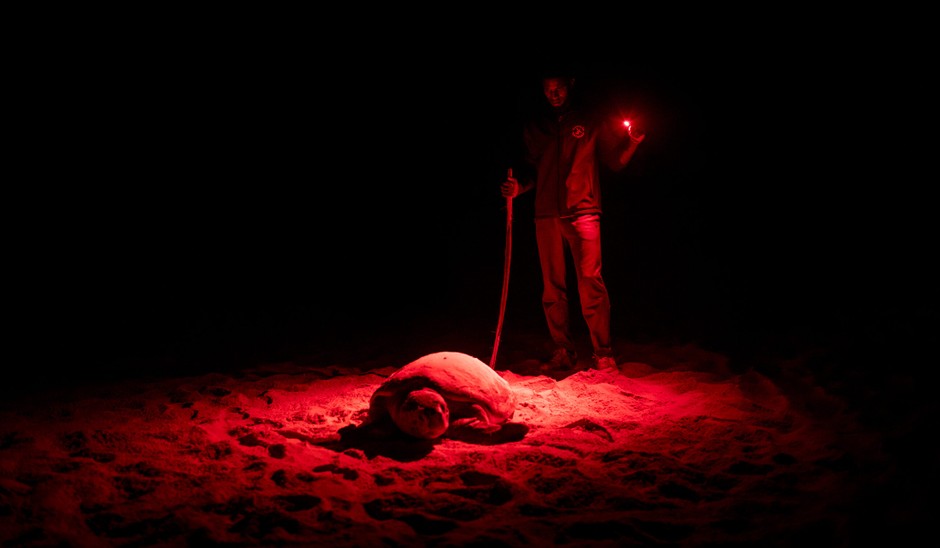
A volunteer who spotted the turtle on the beachLuigi Avantaggia / Politico
Turtles meat
Despite all work on the island, it still comes to poaching. Despite the involvement of the Government of the Zielona Republic, Cape, which in 2018 recognized the consumption of meat and turtle eggs for offensefemales are caught at night, killed when laying eggs and sold on the black market, where meat can reach a price of up to 20 euros (at the current course 85 PLN) per kilo.
“The turtles are hunted illegally because of the meat and eggs, which are sold by transmission from mouth to mouth,” confirms the executive director of FundaCao Tartaruga Euclides Resnde. However, “in 2024 we recorded only six cases of killing turtles on the beaches we monitored, compared to Thousands of cases a few years ago“.
Group monitoring activities are effective thanks to the use of an innovative approach in 2019, which uses guard dogs and thermal technology. “This allows us to expand the monitoring range and gather evidence for any legal actions,” explains the coordinator of the Adilson Monteiro project.
However, it is extremely difficult to eliminate the activity yes deeply rooted in culture a given place: Caretta's meat and turtle eggs have always been consumed on the islands. In places located inland, such as Joao Galego, Cabeca Dos Tarrafes and Fundo das Figueiras, “Ba Pa Bela” (Turtles hunting) is a real ritual of the transition.
– For my family, turtles hunting was normal. My grandfather did it, my father did it, and I learned it from my older brother. Each family in Joao Galego has always ate turtles, it is part of our tradition – says the tourist guide Zenildo F.
It is this difficult coexistence of tradition and environmental protection, along with the need for further regulations regarding pollution and fisheries, that makes the survival of sea turtles on the Zielona Islands Cape is A real global test.