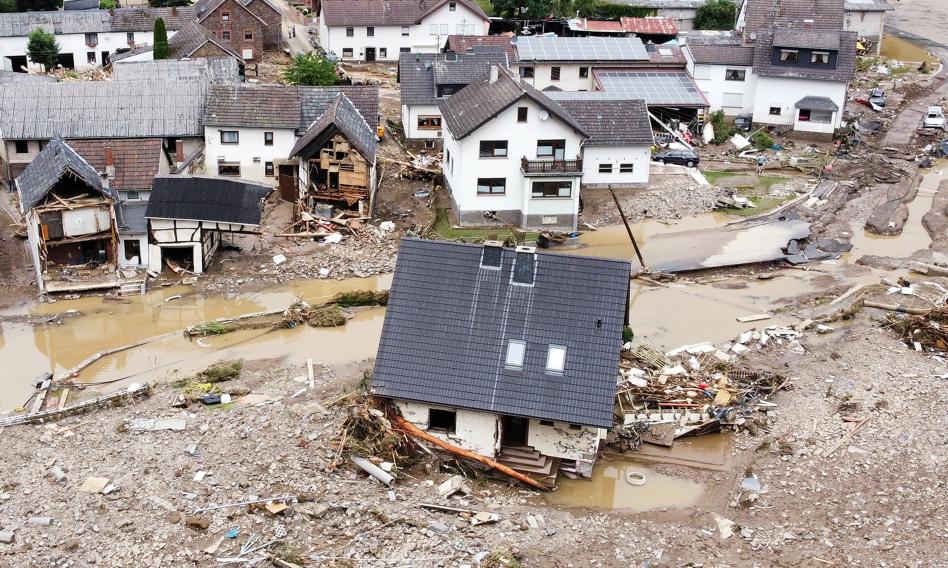
Although the flood cannot be eliminated, the losses they cause – manage to effectively limit. In Europe, the number of flood victims is systematically decreasing, and material losses are less and less severe for the economy – according to the analysis of 1700 floods in Europe in the last 70 years.
Researchers in the publication in “Science Advans” analyzed over 1,700 floods registered in Europe since the 1950s and took a look at factors that affected the amount of human and economic losses. This is the largest analysis of this type.
– Floods will always occur, this threat cannot be eliminated. However, it is possible to learn to function with him and limit the losses most effectively – says in an interview with PAP the author of the publication, geographer Dr. Dominik Paprów from the Potsdam Institute of Climate change (PIK) in Germany and the University of Szczecin. He comments that a better adaptation to the flood is observed throughout Europe: a decrease in the number of flood victims and flood losses in relation to GDP.
The researcher explains that The key to limiting future flood damage is a wise adaptation and “giving away space”, not an attempt to completely control the element.
– Whoever is threatened with flood – whether residents or local authorities – must take direct action to limit the losses. Our research shows that it can be done effectively – sums up the research.
The analyzes showed that an important factor in limiting flood losses on a European scale are better and better warning systems. It is not only about more and more accurate meteorological and hydrological forecasts, but also easy their availability and transmission of the population of warnings about the upcoming disasters.
Losses are also limited thanks to the activities of professional emergency services. For example, in various places in Europe, crisis management offices have been created, which translate meteorological warnings into practical activities of services – they distribute equipment and send rescue teams into specific places where the threat will be greatest.
Another factor that limits the losses is LWaste adaptation: adaptation of buildings and infrastructure so that they succumb to less losses in the event of a flood. Regulations regulating the possibility of developing floodplains are also important.
The development of temporary dams technologies is also important. Dr. Paprów gives an example that European cities are prepared – e.g. along roads or embankments – to which temporary flood barriers are attached in the event of a threat. In some places there are dams hidden in the ground, which are only extended when the flood wave comes.
In recent decades, flood losses have also been limited thanks to retention reservoirs. However, this type of solutions are gradually moving away, because it turned out that they are not as trouble -free as it used to be: they require huge interference in the environment, they are difficult to maintain, and in case of interruption – they are a risk. Therefore, instead of retention reservoirs, therefore, it is focused on reproducing natural floodplains: removing some flood embankments, so that in the event of a high water level – agricultural or undeveloped areas are intended for this.
Studies of my colleagues from Europe have shown that giving water space is – in relation to costs – the most effective solution in the context of future climate change – sums up the scientist.
Studies of the team of dr. Paprotne also show that the impact of climate change on the course of the flood is very diverse regionally. And so Europe can be divided into three zones.
In North West Europe (Great Britain, France, Germany) we are observing an increase in extreme river flows related to climate change.
In Eastern Europe (from Scandinavia to the Balkans, including Poland), we see a decrease in the number of melt floods, but at the same time an increase in the intensity of summer floods associated with rapid rainfall.
In South Europe (Spain, Portugal), on the other hand, the climate has become much dry, which causes a decrease in extreme river flows (although it causes other threats – e.g. heat waves and powerful forest fires).
Along the coast of Europe, in turn, the global increase in sea levels, which systematically raises the level of extreme storm floods, acquires significance.
We are observing a significant decrease in the number of deadly victims of floods. At the same time, absolute economic losses are growing. However, the level of these losses in relation to the general size of the economy (GDP) is falling. So although the costs of flooding are rising, for the economy, dealing with them is a smaller challenge than before – sums up Dr. Paprów.
What advice has a scientist for decision -makers fighting floods? – I would suggest to stop trying to control the environment, or rather act with him. Instead of trying to prevent floods at all costs, you should focus on preventing the losses suffered by people. You have to allow excess water to find its mouth. Decision -makers can largely protect the population and reduce losses, but they will never eliminate the flood completely – sums up the researcher.
Ludwika Tomala (PAP)
lt/ zan/ mhr/