Can Russia invade Ukraine again? History shows scenarios


Ukraine is driven by the fear that Russia can simply invadeif Kyiv does not receive appropriate safety guarantees from the west.
Experts tell The Moscow Times that even if there is a peace agreement, Russia's previous behavior, consisting in celebrating or explicitly violating the conditions of the contracts, should be skeptical about its ability to comply with any future agreements.
The history of controversial peace agreements of contemporary Russia dates back to chaotic years after the collapse of the Soviet Union.
When in the winter of 1991 the Chechen Republic of Iczkeria announced independence, Moscow suddenly found herself in the face of the crisis in a strategically important region of the North Caucasus. After three years of unsuccessful attempts to stop the movement with secret methods, President Borys Jelcyn ordered starting a land and air campaign to neutralize separatists.
According to Marat Ilyasova, Professor College of the Holy Cross and an expert on wars in Chechnya, it is during this conflict For the first time, Russia has used a brutal strategy for suppressing perceived security threats, which currently drives its war in Ukraine.
End of the war in Russian
Ilyasov lived in Chechnya in the 90s, when Moscow bombed the capital of the Rozna region and sent 40 thousand. soldiers to “restore constitutional legality, law and order and peace in the Chechen Republic”.
When the war ended after two years, its victim fell over 50,000. people, mostly civilians.
Two agreements They ended the first Chechen war: a truce in Chasawjurt from 1996 and a peace treaty between Russia and Chechnya from 1997.
Both documents contained a decision that disputes would not be resolved using violence, and the first of them in particular forbade the use of “armed force or threat of it to solve all issues.”
For some time, it seemed that these agreements would be enough to resolve the main disputes between the parties. However, the issue of Independence of Chechnya remained open and three years later, under the direction of the newly appointed Prime Minister Vladimir Putin, Russia invaded the region againclaiming that it is a source of terrorism spreading throughout the country.
According to Ilyasov, the 1999 invasion, which initiated the Second Chechen war, was a violation of agreements ending the first war. – Russia has broken the conditions of peace agreements, it is certain – says the expert. – Yes, there were security problems, but they were not impossible to solve, and security issues were not serious enough to require the Second War.
“Russia will do it”
Instead of negotiating with the rulers, the Kremlin began the 10 -year offensive, which caused the death of thousands of people and led to the takeover of power by the Khadow's friendly Kadyrow family.
For Ilyasov, Chechnya's experience shows a simple truth: if Moscow sees a threat to his safety, No agreement will stop it from the invasion for a given region.
The expert also adds that even if Kiev reaches a peace agreement, “it may take several years, but the Russians will come back”. “If Russia decides that it can break the agreement safely, he will do it,” says Ilyasov.
Russia has not yet completed a military operation in Chechnya when the conflict broke out in other regions of the Caucasus.
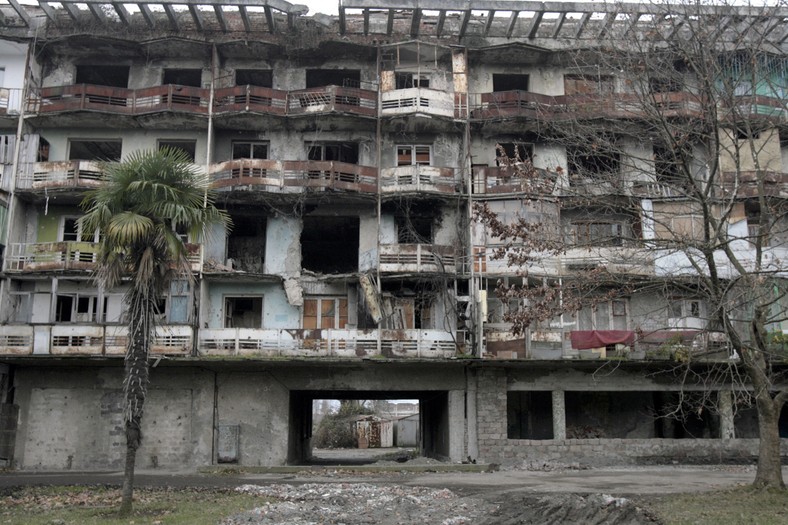
Destruction after the war in Suchumi, Georgia (illustrative photo)
In August 2008, the President of Georgia Micheil Saakashvili ordered his soldiers to repel forces supported by Russia in the separatist region of South Ossetia.
Russia reacted by sending troops to the region, which the then President Dmitry Medvedev called “preventing genocide” – just like later, Moscow justified her full invasion of Ukraine.
Russian sources of influence
After five days of fights, the Russian-Grudzin war ended in a non-comprehensive peace agreement, which is strived by the presidents of Trump and Putin in Ukraine, but by a hurriedly contained truce known as Six -point plan.
His decisions, including the end of the fighting and permission to provide humanitarian aid, remain a binding agreement on the end of the war.
However, according to Georgian experts, within a few years of signing the document Moscow broke the key provisions of the plannamely the fifth point, which requires from the Russian troops “withdrawing to the positions occupied before the start of hostilities in South Ossetia”.
To do this, Moscow would have to withdraw its soldiers from most of the territory of South Ossetia, losing the important source of influence on Tbilisi.
Szota utiaszwili, a high -ranking official of the Georgian Ministry of the Interior during the conflict, says The Moscow Times that the six -point plan was the best agreement that Georgia could have obtained then, even if it did not conclude mechanisms preventing Russia from further territory. – There were not many options to choose from. It was quite clear that the Russians would keep control over the territories they took – he adds.
Lesson for Ukraine
During a few years of experience, Georgia was overshadowed by the outbreak of fighting in Donbas and the failure of multilateral agreements to prevent the invasion of Ukraine on a full -scale in 2022.
American and European officials are currently pressing to organize Double -sided peak between Putin and Zelanski as the next step in a peaceful process aimed at completing the fighting.
Utiaszwili, who also supervised peace conversations with Russia after the war, says that the greatest lesson that Georgia can now give is The importance of security guarantee On the side of the West, which Russian officials have already criticized.
– The most important thing is not the wording of the agreement now, because if Russia decides that it can break it safely, it will do it. The most important is the power of security guarantee for Ukraine – he says.
– Ukrainians must know that if Russia attacks again, cavalry arrives and they are not left alone – adds the official.