Signs that Ukraine's strategy to hit Russia's refineries bear fruit. Huge losses for Moscow


Ukraine's strategy to target Russia refineries that feed Russia's war machine begins, CNN reports, which analyzes the impact of these attacks on Moscow's ability to compensate for losses.
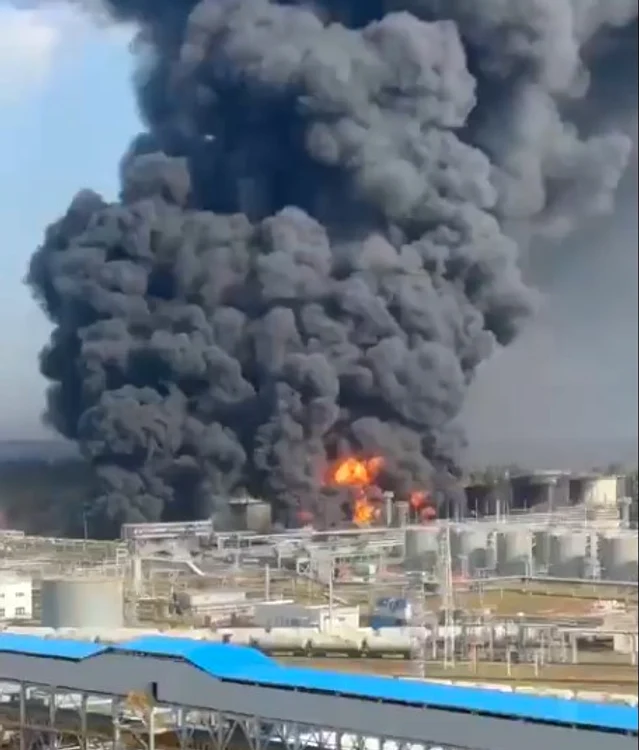
The strengthening of Ukrainian attacks on Russian oil refineries has led to an explosion of fuel prices, which have reached record levels, despite the fact that the Government has banned exports to deal with the crisis.
Drone attacks are focusing on refineries, pumping stations and trains carrying fuel, in an attempt to harbor the Russian war machine – but also to disturb the daily life of Russia. This is when the summer is registered a peak of the fuel demand among Russian drivers and farmers.
Ukrainian drones attacked at least ten Russian key energy installations only this month, according to a balance of CNN attacks.
The most recent attack on Sunday targeted a terminal near the city of St. Petersburg, triggering a large fire, according to a geolocalized video record. The regional governor, Alexander Drozdenko, said the fuel tanks in a nearby port have been affected.
A winning strategy
Kiev's strategy seems to work. The affected refineries produce over 44 million tonnes of products every year – over 10% of Russia's capacity – according to Ukraine's intelligence services.
Targets include the giant refinery Lukoil in Volgograd, the largest in southern Russia. CNN geolocalized clouds of smoke rising from this plant, which was hit in the early hours of August 14. The Russian Ministry of Defense recognized the damage to the boiler, which was attacked again, a few days later, on August 19th.
A large refinery in Saratov, in southern Russia, was attacked earlier this month. And the fires had not been extinguished at another refinery – in the Rostov region – more than two days after it was hit, according to Robert Brovdi, the commander of unmanned systems in Ukraine.
At the same time, gasoline stracks are reported in several Russian regions, but also in the annexed Crimea. The governor installed by Russia, Sergei Aksionov, attributed the gasoline seizures “logistical problems” and said that the government “takes all possible measures to purchase the necessary volumes and stabilize prices”.
An activist in the pro-Ukrainian group in Crimea, Yellow Ribbon wrote on Telegram that the most sought after fuel is no longer found, or from this it can be deduced that “this is the effect of the efficient work of drones on the Russian economy”, a result that does not produce compassion “
Despite government subsidies, Russian consumers pay more at the pump. The wholesale gasoline prices on the Stock Exchange in St. Petersburg increased by almost 10% this month and by about 50% since the beginning of the year.
Much of this growth is transferred to consumers, the extreme Russian East being especially affected. Analysts do not expect any improvement for at least one month, even though the Russian government has imposed a prohibition on the export of gasoline at the end of July – which, in turn, contributed to an increase in oil exports.
“Unfortunately, our forecast is unfavorable for now – we will most likely have to wait at least another month for the prices to fall,” said Sergei Frolov, partner manager at Neft Research, for the Russian Kommersant newspaper. The Russian publication said that the increase of prices this month “due to accidents from oil refineries”.
The army is less affected, because its demand is mainly for diesel, whose supply is not affected at the same level.
A new target for Ukraine
The Army and Ukrainian intelligence services have bet on long distance attacks using drones, rockets and sabotage, while a very different conflict takes place on the ground. The army claimed this month that this year's long distance attacks caused $ 74 billion damage, almost 40% of attacks taking place at least 500 kilometers in the depths of Russia.
If such statements could not be verified, there are many visual evidence of the damages, storage tanks and pumping stations in recent months. In addition, the repairs of these infrastructures are made difficult by European and American sanctions.
In a report published on Thursday, the Ukraine's Foreign Intelligence Service said that Russian companies are urgently acquiring Oil from Belarus to cope with internal penalties. The state refinery in Belarus, Belneftekhim, states that in the last week “the interest in Belaruse petroleum products has increased vertiginously.”
Ukraine also tries to obstruct Russian oil exports. Last week, his drones hit the Drujba pipe, which provides Russian oil and Slovakia – two EU member countries whose governments remain in good relations with Moscow.
Both complained the EU, motivating that “through these attacks Ukraine does not harm Russia, but Hungary and Slovakia.”
US President Donald Trump intervened, commenting on a hand-written note to Hungarian Prime Minister Viktor Orban that he is “very angry” because of disturbing oil supply.
But from the perspective of Ukraine, under pressure in the front line, attacks on the vital energy industry for Russia are a way to counteract the speech of Moscow that its victory is inevitable.
Meanwhile, Ukraine tries to expand its long-range arsenal. Not more than last week, Kiev revealed a cruise missile produced internally, sparely nicknamed “flamingo”. The manufacturer aims to produce 200 pieces per month.
Expert Fabian Hoffman notes that for a target such as the distillation columns of Russian refineries, for example, the lethal rate of the flamingo rocket would be over 38 meters, so it would probably cause substantial damage.
“Every rocket that touches its target will cause a lot more damage [decât armele ucrainene existente] With the focus of 1,150 kilograms, ”says Mick Ryan, the author of the blog futura doctrine.
“Although I would not call it a miraculous solution, it will have a significant impact on the ability of Ukraine to hurt Russia,” not least because it would be difficult to defend all his oil refineries.
On the other hand, analysts are not expected that Russian gas stations will no longer have to sell, instead they anticipate that these disturbances will deepen the already high inflation and will probably lead to an extension of the prohibition on gasoline exports until autumn, while the Kremlin tries to temper the prices.