The most painful revolution in the history of Romanians. Inspired him on Caragiale and became the subject of banks


155 years ago, the most hilarious “revolution” in the history of Romanians took place. An artillery officer and his friend “the gardener” managed to compromise in a typical Balkan way, an anti-monarchic plot as seriously as possible that IC Brătianu would have participated.
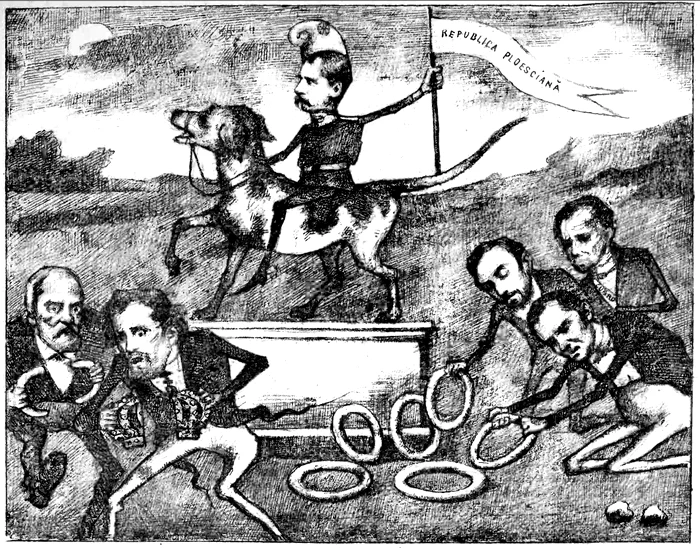
Răzmerita from Ploiești Satirized Photo Wikipedia
On August 8, 1870, in Ploiești, an anti-monarchic revolt broke out that remained known in history as the “Republic of Ploiești”. Improper say “Republic” as her protagonists will confess, but certainly the most hilarious revolution in the history of Romanians. The peak, all the peasants started from a serious thing, a coup that would have radically changed the history of the Romanians and in which the illustrious characters of the time were involved.
We want a foreign prince but not to be a German
The story of the “Republic of Ploiești” has its roots in the political disputes between parties in Parliament. After a political coalition causes Cuza to abdicate on February 11, 1866, after a series of negotiations missed with a Belgian prince, he was brought to the Romanian throne Carol by Hohenzollern Sigmaringen, the son of the powerful Prussian prince Anton by Hohenzollern Sigmringen. The Romanian intellectuals were happy. They saw their dream with their eyes, a foreign prince on the throne of the Principalities.
The peasants a little more reluctant in the beginning (they thought that “Handol” would take the lands given by Cuza) they saw that no one asked for their land back and were satisfied with the Germans. Carol I, a German Get-Beget never reconciled with the Balkan way of making the Romanians' politics. So the problems appeared.
In 1870 the conflict between Prussia and France lit the spirits in the Principalities. The Romanians were the fervent supporters of France, which they felt closer and cultural (perhaps because many Romanian intellectuals had made school in Paris) and developed, implicitly, an dislike of King Carol, Prussian at origin. To all these were added the political struggles between conservatives and liberals. In the summer of 1870, the prime minister was Costache Epureanu, a prestigious lawyer but with conservative visions, which was dissatisfied with the Liberals of Ic Brătianu.
Finally, after only four years, the joy of having a foreign prince on the throne, wasted as fog. It was created a powerful antidinestic current from which officers, boyars, Republican intellectuals or Filo-French were part. No priests were missing. “For 4 years the foreign gentleman had set foot on the steps of the throne and it seemed that, together with him, he had entered the unfortunate Misery, the unstable in government, the unmistakable hatred between the parties.”wrote Candiano Popescu, artillery officer, one of the conspirators. All of them wanted to remove Carol I and to establish a French prince on the throne. During this time, the royal lieutenation was provided by the natives.
A secret plan to remove the king
Carol I's removal conipiration from the throne of Romania was as serious as possible. Even well organized and led by great personalities of the time. The Liberals feared that Napoleon III, the emperor of France, would cease to support the principalities, internationally, because they have a German, that is, an enemy of his country. The fear was fueled by the rumors that Napoleon III would have agreed that the Principalities be taken by Austria. In this context, a group of conspiracyists led by Eugeniu Carada Great Romanian Economist (who will found the National Bank of Romania) and even the leader of the Liberal Party, IC Brătianu. As Rosetti, another marked member of the Liberal Party would have been involved, as a liaison in Paris.
The conspirators had planned the revolution to burst into seven localities simultaneously, including Ploiești, Craiova, Bucharest, Focșani and Tecuci. Even the “revolutionaries” also reached the officers leading the troops from the military camp in Furceni, a locality near Focșani. After putting his hand on the capital and cast out Prince Carol, through his intercession as Rosetti, a cousin of Napoleon III would have been brought to the throne.
Balci a la Caragiale with a fake letter
The plans of the conjurations, as serious as possible, were given in a villa of a ploieștean. In addition, the entire conspiracy sank into derision on the streets of Ploiești. On the morning of August 8, the plots in front of Candiano Popescu, former artillery officer, lawyer and newspaper, left for the central market of Ploiești with the band after them. Candiano Popescu, arrested three times, in the past, as a political agitator, wore a red flag, the symbol of the revolution. Some priests also stuck to conspirators. The word “Handol” was not Orthodox.
Candiano Popescu was proclaimed without hesitation prefect by Prahova, representative of a non -existent revolutionary government. In front of the crowd gathered as the bear read a false letter. “I make you known that Prince Carol I was dethroned tonight. A regency was called General Nicolae Golescu and a new government has been constituted, having at the Ministry of War Ion C. Brătianu”.
Obviously, the king was well thanked on the throne. But the Ploiestii took the story of Candiano Popescu. Included by the revolutionary fever people crammed into positions. Candiano Popescu divided the left and right dignities, in the Great Hall of the City Hall. Cut became sub -prefect, another secretary I do not know where and so on. Firefighters and civic guards also swallow and frantically applaud on the new “prefect” by Prahova. The whole story was a special ridicule. Especially since the Ploiesti were totally broken by reality in those moments. Nothing that Candiano said in the City Hall Hall was not true. Q
The whole story did not escape the satirical count of Caragiale. Even moments detached from the “Revolution in Ploiești” also appear in the plays “D-ale Carnavalului” or “Conu Leonida face to face with the reaction”. The story from Ploiești remained the subject of satire for decades.
“Grădinaru “'s gifa
And that's because the revolt has been compromised from the beginning. But Candiano Popescu did not know. The first stage in the “Revolution” was the occupation of the telegraph station by a Ploieștean Guță Antonescu, said “Grădinaru”. Said and done. Guță occupies the telegraph. However, instead of sending the necessary correspondence to other conspirators in the country, “Grădinaru” makes Gafa and sends it directly to Bucharest. In the shortest time, Ion C Brătianu is arrested in Pitesti and taken to prison in Campulung. At the same time, Carada learns that the information sent by Rosetti from Paris was false. More precisely, Rosetti said that the French beat Prussaci. In reality it was back.
The French were humiliated by the Prussian army. While Candiano Popescu divided functions at the town hall, in front of 3000 people, the conspirators at the top were either arrested or realized that everything was lost. Moreover, Candiano Popescu tried to deceive the same letter and Major Polizu from the garrison in Ploiești. This time the deceit did not work. Moreover, Major Polizu is notified that he has to stop the madness in Ploiești. Thus, the conspirators are arrested, including Candiano Popescu and the crowd scattered quickly.
The conspirator gets the king's right hand
Anti-monarchic tensions have reached its peak after the incidents in Bucharest and the king's desire to abdicate. At that moment, politicians understood that the situation was not a play at all. In addition, France had been humiliated in the war. The king reaches an agreement with politicians. Even most conspirators become loyal collaborators of Carol I. Hello Candiano Popescu. After he is noted as a hero in the War of Independence, he becomes a Highotian of King Carol I.