Deficit of food: we export subsidies, import jars and tomato broth. And a comparison to Poland

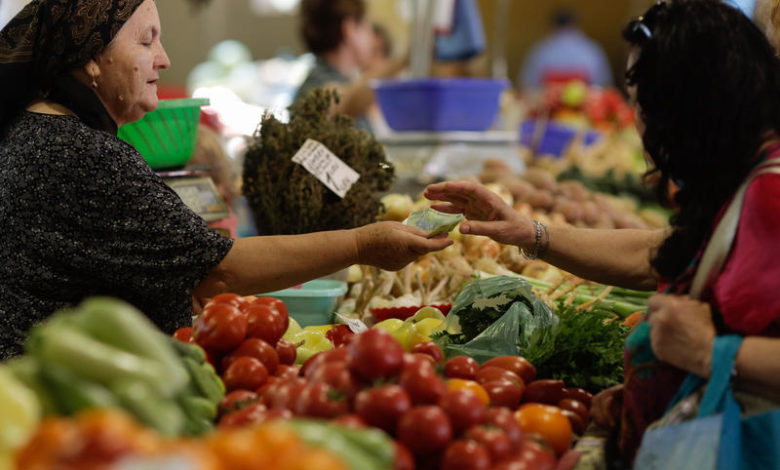
Romania imported foods worth almost 6 billion euros in the first half of the year, ie almost 33 million euros/day, the NIS data shows.
When the students from the school in Voinești- the homeland of the apples- received a few years ago at the snack offered by the imported apple school in Poland, the parents were very revolted. One of the mothers wrote on Facebook: “At school today, apples were given to Poland. Here, where our apples fall into the top of the head. Tomorrow my daughter will refuse this apple that smelled of spray solutions”
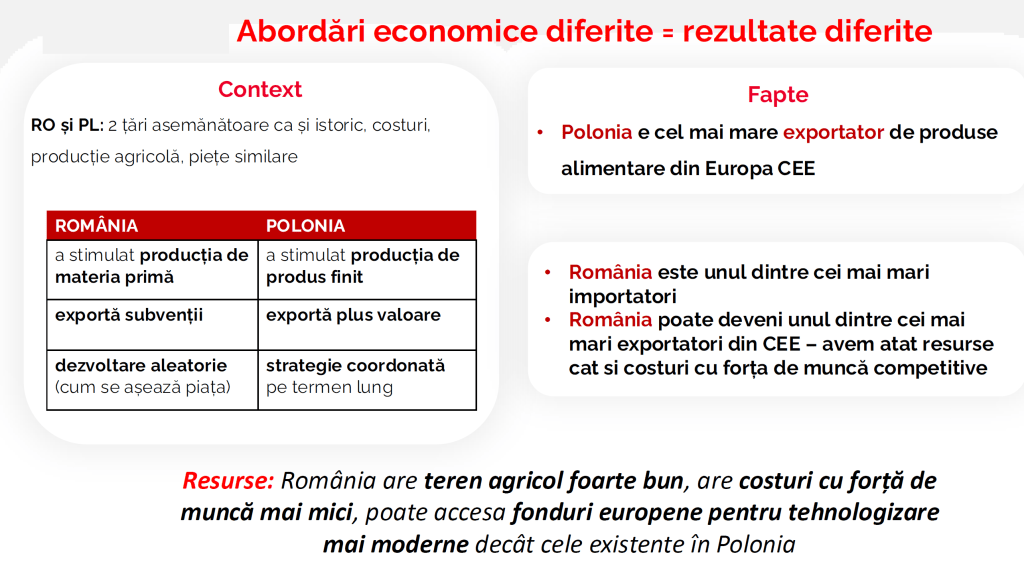
For years, Romania and Poland, two countries with similar resources, follow the radically different trajectories on the map of agri -food trade, shows an analysis transmitted by Hotnews by Călin Costinaș, the deputy director of Profi Romania.
The GDP of Poland remains constantly over 200% higher than in Romania, and the process of economic convergence is slower on our side. However, the most alarming is the commercial deficit: while Poland went from a deficit of -12.3mld.eur in 2009 to an surplus of 13.5mld.eur (2023), Romania deepened from -7mld.eur to -35mld.eur in the same period.
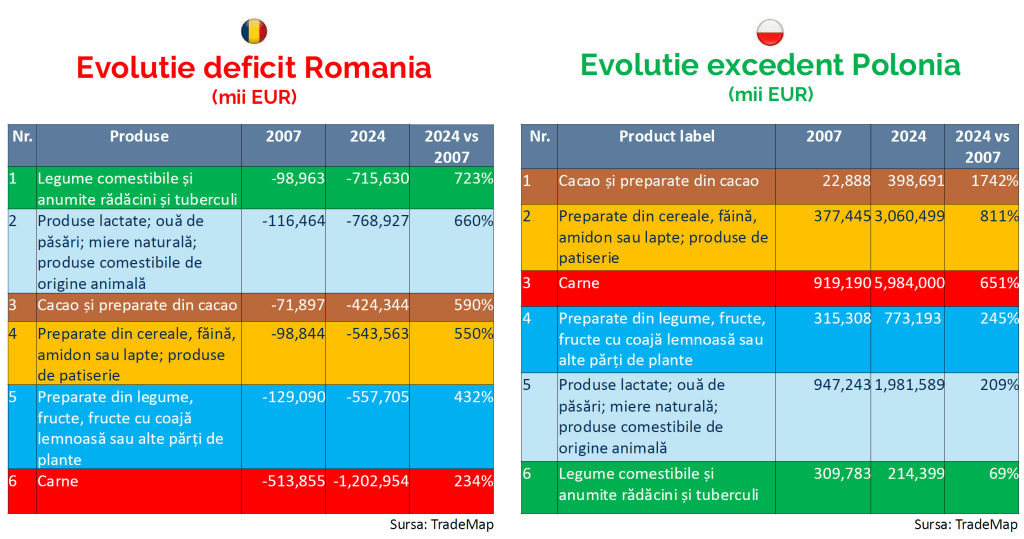
Food industry: a structural fault
The deficit on the food segment has increased more than 7 times, from -0.4mld.eur to -3mld.eur, says Costinaș in its analysis.
The main deficit products? Meat, fish, dairy, fruits and vegetables, sweets, premium bakery products. We import massively from Germany, Italy, Switzerland, Belgium, but also from Ukraine and Bulgaria.
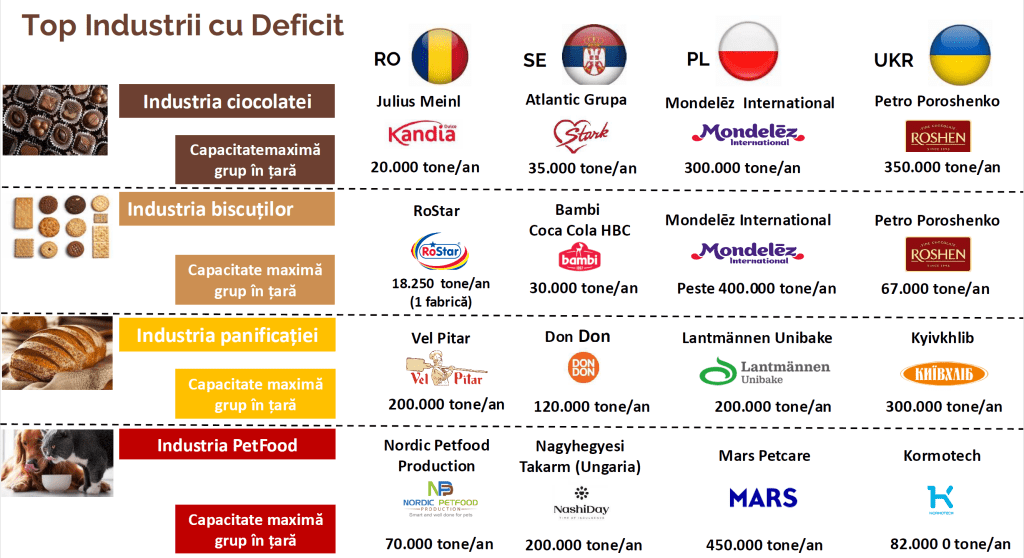
In the market mirror, Poland positioned itself as the third chocolate exporter in the EU, with over 295,000 tons exported in 2022 and a strategy focused on finished products of high value.
Tudorel Andrei, the president of the Romanian statistics, gave some examples in a conference of products in which the ratio between the local prodire and imports are unbalanced. Thus, in sweets, the ratio between import and production is over 6 to 1, on apple juice over 2 to 1, in fish 30 to 1, and at cream 3.6 to 1.
“At the tomato broth, which is incredible, so, in the end, red is a national product, it is a brand, if I can say so, the ratio is close to 14 to 1. Practically, the share of import in the domestic consumption is almost 95%. All this shows us? We are dependent on a European market on those products, to those products to which we have to have a large market. Unfortunately, there are imbalances that have been created within 30 years.
Multinationals draw the deficit after them
Five FMCG-Nestlé, L'Oréal, Mars, Ferrero and Colgate-Palmolive giants-“exports” commercial deficit of about 1mld.eur to Romania. Without local factories, only with import and distribution, these groups increase sales but deepen the deficit. The world example emphasizes the contrast: it invests and produces in Poland, not only sells, while the market remains only consumption.
“We export significant quantities of products with a reduced market value and at the same time we import, among others, residues of agricultural products, most often used for animal husbandry, as well as agro products, obtained from an industrial processing process. Not by chance, from the trade with AGRO products – food in the post -December period, food) of over 22 billion euros ”, showed in an analysis for Hotnews the president of the National Institute of Statistics, Tudorel Andrei.
In apples, we produce only 4.5% of European production, while Poland produces almost 30% of EU production
“In apples, Romania produces only 4.5% of European production, while Poland produces 29% of the production of EU apple. Also, in beef we have only 0.6% of European production, in pork we have 1.5%, and in chickens we have 3.4%. Why are these figures important? Because they are seen in the commercial balance. Agri-food, located in some big products: meat, vegetables, fruits, milk and dairy products ”, explains Ionuț Dumitru, the chief economist of Raiffeisen Bank, in an interview with HotNews.ro
Romania is in the top 5 at European level as the arable area. We should be a great player but we are not
From the perspective of our dimension as a player in the agricultural area we should be a very big player at European level. “When 20% of the busy population produces only 4 percent of GDP, it means that we have great inefficiency in the area of labor use in agriculture. At the same time we have this problem of subsistence agriculture. interview.
Small farms, slow merits- how to be effective?
The average size of the farm in Romania is 3.7 hectares, which is ridiculous, because you can not do efficient agriculture on an area of 3.7 hectares. In the Czech Republic, the size of the farm is 130 hectares. Even our Bulgarian neighbors have an average dimension of 22 hectares and have a very large merger. In us the merger takes place at a much slower rate.
We have among the largest weights in Europe of farms in which the manager is over 65. We have older holders and this obvious thing has major implications.
In the zootechnics we are at the tail of the European ranking
We also have a big problem with zootechnics. As a number of animals/ firm we are the last in the EU. Even at the number of animals per hectare we are stupid, and all this is reflected in the commercial balance.
Agricultural production is very dependent on the climate, and we have not invested anything in irrigation, says the chief economist of Raiffeisen Bank.
In potatoes we stay weak (5.8%), sugar beets are catastrophic, we import almost everything. In general, we stay very bad in vegetables (4.2%) and we have a much larger potential.
Likewise, we have only 0.6% of the European production, in pork we have 1.5% in chickens we have 3.4% and only 2.6%. And these figures are seen further in the commercial balance …
We have a large structural deficit of agri -food products, located in some large products: meat, vegetables, fruits and milk and dairy products.
Moreover, we use soil resources and do not restore them, says Dumitru.
We are the country where the balance of nutrients in nitrogen is slightly negative- we are the only country in the EU with this negative balance. Basically, we give the soil fewer nutrients than we extract from it.
Romania is a country in which milk and honey flow, specifying that they flow from import
We bring 220 million liters of milk from all over Europe every year. From Denmark and Spain, until the closer Belgium, France or Greece- all the European states pour laptic into the Romanian cups. As for honey, it comes from the distant China, from where we bring over 3 million euros annually.
The year 1990 is the one in which one of the most drastic discounts of the exports of agri -food products in the economic history of the country was registered. The volume of exports expressed in value units reduced in 1990 compared to the previous year by almost 85%, while in physical units, the reduction was even higher, over 94%, explains Tudorel Andrei.
As examples, the head of the INS talks about the contraction of exports to: meat and edible organs (-97%), milk and dairy products (-97%), vegetables (-87%), fruits (-67%), meat and fish (-82%), sugar and sugary products (-98%), vegetables and fruits (-82%) (-82%).
Compared to 1989, milk imports increased more than 25 times. Production has decreased in the past 30 years by half
At milk production, five countries in the European Union are among the 20 most important countries worldwide: Germany has a total production of 33.1 million tonnes, which represents over 8 thousand kg/animal and an average production per inhabitant of almost 400 liters, the head of the INS. France occupies the second position in the EU with a production of 25.5 million tonnes, the average production on an animal being 7.2 thousand liters and an average production per inhabitant of over 390 liters.
Poland is one of the important producers at European level, making a milk production of 14.2 million tonnes/year, with an animal yield of 6.4 thousand kg and an average production per inhabitant of 370 liters.
Italy has achieved a production of almost 12 million tonnes, with an average yield per animal of 7.1 thousand liters and an average production per inhabitant of almost 200 liters. With an animal efficiency equal to that of Italy, the Netherlands make an annual production of over 10.6 million tonnes, representing 618 liters/inhabitant.
Ireland is the country in the European Union with the highest average production, almost 1600 liters, obtaining a total production of over 7.8 million tonnes and an animal yield of almost 5.3 thousand tons.
Returning to Romania, our country has a milk production of almost 4.2 million tonnes, with a much lower animal yield than for the other important countries in the European Union, of only 3.62 thousand tons of milk, the production per inhabitant being 215 liters.
Solution: Mindset & coordinated action
The correction of the deficit cannot be done without a change of vision: we must move from “we sell what we produce” to “we produce what is required”. Costinaș proposes in his analysis transmitted Hotnews to create a task force with farmers, processors, retailers and authorities, focused on strategies specific to each deficient industry. “Local factories must be stimulated, created regional brands, help the large Romanian companies to scalify and export, but also attracted to multinational producers to invest directly into production units,” says the retailer.
See here Călin Costinaș's full analysis