The “Colosseum in Romania”, reopened after three years of works. The completely changed face of the Amphitheater in Sarmizegetusa

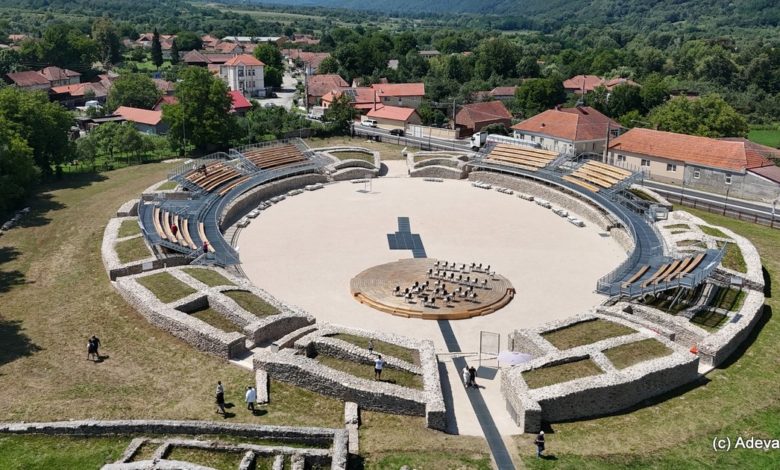
After almost three years in which he was in the conservation and restoration site, the ancient amphitheater in Ulpia Traiana Sarmizegetusa, one of the most valuable monuments in Roman times, was reopened to the public.
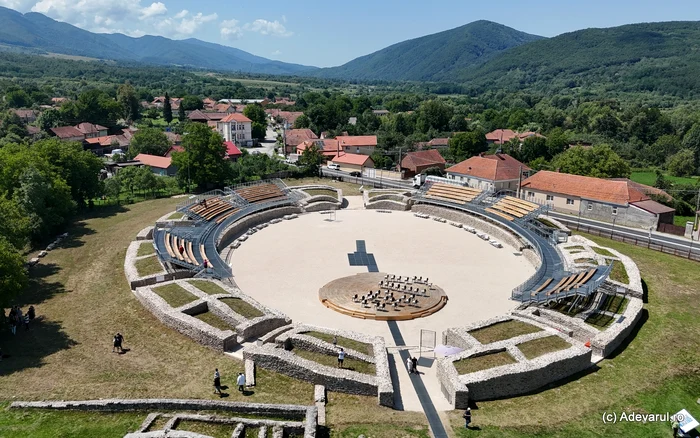
The amphitheater from Ulpia Traiana Sarmizegetusa. Photo: Daniel Guță. TRUTH
The preservation, restoration and enhancement works of the Amphitheater in Ulpia Traiana Sarmizegetusa were received, and on Friday, August 8, 2025, the historical monument, similar to the famous “Colloseum” in Rome, was reopened to tourists.
Will be able to host events
The Roman amphitheater, built at the beginning of the second century in the former antique city founded by Emperor Trajan, was rediscovered in the 19th century, completely unveiled at the beginning of the 20th century and passed through several stages of restoration.
The most important of these began in 2022 and represented an investment of almost five million euros, financed by European programs (ROP 2014-2020 and the Regional Program West 2021–2027), funds attracted by the Hunedoara County Council.
“Our intention was to preserve the ruin and allow visitors, from here to perceive it, to visit it, to have the experience of this space as it was for 100 years. But we have not been limited to conservation, but we added another layer, the one of interpretation. In general, the ruins are not explicit, what is not to be explicit. row, to return to the monument its character of introverted space, returned to the center, to the arena. said the architect Stefan Bâlici, the president of the Order of Architects of Romania.
Amphitheater with metal stands
The project meant the research and preservation of the amphitheater, but also the restoration of its vestiges, the reconstruction of architectural elements, the consolidation of the walls, the arrangement of some tribunes on removable metal structures, the construction of a scene, the installation of an architectural lighting system, as well as the exterior arrangements that facilitate the access and visit of the monument.
Image 1/10:
Ulpia Traiana Sarmizegetusa Photo Daniel Guță Adevărul (49) JPG
The amphitheater will be used for cultural events and shows, its new stands can accommodate up to 500 spectators.
“It is the only archaeological monument in Romania that allows such a recovery of the original function, while maintaining the unaltered character of the ruin. We speak, therefore, of a complex intervention, which contains two main layers: the conservation and the interpretation, respectively.”added Stefan Bâlici, who participated in the project from the beginning, being director of the National Heritage Institute.
The solution of realizing the degrees of zinc -plated metal structure, independent of the historical structure, was accepted by specialists, but has aroused controversy, through the new appearance of the monument. It is a reversible intervention, because, in the case of future restorations, the degrees can be extracted without damages on the historical monument, the architect adds. The works were carried out under archaeological supervision and were approved by specialists in restoration and the Ministry of Culture.
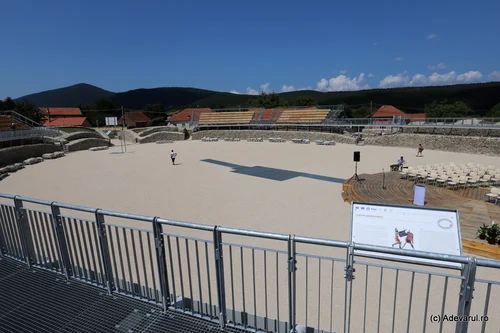
Image 1/11:
Ulpia Traiana Sarmizegetusa Photo Daniel Guță Adevărul (21) JPG
Along with the amphitheater in Ulpia Traiana Sarmizegetusa, several valuable historical monuments in Hunedoara have been restored or are in the site. The Corvin Castle is located in the yard since 2019, being in the second stage of restoration, financed with European funds, the Deva fortress was rehabilitated, the city of town was restored, and monuments from Sarmizegetusa Regia, the capital of the Dacians, are also under restoration.
The emblem of the Roman city
Ulpia Traiana Sarmizegetusa, the former capital of the province of Dacia in the time of Emperor Trajan, is 15 kilometers from Hațeg, and in ancient times the colony stretched over an area of at least 30 hectares.
In ancient times, the settlement was called Colonia Ulpia Traiana Augusta Sarmizegetusa and was the place where many veterans from the troops who fought for the conquest of Dacia. At first the city counted several thousand inhabitants, who enjoyed the privileges of the exemption of taxes and ownership rights on the surrounding fertile lands, historians say.
The city in a quadrilateral form was extended on a large surface that included the current territory of the villages in the surroundings of Sarmizegetusa, and the population gradually increased, up to 20 – 25,000 inhabitants.
The most well -known monument of the ensemble of ancient construction is the Roman amphitheater, a stone and marble building, well preserved, although in the past it has been dismantled by the locals so that the materials from which it was built can be reused.
“Originally built of wood, he was restored in the stone still during the reign of Trajan, acquiring a monumental character. His decoration exalted the recent victory over the Dacians. In front of the entrance was the altar (Grooma), raised on the occasion of the colony and the founding of the province, the whole space, thus a great value,” inform the National Museum of History of Transylvania. The amphitheater was revealed at the end of the 19th century, and has since been through several recovery periods.