In an era marked by the fascination for social networks and for a media platform with bisilabic names, the degradation of the aesthetic sense has become almost a norm. It is reflected, more recently, in the clear interest for the unnatural proximity between works of art and contemporary pseudo or even Kitsch creations.
In the last decade, more and more museums are choosing to expose, in a forced joining, works forming an amalgam of strident and dismaying inadequacy. This dialectical report is addressed to the gaze and mind in the lamentable attempt to stimulate the “dialogue” between artistic currents and epochs. Without denying the gift of art to create links between centuries and people and between an aesthetic vision and another, we can only wonder what bizarre resorts are behind this increasingly widespread kings.
If in certain situations, the decision to intervene using contemporary pedagogical methods is strictly ideological (in a previous article I described an eloquent case), in others it can be able to attract spectators who share the precarious education standards of the curators of the exhibitions or who are only convinced that they discern the art. A horrified scream should end the silence of the museum room. But the reality is between different parameters. It is sufficient to follow, for about five minutes, the reactions of the visitors, to observe that most admire, analyze and enthusiastically photograph the recent exhibits, and not the classic ones. The more the first they move away from art or deepen into kitsch, the greater their satisfaction. The candor he displays becomes a show in itself.
At the beginning of last year, Palazzo Maffei (Verona), which proposes vast art collections from antiquity to our century, ordered the placement of cloths, sculptures and contemporary installations along with the pieces from the permanent collections. As an effect, the gaze was attacked, the mind upset, and the guide ambience of an impossible stylistic confusion. One of the exhibits consists of a set of colorful and transparent plastic tomes, a kind of butaphoric object or article of the species of vulgar decorations from the villas of Instagram states. In another room, a medieval triptych depicting the crucifixion was displayed alongside an aesthetic emotion work, made in 1965. The latter enjoyed the most photos.
In June of this year, the same museum witnessed an unusual scene. A visitor sat on an exhibit signed by the Italian Nicola Bolla. Reproducing the famous chair painted by Van Gogh in 1888, the object has undoubtedly attracted numerous spectators fascinated by the “Feeria” Kitsch offered by Swarovski crystals. cover ad nused Of crystals and glitter, Bolla's creations could be successfully included in the videos of hip-hop singers.
In the famous Piazza Bra from Verona, a few tens of meters from the arena, a medieval editor depicting Holy Virgin, more recently, the proximity of a metal decorative element. Captivated, tourists are photographed in front of this object of a remarkable stupid taste, probably meant to remind them of the existence of Romeo and Juliet. In other words, Verona's millennial architecture becomes irrelevant to those who prefer a contemporary metal.
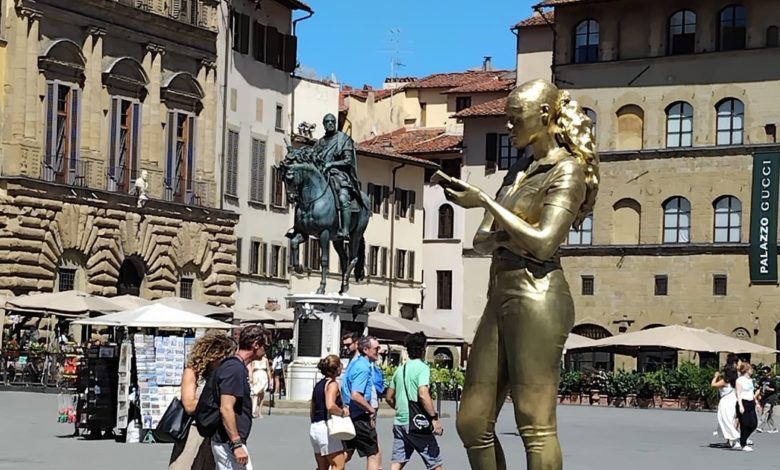
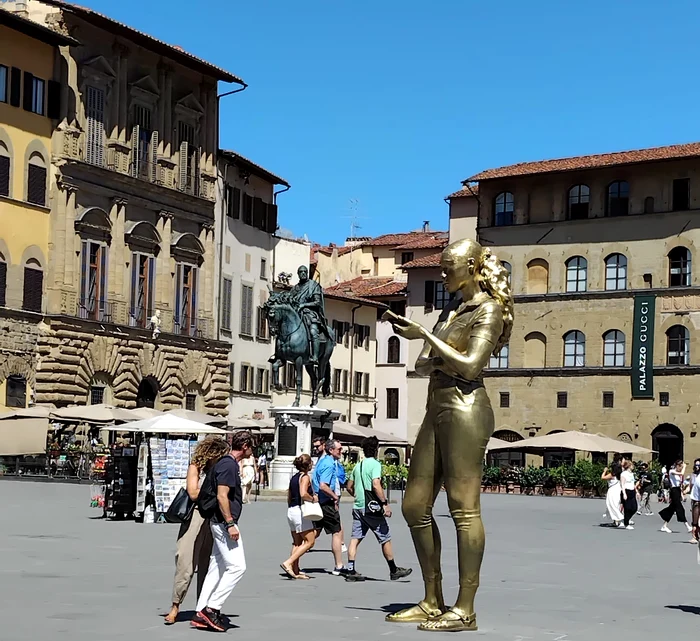
This year, an even known place of Italy is subjected to a cake worthy of a universal kitsch anthology. In Piazza della Signoria, the universe of the harmony of forms and volumes, a look that shakes the being render the improbable relationship between walnut and wall. Product of the mind of British sculptor Thomas J. Price, she is a 4 -meter statue, from bronze, depicting a black teenager who looks at the cell phone. Specialized in statues representing corpulent women, with contemporary physiognomies and clothing, Price says it aims to capture people in ordinary situations. However, an abyss separates him from the gender scenes four centuries and, moreover, from the status of artist. It is sufficient to read the reactions broadcast on social networks to understand the magnitude of the success of this sculptor that volumes with pseudo forms. To expose a creation of it in the middle of a beautiful concentration like Piazza della Signoria is a lamentable act, and the finding that it delights a vast public part can only worry. It is surprising that just Italy, endless land of art and probably the only place in the world in which half a millennium can be admired on the walls of institutions or even ordinary homes, has adopted this grotesque show in recent years.
Of other countries whose museums are also stated by such juxtapositions worth mentioning the United Kingdom. Last year, Tate Britain proposed an exhibition in which, in different rooms (detail, essentially irrelevant), were presented engravings of William Blake, as well as illustrations signed by British painter Chris ofili. Defining the exhibition as “a revealing conversation”, the museum offered visitors the chance to see works by a deconcertent infantilism, in the company of which Blake's famous engravings seemed to be condemned by contamination. If they had been animated, they would probably have blushed by the shame of such proximity or in different rooms. Over time, Ofili has been noted for creations made with resin, beads, glitter and elephant, as well as thanks to a blasphemy painting. Graduate of the institution Royal College of Artconfesses that he discovered Blake's engravings in adolescence and was attracted to “wonderful contours and delicate color use.” The material it produces is, in the best case, worthy of parody.
The reality described opens the path of a bitter reflection. Our era is under the sign of art. To claim that today the kitsch were born and his lovers would be absurd. It is enough to look at many Rococo creations to capture a part of the eternal sap of inadequate aesthetic sense. In the same context, but about the other century, the Literature lover can play, for example, the description of Nana's home in Émile Zola. Today, however, if the walls of the museums support everything, and if many visitors react enthusiastically it is because the appetite for easy entertainment and the preference for the empty forms of content feed a noble noble approach. The brain trained with the flow of images delivered incontinently by advertisements, social networks and media platforms Any colorful or glittering image arouses its interest. A visit to a museum as the evoked ones assures such a spectator not only the aesthetic level, but also the pace of observation that they have learned, on the phone screen, from one video to another, from football to young people, from the role of clothes, from culinary recipes to makeup tips, from the curses to the ideas to the ideas for the ideas for the ideas for the ideas for the ideas for the ideas for intellectual.
Whether or not he suffers from the snobbery that urges him to enter a museum in order to mean the activity into a cultural agenda is irrelevant, as long as it transforms this act into an unnecessary one as visiting a technological institute, in the absence of knowledge or inclination for science.
A few centuries ago, art was the object of pleasure a few privileged. Today, global dissemination, technology and unlimited access to the internet ensures democratization in certain situations it becomes a source of entertainment. And the pseudoara who sometimes accompanies her slides in the territory of artistic infantilism, sordid or periodology. At the time when some people install ionic columns in the salon of their own home, and the electric fireplace knows glory, such preferences are naturally placed in a certain fashionable options catalog.
In order for the exhibits in the museums not to appear as simple articles are needed vocation, knowledge, clinical eyes, analytical finesse, flair for understanding allegory and metaphor and for discerning the religious, mythological or historical, availability, as well as patience, virtues, more and more, The beauty of the authentic forms of expression, allowing the aesthetic vacuum to encompass more and more of the contemporary being. Long under siege, the canon has become the subject of derision, and if it survived, the duty will be duty, provided that it will be less permeable to the manifestations described. Perhaps not a salon of the refused, but a salon of worshipers, alias the realm of kitsch and artistic misses, comprising as many of the objects that were given an inappropriate place in some museums, could now restore the harmony in suffering …
Bibliographic notes:
https://news.artnet.com/art-world/museums-reconsider-historical-collections-2445040
https://www.britannica.com/biography/chris-ofili
https://www.tate.org.uk/visit/tate-britain/display/historic-arly-modern-pritish-at/chris-fili