America in transition: How Donald Trump changes US foreign policy and what does that mean for its allies

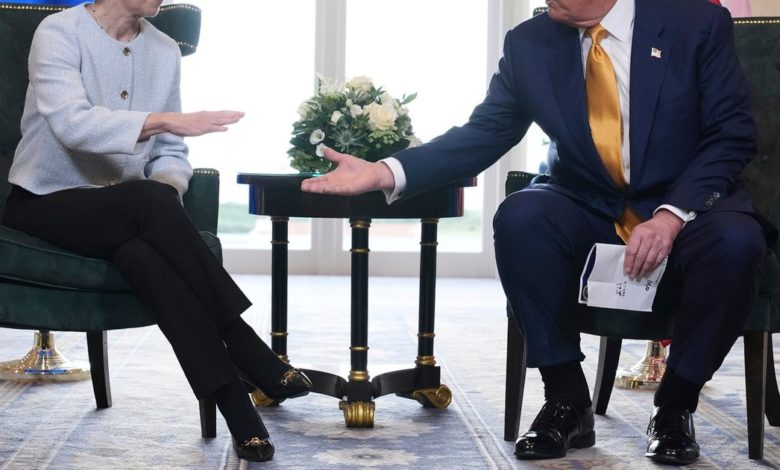
With the return of Donald Trump to the White House, the foreign policy of the United States has undergone a deep change. The volume of international aid has been drastically reduced, and the economic influence of Washington is increasingly used as a pressure tool – even on traditional allies.
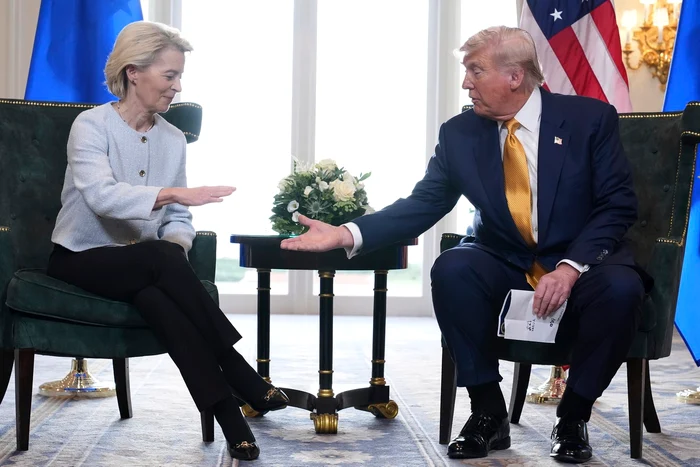
The head of the European Comsia and US President Donald Trump/Photo: EPA.Efe
In just a few months, the global role of America went from the “indispensable nation”, as the former Secretary of State Madeleine Albright called it, to that of its dominant actor, sometimes to the detriment of international stability, I write, for Project Syndicate, Moreno Bertoldi, an associate researcher (to the Italian Institute for the International Institute. Buti, from the Robert Schuman center of the European University Institute.
Instead of supporting the order -based order and guaranteeing the global balance, the new US external strategy is focused on maximizing internal winnings – using all available means: political, economic, diplomatic and military.
An operating key superpower
In their book “Why do nations fail”, economists Daron Acemoglu and James Robinson describe “extractive” institutions as those that redistributes from most population to a privileged elite. The same logic seems to be the basis of the new American doctrine: a superpower that seeks to extract economic value not only from the relationships with rivals, but also from those with its allies.
The Trump administration exploits popular narratives about the supposed US economic exploitation by other states and promotes the idea of a “historical correction” of this imbalance. In a recent speech, the president accused “close and distant” countries, including allies, of “robbing” the American economy, promising firm measures, including customs tariffs and withdrawal from multilateral agreements.
This rhetoric is often exaggerated, but serves the purpose of justifying an foreign policy based on the principle of force. As the French moralist Jean from Fontaine observed: “Force does justice.”
A changing world, an unpredictable America
Many world leaders, especially from Europe, seem to underestimate the extent of Washington transformations or refuse to accept that the rules of the game have changed. But recent decisions – from reducing development aid to imposing new conditions for military support – indicates a clear abandonment of the old order.
The cancellation of the USAID, the withdrawal from the Paris Agreement and the World Health Organization, the conditioning of support for Ukraine to access its mineral resources, imposing unilateral rates – are all symptoms of a foreign policy in which internal interests have absolute priority.
The Trump administration believes that international aid, poverty control or global health support are undue expenses. Thus, financing for the fight against HIV in Africa has been reduced, vaccine deliveries were limited, and asylum policies have been restricted.
Against the background of a regressive climatic policy, the US reaffirmed its exit from international climatic agreements, eliminated clean energy subsidies and promoted fossil fuels-all in order to promote internal industries.
A Europe caused to action
Another notable manifestation of this change was the US attitude within NATO. The request for the allies to increase the defense expenses to 5% of the GDP, without a common analysis of the real security needs, is perceived as a pressure exercise, especially given that most of the military equipment come from the United States.
This approach risks transforming traditional alliances into unbalanced commercial relations, in which Europe pays to maintain access to Washington's security guarantees.
Regarding Ukraine, the United States recently conditioned military support for assuming favorable commercial agreements to American companies, and continuing the aid depends to a greater extent on the financial involvement of European states.
From global leader to unilateral actor
In terms of trade, the Trump administration promotes a vision of “zero -sum game”, where any winners are regarded as a loss for America. The new package of tariffs, which will enter into force in August and will affect dozens of countries, is a new expression of this principle.
Even if it promises reindustrialization of America, this policy risks disrupting global supply chains, affecting emerging markets and feeding internal inflation.
A new role for Europe?
In the context of US withdrawal from its traditional role as a guarantor of the international order, the European Union has the opportunity – and responsibility – to promote an alternative: a multilateral, fair and sustainable model, the authors say.
The first step could be the cover of the goal left by the withdrawal of USAID, by extending the support programs of the Team Europe initiative. The second step – strengthening commercial partnerships with savings with similar values, to reduce strategic addiction to the US.
An international conference dedicated to the elaboration of a new global framework for fair trade could provide a starting point. In parallel, the ratification of commercial agreements with countries such as India, Australia, Mexico or ASEAN states would demonstrate Europe's commitment to an open and predictable international order.
The model promoted by the Trump Administration reflects a redirection of global resources to US internal interests – a short -term profit potential strategy, but with high -term risks.
In a world in a fragile balance, the European Union plays an essential role to play: to keep the spirit of international cooperation alive and to defend the idea of multilateralism in an era in which America seems to abandon it, urges the authors.