Trojan horse in the Baltic countries. This is how Russia will carry out a hidden attack [OPINIA]

Baltic countries – Lithuania, Latvia and Estonia – have long been struggling with problems related to the integration of significant Russian -speaking minorities with society. These minorities, rooted in Soviet times, are both an opportunity and a challenge for national cohesion and security. Recent geopolitical tensions, especially Russia's actions in Ukraine, caused increased observation of Russian minorities living in the Baltic countries.
In Estonia, the Russians officially constitute about 25 percent. the population, with a significant cluster in the north-eastern province of Viruma Eastern. A similar demographic situation occurs in Latvia, where the Russians constitute about 25.8 percent. population. Lithuania, despite the less numerous Russian minority (about five percent), is still struggling with integration problems.
These communities often maintain language and cultural ties with Russia, which affects their media consumption, and in some cases also political views. In fact, these numbers are twice as high, because in both Estonia and Latvia half of the population is Russian -speaking, associated with the Russian Orthodox church or has a Russian spouse or a relative.
After regaining independence, the Baltic States implemented a policy aimed at promoting national languages and national identity. In Latvia and Estonia, knowledge of the language became a condition for obtaining citizenship, which caused a part of the Russian -speaking population not to have it. This status limits their participation in political life and access to certain social services.
Educational reforms also caused controversy. The decision of Latvia on the gradual withdrawal of education in Russian until 2025 met with the resistance of the Russian -speaking community and criticism of international human rights organizations, which claim that such measures may violate the rights of minorities.
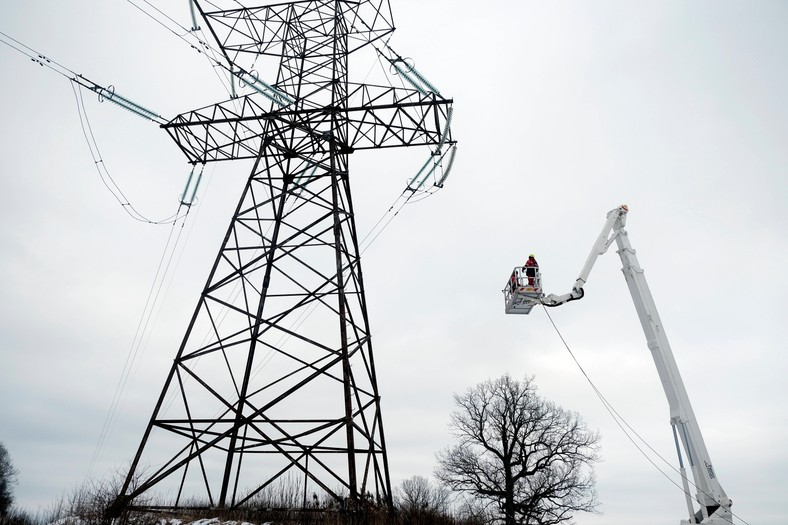
Specialists crossing the power line at the border of Russia and Latvia, February 8, 2025. Baltic states disconnected from the Russian energy network to join the EU and ensure energy security
Russia's actions to date
The presence of significant Russian minorities is now the main topic of security discussion. The Russian doctrine of “protection of compatriots abroad” raises concerns about the potential justification of interference in the affairs of the Baltic countries. There were cases of espionage and disinformation campaigns directed against the Russian -speaking population, aimed at using social divisions and undermining trust in the rule of the Baltic countries.
So far, we have been witnessing rather typical threats and actions that can be summarized at the following points:
- Hybrid war and disinformation: Russia uses Russian -speaking media and telegram to shape opinions in Russian -speaking communities, promoting distrust of Baltic institutions, fueling ethnic unrest and undermining support for NATO.
- Repeating the narrative about being a “defender”: The Kremlin's rhetoric presents Moscow as a defender of Russian -speaking residents, which is a doctrine enabling potential justification of intervention.
- Political espionage and infiltration, politics agents: Latvians, such as MEP Tatiana Żdanok, were the subject of investigation into the alleged connections with the FSB [Federalną Służbą Federacji Rosyjskiej]which raises concerns that the Russian intelligence services infiltrate power institutions through Russian -speaking supporters.
- Sabotage and secret activities, arson in Estonia: setting on the Ukrainian restaurant in Tallinn at the order of GRU [rosyjskiego Głównego Zarządu Wywiadowczego] In January 2025, he shows the use of agents from third countries and Russian informants to destabilize local order.
- Decentralized sabotage network: Russia, through the 29155 unit, recruits marginalized people – including some of the Russian Baltic communities – for attacks on the so -called soft infrastructure [systemy wspierające działanie gospodarki i państwa, np. edukacyjny, zdrowotny, prawny] throughout Europe.
- Coordinated subversive actions and intimidation, pro -region activists: People from Russian -speaking circles were already caught in the Baltic countries in conducting the intimidation campaigns managed by GRU – such as the destruction of Estonian cars of officials and journalists.
- Local threats in Narvo: In this Estonian border city inhabited mainly by the Russians, officials are regularly intimidated and receive death threats in connection with growing tensions.
The Kremlin's new strategy
From now on, however, we will witness completely different events.
- Using civil protests to block infrastructure: Russia trains recruits – including Russian -speaking inhabitants of the Baltic countries – to conduct discrete acts of sabotage and blockades: backfilling of pipelines, blocking roads, and sabotage of objects. Saboters acting as brokers organized coordinated locks of logistics centers, power plants and transport routes, hindering reacting and disturbing the supply chains.
- The use of civil sabotage artists who can easily be discredited: Russian intelligence services recruit people (criminals, migrants, deprived of local rights of residents) through a telegram and social media, promising a small salary (from several hundred to several thousand dollars) for sabotage, surveillance or blocking of infrastructure. These “disposable” recruits carry out attacks using Molotov cocktails, cut cables, block power plants and commit vandalism – it can be easily denying it, explaining that it is non -state activities.
- Attacks on critical infrastructure: Serious acts of sabotage include attacks on submarine cables, electrical substations and transport networks. The Baltic States are already disconnected from Russian energy networks in connection with the increasing files of sabotage near energy infrastructure. Disturbances of transport – energy, sea, railway – cause strategic shocks, hinder military logistics and cause panic in society.
- Local ambushes under the guise of protests: Civil locks, traffic disruptions and rapid protests can cause emergency switching off power plants, airports or border crossings, creating an opportunity for a deeper sabotage or espionage. Such maneuvers are to pretend to be actions on the initiative of civilians, while in reality they are coordinated by the state.
- Strategic risk enhancement: The mobilization of civilians gives Russia the possibility of reliably displacing responsibility for their actions and allows it to strengthen the threat without overt military involvement. For example, blockades and difficulties in the functioning of key nodes – such as power plants or logistics centers – can weaken readiness and put political pressure on governments, especially in crisis situations.
All this is to create a potential justification for Russia interventions in another country under the pretext of protecting their ethnic compatriots.
The number of Russian -speaking civilians in the Baltic countries is growing rapidly and they will be used as tools in the hybrid war: recruited to block, sabotaging and destabilizing key infrastructure under civil cover. These activities can even disturb the functioning of national security services, overload rescue systems and create an excuse for intervention.
It is extremely important, therefore, that local authorities and emergency services a) recognize this new threat, b) are trained to quickly respond to unique situations with civilians instead of uniformed perpetrators, c) provided smooth communication and interoperability between sectors and cross -border cooperation. The enemy is already here, there is no time for the integration process, only for a quick response and managing possible effects.