The “Shuiqiao” landing barges could allow the Chinese army to bypass the strongly defended beaches of Taiwan. A scenario with Horizon 2027?


A new set of satellite images reveals the discrete, but bolder activities of China near its eastern coasts. In the center of attention is a fleet of massive amphibians-a seemingly trivial piece in the military arsenal, but, according to analysts, could play a crucial role in a Taiwan invasion scenario.
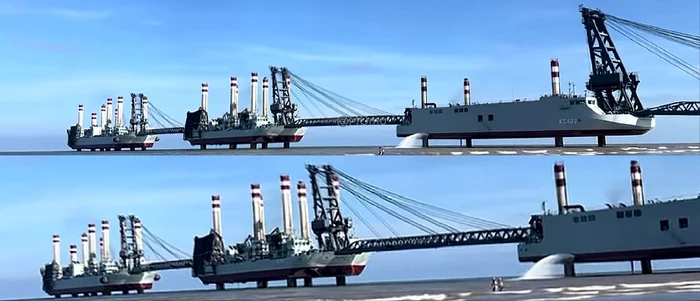
“Shuiqiao” landing barges/ Photo: X
These platforms-suggestively called Shuiqiao (“water bridges”)-were recently observed off the island of Nantian, in the province of Zhejiang, in an area chosen not by chance: the marine relief resembles that of the northeast coast of Taiwan.
According to an analysis published by Naval News and confirmed by images broadcast on Chinese social networks, the barges were built on the naval sites in Guangzhou, by the Company of the Chinese Army. What makes them remarkable is not only the size (over 120 meters long), but the ability to be connected between them, forming a floating bridge capable of transporting armored and heavy combat vehicles from the drain ships directly to the land – thus bypassing the beaches or defended strongly.
The satellite images, dated July 27 and provided by Skyfi, capture three such barges near the island of Nantian, accompanied by a Fujian class power tank. According to MT Anderson analyst, who published the images on the X platform (former Twitter), the barges were in operational testing phase.
A repetition in natural decor: northeast taiwan, in the mirror
According to military experts, the choice of place is not accidental. “The marine relief and the coastline in the area almost faithfully reproduce the shore near the capital of Taipei, especially the Yilan and New Taipei regions, where the defense is weaker and the rough terrain favors asymmetric operations,” explains Bryce Barros, an analyst at the Globsec think tank, quoted by Newsweek.
If these “water bridges” will be integrated into the logistics of landing of the Chinese army, they could allow the rapid development of troops and military technique in key areas, without going through the strongly defended areas.
However, the efficiency of these barges remains conditioned by obtaining air and naval superiority – a recently illustrated lesson in the Ukraine war. In the absence of these conditions, platforms would become light targets for drones, portable missiles or guerrilla forces.
A scenario with Horizon 2027?
Although Beijing insists that unification with Taiwan is “inevitable”, Chinese leaders avoid announcing a clear calendar. However, American officials – current and former – claim that President XI Jinping would have ordered the army to be prepared for a possible invasion by 2027.
In this context, each military exercise, each technical test or logistical detail observed becomes a piece in a much larger strategic puzzle. The development of such amphibious platforms is not only a demonstration of military engineering, but also a signal transmitted – both outside and inside – that the Chinese army refines its capabilities for a possible confrontation in the Taiwan Strait.
An open question: will other rehearsals follow?
The latest images, also distributed by Anderson, show that the three barges – with the identification numbers “Dongong 401”, “402” and “403” – were still near the island of Nantian at the end of July.
If current tests prove to be a success, experts estimate that platforms could soon be integrated into the popular liberation army fleet.