The data of the German statistical office showed the poor condition of the German economy in the second quarter of this year. The result is in line with forecasts and indicates another difficult year with our western neighbors.


In the second quarter of 2025, Germany's GDP was realistically (i.e. after taking into account the increase in prices) lower by 0.1% than the quarter earlier and 0.4% higher compared to the analogous quarter of the previous year (after taking into account the calendar effects and price increase) – Destatis informed. Macroeconomic forecasts predicted a reading of -0.1% KDK and an increase of 0.2% yard.
So we have a quarter of the German economy after the quarter had a growth earlier. This is a return to alternating periods of growth and a decrease in economic activity. In previous quarters, it avoided the so -called technical recession, understood as following at least two quarters of negative GDP dynamics.
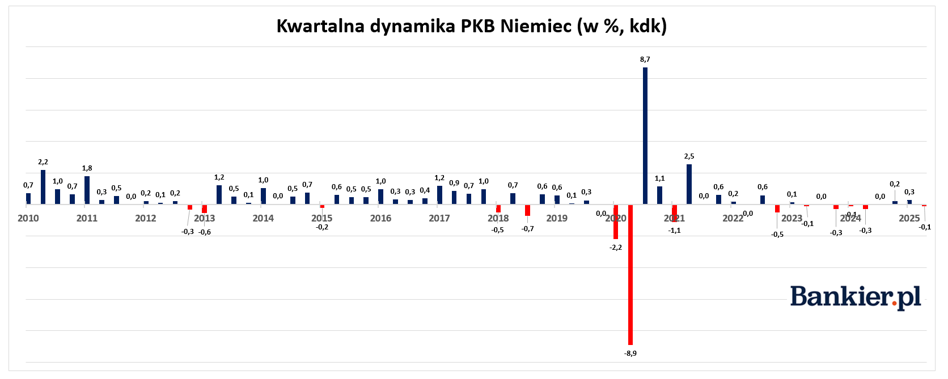
However, Destatis made significant searches, which show that in the first quarter we had an increase of 0.3% (previously an increase of 0.4% was given). In the fourth quarter, the result was changed to an increase of 0.2%, although a decrease of 0.4% of KDK was shown earlier. However, the third quarter of the previous year was to be flat (0.0% KDK), due to a decrease of 0.2% shown after another search. As a result, it can be said that before the second quarter of 2025. From three quarters, the German economy did not fall, and for two it grew.
Advertisement
So much in a quarterly terms measuring ongoing activity, but the annual balance of national accounts, shows that there is a regression and erosion of the euro -euro -euro motor force. In the annual terms, Germany fell in 2024 by 0.2%, after it has shrunk by 0.3% in 2023.
Returning to current data, the decline in the second quarter was expected due to the effect of customs duties introduced by the US. They particularly hit the German automotive industry. For example, Porsche and Audi from the VW group, which do not have production in the US, have recorded a decrease in operational profit in the second quarter by 90% and 64%, respectively.
It is also worth recalling that in the first quarter of 2025 German GDP increased by 0.3%(revision from 0.4%) against the fourth quarter of 2024 (which brought a decrease by 0.2%), which was a better result than expected, after preliminary data (0.2%), mainly due to export and industrial production.
According to preliminary data presented by Destatis, investments in equipment and construction infrastructure were in the second quarter of 2025 lower than in the previous quarter, which reveals that the announced investments have not yet begun. In turn, when taking into account the increase in prices and calendar effects, the consumer expenses of the private and public sectors increased.
“Germans will probably feel the effects of duties more than other large economies and will continue to struggle with problems this year, until the fiscal stimuli begins to revive the economy in 2026,” said Franziska Palmas, an elder economist for Europe at Capital Economics.
Magi in the largest economy of Europe continues. Despite significant changes in the approach to public debt by the new federal government and announced multi -billion expenses for armament and investments in infrastructure, to implement and translate into economic data. Meanwhile, the actions taken by the USA, which relieved its trade relations, immediately began to weigh.
“Wednesday data on GDP” “painfully remind you that optimism itself does not automatically guarantee strong growth,” said Carsten Brzeski, global macroeconomics director at ING.
Although the Germans are to fall better this year than in previous years, it is far from the breakthrough. The International Monetary Fund (IMF) forecasts that the German economy in 2025 will increase by about 0.3%, which is one of the lowest results among the analyzed countries. A similar result, i.e. stagnation, is assumed by the federal government, although it previously counted on the reflection of over 1 percent. The Bundesbank predicts even more modest growth, at the level of about 0.1-0.2%. Long -term growth prospects for 2035 are also low, in the order of about 0.5% per year, including due to the aging of society and the decrease in labor.
The full report for the second quarter will be published on August 22, 2025.