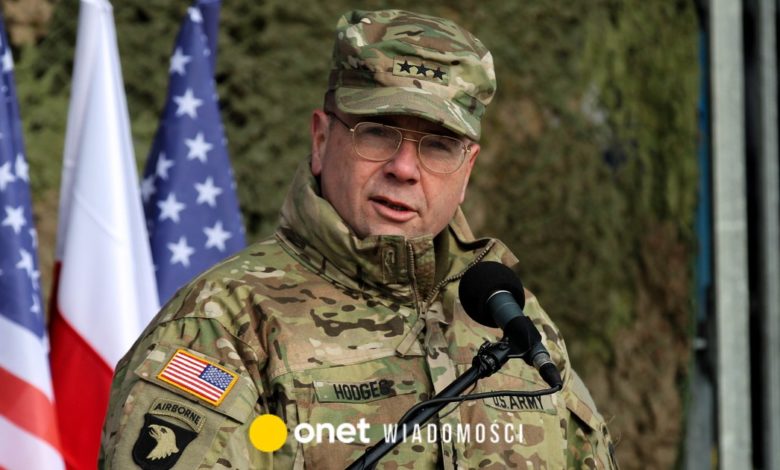
Chelsea Sinieker: Many politicians and military believe that in the next two years Putin can try to test NATO's defense [premier Donald Tusk stwierdził, że do konfrontacji może dojść już w 2027 r.]attacking the Baltic States. How realistic is this scenario?
Gen. Hodges: Unfortunately, I consider it very real – especially if Ukraine suffered a failure or the Kremlin will get the impression that the United States does not fully support Ukraine or that Europe does not work with the necessary determination.
The problem is that Russia is closely observing how shyly we react to its illegal and aggressive actions – for example, to the Sabotage acts in the Baltic Sea, destruction of submarine cables, violation of airspace, illegal tankers [tzw. flota cieni]disinformation campaigns, attacks.
There is currently a fundamental change in the perception of security policy. What is she about?
As long as Russian provocations remain below the threshold specified in art. 5 – that is, they are not an open attack on NATO – we have difficulty reaction. This shyness encourages Russia. The Russians have long been waging a war against us, even if we do not see it. But that's what Moscow thinks. We need to find ways to stop it and prevent further escalation.
There was awareness that the fall of Ukraine would cause a influx of millions of more refugees to Poland, Germany and other parts of Europe. This would be a huge burden – both economic and social.
And although many of my German friends do not like the word “leadership”, the awareness is growing that Germany must at least set a good example – in terms of combat readiness, the defense industry and support for Ukraine. If not Germany, who? The change should leave Berlin.
What message does Germany and other NATO partners currently send to Vladimir Putin?
Countries such as Germany, France, Finland, Poland and Denmark are currently a more definite position than the United States. There is a great uncertainty about Trump in the US – as to his strange relationship with Putin.
But also Biden's administration did not explain that in our own interest it is located so that Ukraine could stop Russia – that Russia would be pushed back to its borders. It was neglect.
Continued article under video material
Trump seems to be only for contracts [gospodarcze] – and not worth a value such as sovereignty, international legal order or freedom of navigation. In Europe, however, the image is more clear – it is known who is the aggressor and what to do to defend the international order based on the principles, which we all use.
There are also fears that China can try to attack Taiwan and attach him – and at the same time as possible Russia's attack on Europe. In this case, how will the US armed forces separate their military abilities? And in what situation would Europe find itself then?
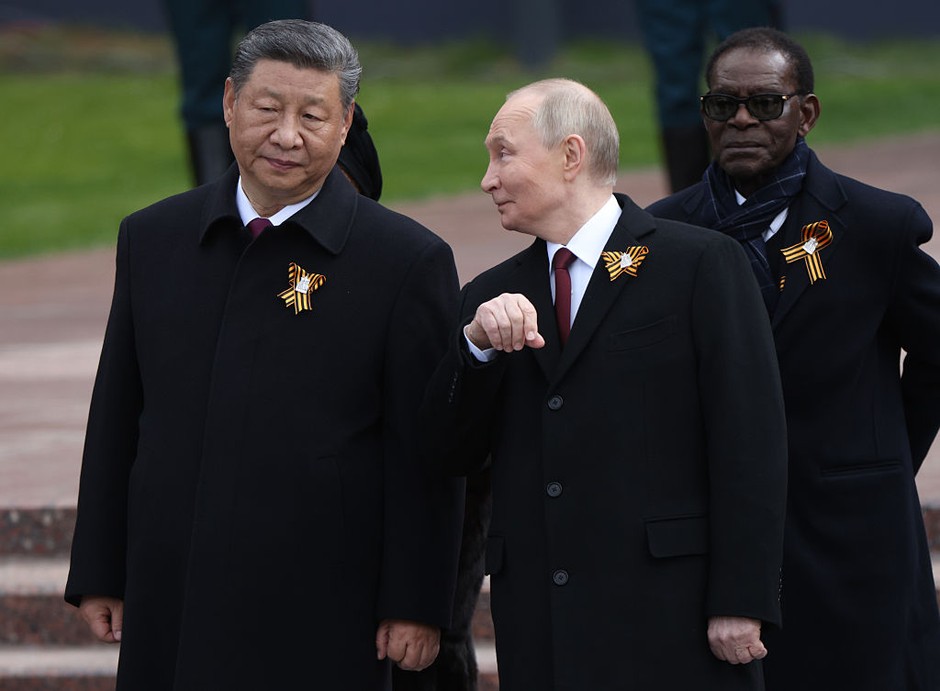
I assume that Russia and China – if they actually start large -scale operations – they will not do it together, but at least in a coordinated manner. Just to create this dilemma for the US and their partners.
Chinese leader XI Jinping and Russian President Vladimir Putin (illustrative photos)Contributor / Getty Images / Getty Images
The fact is that the United States does not have so many soldiers in Europe. In total, it is about 80 thousand. soldiers – including land forces, navy, air forces, permanent forces and rotary troops. This is enough to fill the FC Bayern stadium in Munich.
However, the abilities we have in Europe are not necessarily those that would be needed in the Indo-Pacific region. In the case of some issues, such as satellite diagnosis or special forces, there would be difficulties, because these resources would be concentrated in the Pacific. That is why US rule – long before Trump – demand from their European allies to be able to scare Russia even without the strong presence of the USA. Of course, nuclear deterrence remains in force.
However, this is less important in conventional areas. That is why it is so important for Europe to have the necessary abilities itself – and that Moscow sees that Europe is ready to stop Russia if necessary if the United States was occupied in the Pacific.
“War is not a business”
If you still commanded American troops in Europe today, could you sleep peacefully because the way of thinking about security policy in Europe is changing? Would there be things that would still keep your night sleep?
I think that no commander never sleeps really calmly – combat readiness is a continuous task. This is not a goal that is achieved once and for all – it is a state, almost an attitude. I would still wonder: do we have sufficient air and anti -cancer defense to protect our sea and air ports? If Russia really wants to attack NATO, it will deliberately hit our transport infrastructure – because Moscow knows how much NATO is about quickly moving meals.
Ports such as Bremerhaven or Wilhelmshaven would be under fire, just like the Ukrainian cities today. Cyber attacks should also be expected to do this infrastructure. I am also worried about mobility in Europe, which largely depends on the German railway network. And this simply does not have enough bandwidth to transport everything that would be necessary in the event of a crisis.
And then there is a question that constantly appears in the news: do we have enough ammunition reserves – all types of ammunition? Meanwhile, no one wants to maintain huge stocks. You don't want to bind capital in wrestling. But war is not a business.
In a crisis situation, surpluses, surplus of production capacity are needed – because you can never accurately predict all needs, and in the fight something is always lost. And the consumption of ammunition during the war is always, always, always higher than the planners assumed earlier.
What do you think is the most important priority for European decision -makers in the field of defense?
This is obvious – combat readiness. Is there enough staff? Does the equipment work? Are soldiers trained and capable of performing their tasks? There is a lot of talk about percentage [Produktu Krajowego Brutto, PKB, jeśli chodzi o wydatki zbrojeniowe] – 2 percent, 3.5 percent – And it is important. But not new equipment is decisive, but the ability of people in uniforms to fill their mission.
So – combat readiness in the first place – and then I would deal with the specifics of air and missile defense.
I’m Ashley Davis as an editor, I’m committed to upholding the highest standards of integrity and accuracy in every piece we publish. My work is driven by curiosity, a passion for truth, and a belief that journalism plays a crucial role in shaping public discourse. I strive to tell stories that not only inform but also inspire action and conversation.