The Oval Office of the White House, polished with Trump gold. The US President asphalted even the emblematic rose garden

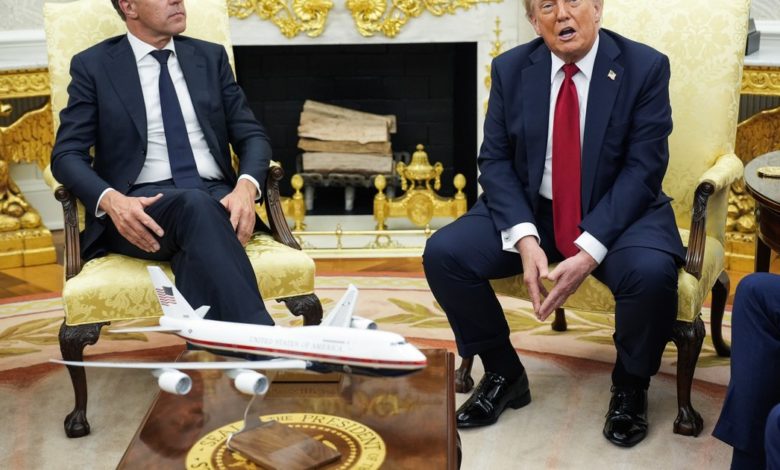
Less than six months after Trump's investment, the reconstituable presidential office looks totally different, reminiscent more and more of the pompous Mar-Lago residence in Florida.
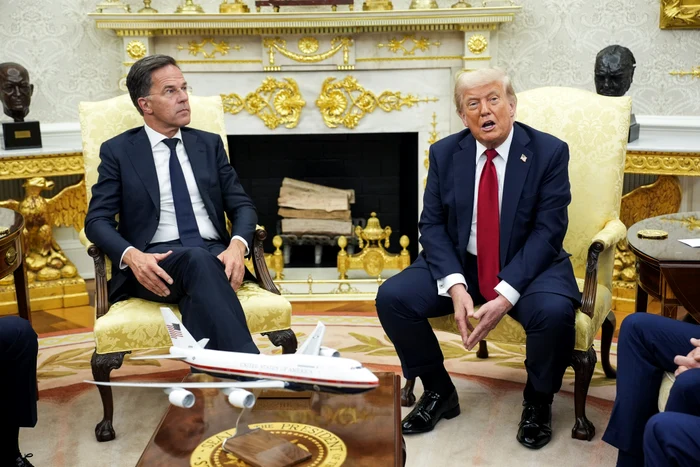
Mark Rutte and Donald Trump in Oval PHOTO Office: EPA EFE
Upon his return to the White House, US President Donald Trump has struggled to radically change the course of American politics and cancel everything his predecessor has done, Democrat Joe Biden, leaving a golden imprint on the walls of the oval office and covering the emblematic garden of rose, the former lady of the US.
A mini versailles in the oval office
Trump never hid his fascination for gold. His great style is immediately obvious to anyone visiting the Florida New York refuge, which was compared to Louis XIV's verses for his richly ornate decor.
Unlike his first mandate (2017-2021), when he installed a new carpet and replaced the red curtains used by Barack Obama (2009-2017) with some golden Biden has, Trump has now gone, EFE notes
Since his return to the White House, in January, he doubled the number of paintings in the Oval Bureau and added mirrors with heavy and gold frames, as well as golden details, on table tops and even on the walls.
Moon after month, the ornaments seem to multiply, and where at first glance it seemed that there is no room for a watermark, a new ornament appears.
The difference is striking when comparing two photos, one with Trump and Biden at a meeting at the White House in November, and another, more recent, during this week's meeting between Republican and NATO Secretary General Mark Rutte.
The ivy that served as a background for important events in the Oval Office for more than half a century has disappeared from the fireplace. Instead, Trump chose what they seem to be golden trophies, to which he recently added a clock, and this gold.
Other notable completions: at the entrance to the Oval Office, hang-in a golden frame-the first page of the New York Post, which presents Trump's record photography in August 2023 in Georgia (South). That year, Trump was photographed and imprinted by the authorities, for his alleged attempt to cancel the results of the 2020 presidential elections in that state.
Goodbye, garden of roses!
Changes are not limited to the famous oval office. In one of the most controversial redecorations, Trump ordered that the rose garden around the Oval Bureau, designed in 1962 by the first lady, Jacqueline Kennedy, to be paved.
The intention of the Republican is to facilitate the development of events in this emblematic space, about 40 × 20 meters, surrounded by roses.
At his order, two 30 meters high masts were installed to lift large American flags, financed from their own pocket.
Trump also ordered the cutting of an emblematic magnolia planted during the mandate of the seventh president, Andrew Jackson (1829-1837), claiming that the tree was sick.
In a decision that made the population by surprise, the US president hanged a portrait on the wall where until recently a portrait of the former US lady, Hillary Clinton, as part of the collection of paintings with presidents.
Trump has announced that he wants to build a ballroom at the White House, similar to the one he has at Mar-A-Lago, with an estimated cost of about $ 100 million.
Controversies on redecorations
These controversies are not a novelty, according to Stewart Mclaurin, the president of the Historical Association of the White House, who notes in his essay “a constantly changing white house” that the edifice has undergone major changes from its 1792 construction.
The renovations ordered by President Thomas Jefferson (1801-1809) and Andrew Jackson, who added the colonies and northern veranda-now emblematic-of the building, were criticized for their extravagance and cost.
As an irony, the redecoration thought by Jackie Kennedy was considered elitist at the time. The former president Richard Nixon (1969-1974), who transformed the indoor pool of Franklin D. Roosevelt (1933-1945), did not escape the accusations.
Despite the critics, “”Many of these changes have become an integral part of the identity of the White House“,”which it would be difficult for us to imagine today without these extensions and completions ”, concludes Mlaurin.