The former city of the glass, revived by highways. His palace was once called the “Eden of Transylvania”


Two highways in the construction site could be renamed one of the small historic cities in central Romania. Located 25 kilometers from Sibiu, Avrig is a gateway to the Făgăraș Mountains and the Olt Valley, but it suffered from the industrial decline.

Brukenthal Palace in Avrig. Photo: Daniel Guță. TRUTH
Avrig, a small town in the vicinity of Sibiu could take full advantage of the construction of the two highways that will be connected near it.
The town close to the highway knot
The Sibiu-Pitești Mountain Highway, part of the A1 Bucharest-Nădlac highway will pass 15-20 kilometers from Avrig.
The closest road knot of the 122 kilometers highway is located in Boița, where the first section of the route is over – the 14 kilometers between Sibiu and Boița, open to traffic in 2022. Recently, the Curtea de Argeș – Pitești section, of 30 kilometers, was completed. Three other sections, which will cross the Olt gorge, between the localities of Boița and Curtea de Argeș, are in the site and have a deadline between 2027-2028.
“This highway (section of the A1 highway), built through European funds, is the first to cross the Carpathian Mountains and will ensure, on the territory of Romania, the connection on the East-West axis (Constanța-Nădlac). Currently, there are still three sections of this highway, between Curtea de Argeș and Boița, which have a length of 78. inform the Ministry of Transport.
Sibiu Highway – Făgăraș A13 (Video, Avrig yard)with a length of almost 70 kilometers, will pass on the outskirts of Avrig.
All four sections were contracted, but the works started only on two sections: Avrig – Arpașu de Jos (20 kilometers) and Arpașu de Jos – Sâmbăta de Sus (18 kilometers). The works on the new highway, which will pass at the foot of Făgărașului, climbing on the Olt Valley, will have to be completed until 2029, according to the Ministry of Transport.
The tradition of glass, centuries -old
The city of Avrig, from Sibiu county, has about 12,000 inhabitants and is visited by tourists for Valea Avrigului, a picturesque area at the foot of the Făgăraș Mountains, where in recent years, numerous pensions and leisure places have been built.
In the last two centuries, the economy of the city has largely based on the operation of its glass factory, attested since the seventeenth century, according to historians.
In the last years of the Ceausescu regime, almost 1,500 people worked at the Glass Factory in Avrig, and for workers had been built several blocks of housing and homes.
“At the Avrig glass there are over 400 assortments of products each month, most of them export in 12 countries of the world. They have become traditional contracts with companies in the US, RFG, Switzerland, England, and more recently, from Japan. At the same time, 98 apartments have been built, a 300-seat youth,”the factory representatives reported in 1989.

Image 1/34:
City Avrig Photo Daniel Guță Adevărul (53) JPG
A few blocks of reduced comfort and former dormitories of unfamiliar, located in the vicinity of the factory bankrupt in 2022, now offers a bleak view, in contrast to the historical buildings of the city.
Brukenthal Palace, the historical emblem of Avrig
In the center of Avrig, the Palace with Baroque architecture, erected two and a half centuries ago, keeps the story of one of the remarkable personalities of the past of Transylvania.
The Brukenthal Palace was built at the end of the eighteenth century and was used as a summer residence of the former governor of Transylvania, Samuel von Brukenthal (1721-1803), an emblematic figure for the Saxon community and a historical character appreciated for his cultural contribution.
“Towards the middle of the eighteenth century, a Transylvanian Sas became a counselor of Empress Maria Terezia (1740-1780) and also the highest civilian official in native Transylvania. Brukenthal's name is also mentioned in relation to his considerable collections, which, together with the rest of the property, he left the High Sibiu High Sibiu Museum. which contains a very valuable library, later enriched by donations, is still the richest collection in Transylvania “, informs the authors of the volume” Transylvanian Saxons: historical landmarks “, published by the Union of Transylvanian Saxons (USA, 1982).
In the past, surrounded by a garden, an orange (orange greenhouse) and a dendrological park, the Brukenthal Palace in Avrig is the dominant building of the summer residence of Baron Von Brukenthal.
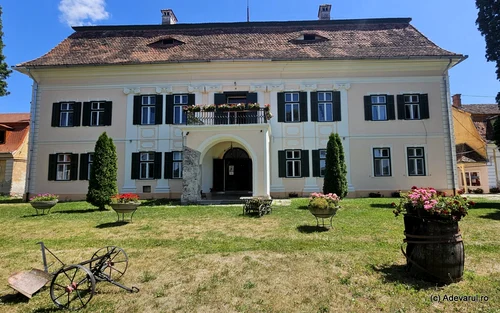
Image 1/14:
Brukenthal Palace, the city of Avrig Photo Daniel Guță Adevărul (96) JPG
“It is a wonderful and historical place that was once considered the Eden of Transylvania and has the form of the Schönbrunn Palace in Vienna, because it was designed by the same architect at that time. The palace is a miniature, seven times smaller than the original.”shows the administrators of the palace.
The historical ensemble was partially restored and rendered to the public of 2011, after, in the decades after its nationalization of 1948, when for a long time it was used as a sanatorium, it had become in an increasingly degraded state.
Avrig was also the birthplace of the scholar Gheorghe Lazăr (1779-1823), considered the founder of modern education in Romanian in the Romanian Country. In 1818, Gheorghe Lazăr opened in Bucharest the first school with teaching in Romanian, at the Saint Sava school. Its place of forever is in the courtyard of the old Orthodox Church of the city, and in its vicinity is the museum dedicated to it.