What does Donald Trump play about customs? “He doesn't try to confuse mindlessly”

In May, the first full month after the entry into force of the customs, the export of the United States fell. Even despite new records on the stock exchange and better data on employment, the mood of consumers and American enterprises remain pessimistic.
Trump does not bother.
“We can do what we want,” said the president last week about the Tuesday date when countries must conclude contracts or face new duties. – We can extend it, we can speed it up. I would like to speed up him.
This ambivalence was a characteristic feature of the last three months of negotiations, during which world leaders were in a hurry with the conclusion of agreements to avoid duties of 20 to 50 percent, which in many cases meant a real trade blockade. This emphasizes the important tension in the second term of Trump: the president's long -term propensity to apply duties interferes with his reputation of a clever negotiator.
Foreign officials, trade experts, legislators, and even some allies of the White House expressed nihilistic views on the July date, questioning the sense of agreement with the Trump administration, taking into account the president's propensity to use duties as a means of pressure to achieve his goal.
– Trump knows that the most interesting element of his presidency are talks about duties – admitted anonymously a person closely associated with the White House, who is familiar with trade negotiations. – It's hard for me to believe that it will be so easy to give up. It is all false. There is no date. This is only a symbolic point in this theater staging and we are at this stage – she added.
Wednesday's announcement by Trump by the preliminary commercial agreement with Vietnam was a good example: while Trump announced new customs rates for this country on Truth Social, the design of the statement to be issued by the United States and Vietnam, emphasizes that the agreement is still under negotiations.
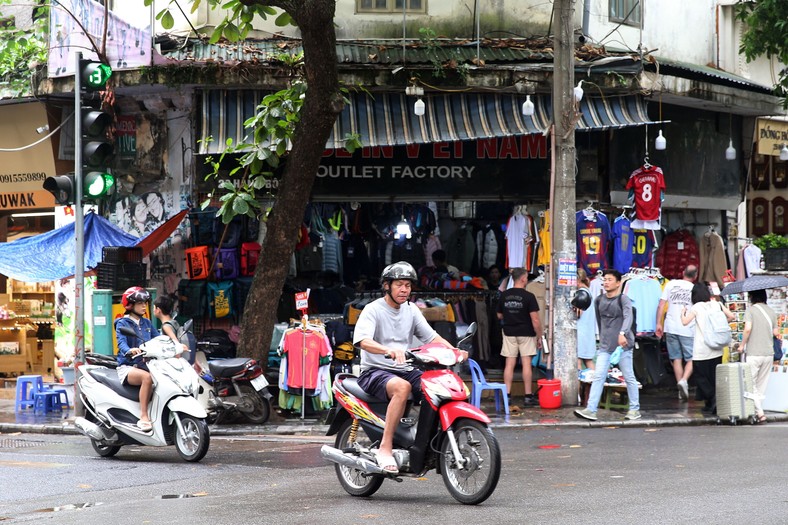
The “Made in Vietnam” store on the street in Hanoi, Vietnam, July 3, 2025.
Crazy race and confusion
Since the announcement of the plans of the historical increase in American duties during the event in the Rose Garden on April 2 – which the White House hailed the “Day of Liberation” – Trump is trying to play on two sides in terms of commercial contracts.
His administration seems fully involved in the policy of customs, maintaining a basic rate of 10 percent. For almost all trading partners. He also imposed higher fees on some sectors, such as car and car parts import, and the next ones are to take place as part of reshoring, national security protection and obtaining new income.
In the meantime, three commercial negotiators – Treasury Secretary Scott Bessent, Secretary of Trade Howard Lutnick and USA commercial representative Jamieson Greer – began a crazy race to conclude many contracts with the rule of other countries, without the right to significantly reduce new barriers.
As a result A complicated process was created, which did not bring any progress and is endless. The countries sent their representatives to the United States for multiple negotiating visits, but some did not even manage to get matches. Those who talked to Trump officials sometimes left the meeting confused as to the demands of the United States or later witnessed Trump's criticism of their countries in social media.
Even in the face of the upcoming Tuesday term, the White House and the closest associates of Trump send contradictory signals as to the importance of this term. Both Bessent and the Director of the National Economic Council Kevin Hassett disseminated information on the Capitol and on television that the president would probably extend the deadline, even if Trump himself ruled out this possibility. “I think for a labor holiday [1 maja] We can finish commercial negotiations, “Bessent said last week by Maria Bartiromo from Fox Business.
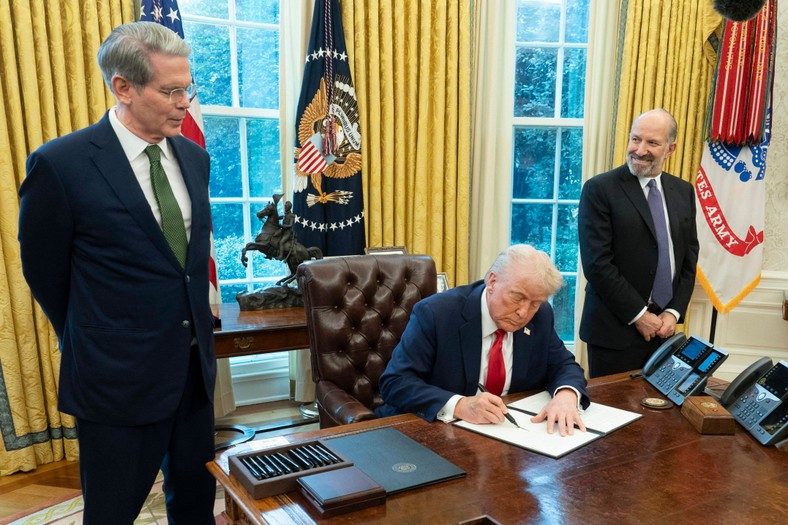
US President Donald J. Trump while signing decrees in the Oval Office of the White House in the presence of the Secretary of Treasury Scott Bessenta (L) and Secretary of Trade Howard Lutnicka (P), Washington, USA, February 3, 2025.
Trump's “very clearly defined goals”
The White House advisers privately emphasize that Trump seriously treats the date of introduction of duties and the conclusion of agreements. They admit, however, that the conclusion of an agreement with the country, which they currently perceive as a commercial imbalances seeking to correct, does not exclude that the president will impose duties on this country in the future for reasons not related to trade, as he did in the case of centers at Fentanyl from Canada, Mexico and China.
– It should be assumed that he treats it as a game – he is the president of the United States. He understands what's going on. He does not try to mindlessly sow economical confusion only for viewership on television – said one of the officials of the White House, which, provided that anonymity has been shared by the president's thoughts. – He understands what he is doing and has very clearly defined goals.
The Japanese Minister of Trade Ryosei Akazawa visited the United States almost every week in June. However, shortly after his journey last weekend, Trump wrote on X that he did not believe that Japan would be open to a rice agreement, and threatened to send her a letter with information about duties, which she will have to pay for export to the USA – potentially even 35 percent, i.e. more than 24 percent. The rate that the country paid as part of the “mutual” duties, which the president suspended in April.
In recent weeks, Trump has repeatedly suggested sending such letters to other governments, hinting that he was fed up with commercial negotiations and would simply prefer to impose duties on US trading partners, informing them at the same time that they have the “honor” to conduct business in the United States.
On Thursday afternoon, Trump told journalists that “probably” from Friday he would start sending up to 10 letters a day, informing countries “how much will they have to pay for doing business with the US”.
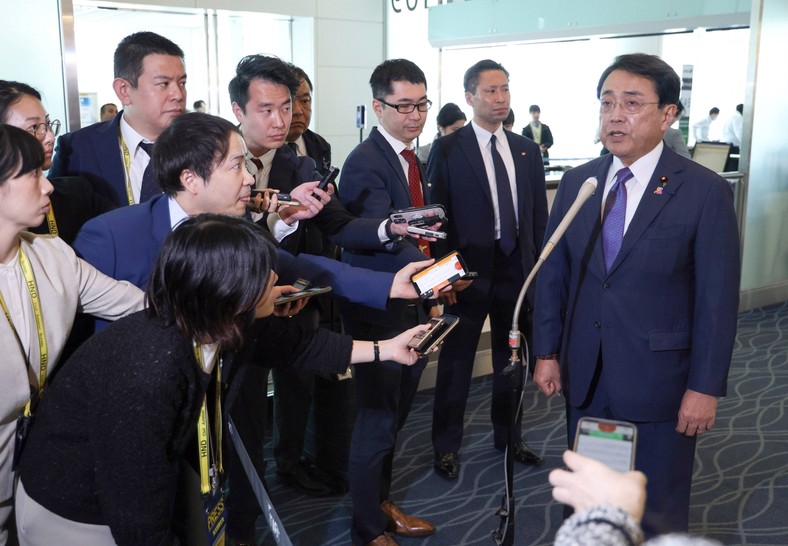
The Minister of Economic Navigation of Japan Ryosei Akazawa (P) before departure to the United States at Haneda airport in Tokyo, Japan, April 30, 2025.
Vigilance and warning
Such a plan seems similar to its original introduction of mutual duties, which were suspended after panic among entrepreneurs and investors, which caused drops on the stock exchange and an increase in interest rates.
Wendy Cutler, vice president of the non-profit organization Asia Society Policy Institute I was a negotiator at the United States Trade Representative Office during the Obama Administration, said that she was expecting an avalanche of contracts in the coming days, but she warned:-Everyone is vigilant because of these contracts and the agreements themselves will not necessarily mean that you will be protected from the closes-he says.
– You can just do something that irritates Trump, and he can [wtedy] threaten more duties – added Cutler.
In addition to Vietnam, the White House announced that he was close to the conclusion of an agreement with India. In recent weeks, many sales representatives have arrived in Washington to negotiate an agreement, and the European Union, which Trump once accused of delaying negotiations, seems to be prone to significant concessions to conclude an agreement.
Endless story
Mark Diplacido, who worked in the office of the United States Trade Representative during the first term of Trump, said that In his opinion, Trump will threaten one -sided duties until the deadline. However, he finally wants agreements He added.
– I think that the president hopes to reach an agreement and obtain concessions that he expects from these countries – and is ready to come from negotiations or suspend them to obtain these concessions – said Diplacido, currently a political advisor at the American Compass, Think Tank supporting economic populism. – Ultimately, however, in most cases he cares about real agreement. If it was only about sanctions, the deadline would not be extended by 90 days.
However, the announced agreements will not be full -fledged double -sided trade agreements that require approval by the Congress. It seems that this process takes place similar to the first framework agreement introduced by the administration in May with Great Britain. Instead of refining the details, the parties agreed on specific conditions for the purchase of tariff goods and quotas and decided to continue talking about some more difficult issues, such as British taxes on digital services and agricultural barriers.
– Even if the contract is concluded, the negotiations will last. These are framework contracts. They are not final – said Everett Eissenstat, a trade advisor at the White House during Trump's first term.
– In a broader perspective, the president is heading in the desired direction, i.e. towards greater reciprocity, as well as higher basic duties – added Eissenstat. – It will be a bit of a bumpy way, but ultimately the president is achieving progress.
– You have victory. Use them – said a person close to the White House, when asked about the advice she would give to the US president. – [A wy] You just have to assume that he does not want to use them because he likes this game too much – he added, referring to the negotiating duties.