The Turkish drone Bayraktar returns to the foreground. Ukraine hits with her the Russian Fleet of the Black Sea

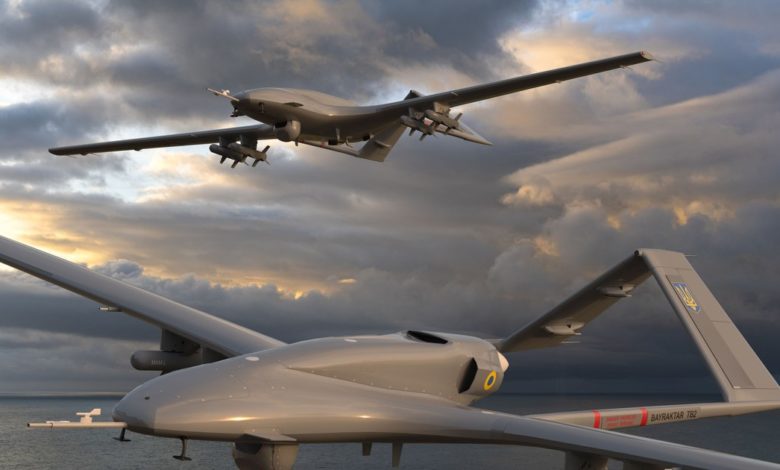
After a period of operational silence, the Bayraktar TB2 drones – a symbol of the first months of Ukrainian resistance – return to the active arsenal of Kiev, with a new mission: the targeting of Russian war vessels near Crimea, writes Euromaidans.com.
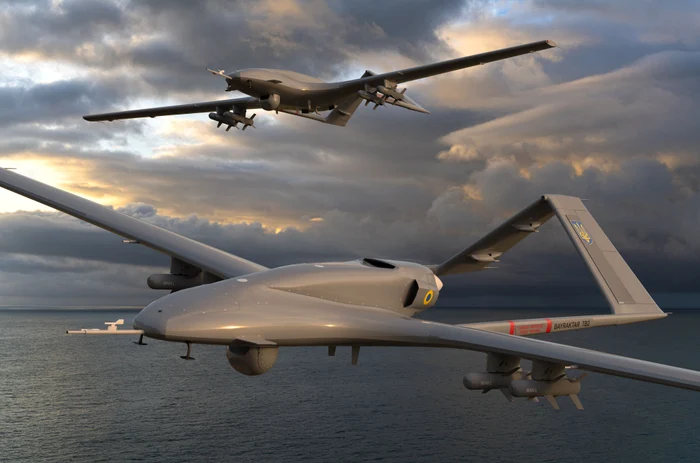
Drone trucești Bayraktar/photo: Archive
The resumption of the use of these drones comes against the background of significant evolutions: Ukrainian factories now produce over 120 units, thanks to a consolidated partnership with Turkey. In parallel, Ukraine has managed to significantly weaken the Russian aerial surveillance and air defense networks – an essential precondition for relaunching risky air operations.
The recent past: a symbol that has become vulnerable
At the beginning of the Russian invasion, the Bayraktar imposed as one of the few weapons capable of destabilizing the Russian moving formations. However, as Moscow strengthened its anti-aircraft defense, the visible radar signature of the drone became a disability. Ukraine was forced to withdraw them from the first line.
Today, the conditions have changed. The local production capacity and systematic degradation of Russian defense opens a new operational chapter.
Attacks on oil platforms and landing vessels
A recent record shows how more Bayraktar TB2 hit Russian boats near the tendrivska liman, in the context of an attempt to land on Russian forces on strategic islands. The attack was not unique: Ukraine extends these operations to the oil platforms, previously captured by the Russians and used as supervisory stations and signal relaunch for drones.
For both camps, these platforms became nodal points-a land played repeatedly, with the control changing from one week to another.
Western support and combined tactics
Western support is not only political or economic. Regular flights of British RC-135W recognition aircraft in western Crimea indicate a complex coordination, meant to provide Ukraine with real-time information. On the ground, these data are used by Bayraktar operators, who can react quickly and targets precisely.
Russia counterattacked through a combination of lancet drones and zala recognition platforms. However, according to Russian analysts, the efficiency of this system is limited to the rapid Ukrainian boats, now equipped with electronic jams and even improvised soil-air missiles, capable of breaking drones or even enemy aircraft.
Operations on Russian air defense
A turning point in this operational puzzle recently came, when the Ukrainian army information direction performed a precision of a Russian S-400 complex. The essential radars 92N2E and 91N6E, as well as a missile launcher were destroyed. This attack “opened the sky” above the West Crimea and the Black Sea, allowing the resumption of air incursions.
In an immediate movement, Ukraine has launched two non-actual missiles on a Chornomorske Special Naval Forces base, causing major damage.
The Russian fleet withdraws, Crimea becomes vulnerable
Against the background of these pressures, the Russian commanders withdrew much of the fleet from the contested waters, transforming it into a symbolic presence. In a gesture that betrays despair, the naval armament is disassembled from the ships and transformed into fixed laps on the shore-a solution that brings with the improvisation of a trenches defense than with the doctrine of a naval superpower.
A strategic plan that takes contour
Control on offshore platforms provides Ukraine a double advantage: extensive surveillance capacity and advanced bases for future attacks. A coherent plan is outlined, in which the blows on the anti -aircraft defense create color for air and bolder naval operations.
Bayraktar's return is not just a symbolic return. It is the sign of a refined strategy, in which Ukraine no longer fights to resist, but to regain key territories-meter by meter, island with island, platform platform.