What is a 0 km car, sold as a used car? The hallucinating tactics used by the Chinese, to manipulate the car market

Cezar Titor article – published on Saturday, June 28, 2025, 00:56 / Updated on Saturday, June 28, 2025 00:57
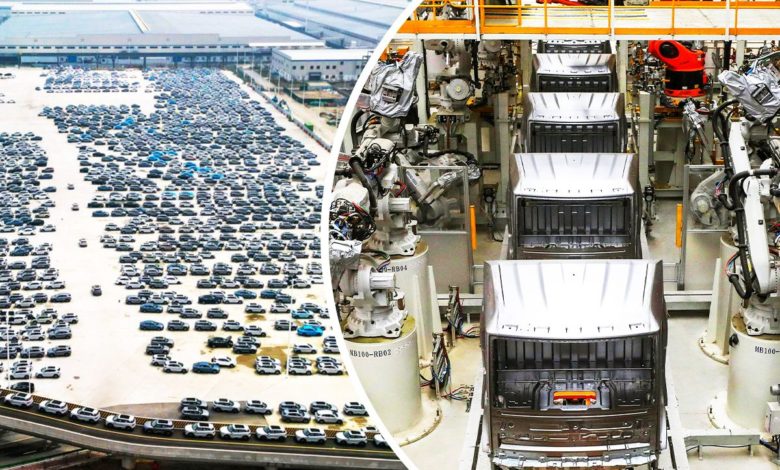
In recent years, Chinese car producers have announced spectacular sales of local brands, presenting these figures as a clear proof of the success of the national auto industry. However, an investigation conducted by Reuters reveals the unseen face of these statistics: a well -developed system by which the reported increases are, in fact, artificially inflated, masking the truth behind a market under the pressure of overproduction and fierce competition.
The Chinese car industry has found an ingenious but controversial way of maintaining its growth rate: By registering new cars directly from the production line as “second-hand” and their export to foreign markets such as Russia, Central Asia or the Middle East.
Although these cars have not taken any kilometers, they appear in statistics as used vehicles sold, which allows producers to report larger sales and get rid of hard -sales selves.
This phenomenon, supported by the local authorities for various reasons, reflects the increasing pressures of an industry in a fragile balance between production and demand.
“It is the result of a prices war that lasts almost four years”
Byd, Chery, Saic, Geely, Gwm (Great Wall Motor), Dongfeng, Faw, Nio, Xpeng or Leapmotor are among the most important car exporters in Chinaoffering much cheaper alternatives compared to markets in Europe, North America, South Korea or Japan, their big problem, noted by many of the specialists being, in fact, their reliability, which is why there is some general reluctance in purchasing a “second-hand” car in the region.
“Is the result of a pricing war that lasts almost four years and has made desperate companies to record any kind of sales”You, the founder of Sino Auto Insights, said, a consulting firm based in Michigan.
The practice drew attention at national level only after the director of the Chinese car manufacturer Great Wall Motor criticized, in May, the sales of zero -kilometers inside China.
On June 10, the newspaper People's Daily also condemned internal sales of such vehicles, considering them responsible for lowering prices in a market already suffocated by a prices war.
The publication, often reflecting the position of the Chinese Communist Party, asked “Hard regulatory measures to restore order“, Notes Reuters.
Why do Chinese car producers resort to these practices?
In this regard, the reasons can be multiple:
-
In many of the countries where China exports, A SH car is easier to import than a new one (lower charges).
-
By registering cars as “sold”, Manufacturers can report spectacular growthwhich grow by itself the image and attractiveness in front of potential investors.
-
China produces more than it can consume the internal market, so it does to get rid of overproduction. The stocks of cars that are very difficult to sell are exported as SH, which maintains the production of active factories.
-
Artificial growth of the local GDP, the local governments, which tacitly support the respective practices, being subject to the pressure to deliver economic growth.
-
The Chinese state has not regulated or prohibited this practice!
690,000 carsHe exported China in May 2025, registering an increase of about 17% compared to the same month last year.
Regional authorities encourage practice!
“The export and selling of used fake cars are actively encouraged by China regional governmentsaccording to a Reuters analysis of state press reports and government documents. Local authorities have embraced this practice as essential for achieving ambitious economic growth objectives imposed by Beijing ”, notes the source.
Chinese local authorities practically encourage the export of new cars registered as SH to meet their financial goals. The cars go directly on the production line, are registered in China as sold, then exported as goods to the second hand.
The result? The producers can report higher sales, which leads, as I wrote above, to an artificial growth of the gross domestic product. In some of the state regions, tax reductions, logistical support for exports are offered.
Local governments in China support the export of “second-hand” cars with zero kilometers in several ways: It simplifies the documents, offers additional odds for registration and provide free warehouses near borders or ports.
For example, in February 2024, the city of Shenzhen, one of the richest in China, announced that it will expand this type of export to reach the goal of 400,000 vehicles exported to the year.
And the example is not one: Guangzhou or Zhengzhou practices the same things.
“Because these export companies buy and sell the same car, the transaction value is double compared to new or second-hand car purchases, so the local authorities are trying to attract them to open their business to rapidly and artificially increase the figures of GDP,” said two directors in the Chinese car industry.
– Reuters
Photo gallery. Byd, the leader in the export market, builds a giant factory in China
Concern among countries that export cars from China
2019 is the temporal landmark of the beginning of practice, being the moment when China allowed the export of used cars for the first time to other countries. Since then, thousands of traders have been involved in this system, in which new cars are sold to be “used”, in order to be exported, according to Wang Meng, consultant of the Association of Car Dealers in China.
Of the 436,000 “second-hand” passenger and commercial vehicles exported by China in 2024, it is estimated that about 90% are, in fact, zero-kilometer cars, Wang said.
The expansion of this phenomenon supplies the fears that China “throws” its subsidized vehicles on the external markets, at a time when Beijing is desperately trying to find export markets outside the United States, where customs tariffs have increased significantly, according to Donald Trump's regulations.
-
The US administration, under the leadership of President Donald Trump, has decided to impose an additional 25% tax for imports from the car sector.
-
The new rates entered into force on April 2, the date Trump described as the “Day of Liberation”. This represents a protectionist promise in the election campaign passed the Republican President. Donald Trump invoked a 1962 law to be able to increase taxes on any vehicles or car parts coming to the US.
Some countries, worried that this wave of cars will suffocate local dealers and confuse consumers, have begun to take measures to limit imports. For example, Russia has taken measures in this regard, since 2023.
At that time, the Russian authorities issued a decree forbade the import of “second-hand” cars with zero kilometers from brands that already have official distributors in the country.
A first reaction: “We did not proceed like this”
Tang Zhikun, General Manager of the XPEG International Business Center, said that a large number of new internal cars are exported as so-called “zero kilometers” vehicles in foreign markets such as the Middle East, North Africa and Central Asia, But he denied his practices among his own company.
“We really had more luck, because last year we were very detained and did not do so“Said Zhikun.
Photo gallery. Xpeng P7, the latest model launched by Guangzhou car manufacturer