
An order of the National House of Public Pensions (CNPP) changes the calculation method that establishes the seniority in work, since the employers report the number of working days for which the contribution was paid, while the contribution period in the new pension law refers to calendar days.

The way of calculating seniority is changed to retire
“It is approved Technical procedure for transforming working days into calendar daysin order to determine the contribution period made by the insurances of the public pension system, provided in the annex that forms an integral part of this order.
At the date of entry into force of this order, the applicability of the Order of the President of the National House of Public Pensions no. 59/2014 for the approval of the technical procedure for transforming the working days into calendar days, in order to determine the contribution period realized by the assurances of the public pension system ”, It is shown in the order published on Thursday in the Official Gazette.
The technical procedure for transforming the working days into calendar days, in order to determine the contribution period made by the insurances of the public pension system, establishes calculation formulas for the transformation of the working days into calendar days, as follows:
For the period April 2001-February 2003, the sum of the days worked in the month under normal conditions is calculated as follows:

That is, the sum of the days declared in the month by the employer/employers under normal conditions, calculated according to the norm and the number of hours worked per day (without the days when the insured has benefited from aid/unemployment benefit/support allowance) – Z_NN_T – is equal to the number of days worked under normal conditions (without the days when the insured person has benefited/ Nominal insurance declaration (NN).
For the period March 2003-June 2005, the sum of the days worked in the month under normal conditions is calculated as follows:
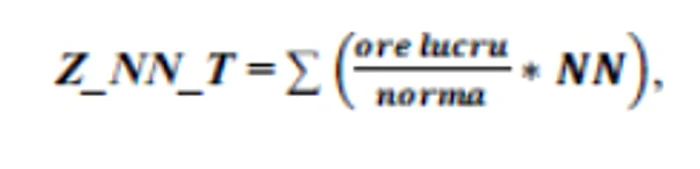
That is, the sum of the days declared by the employer (without the days when the insured benefited from help/unemployment allowance/support allowance) = the amount of working hours to divide the norm – the normal work program specific to the workplace, expressed in hours (may have values 8, 7 or 6), registered in the nominal declaration of insurance, to be divided.
Working hours means the number of hours worked/day as follows:
– in the case of individual full -time employment contracts it is equal to the norm;
– in the case of individual employment contracts partially equal to the number of hours stipulated in the individual employment contract, registered in the nominal insurance declaration (can take values 1,2,3,4,5,6,7);
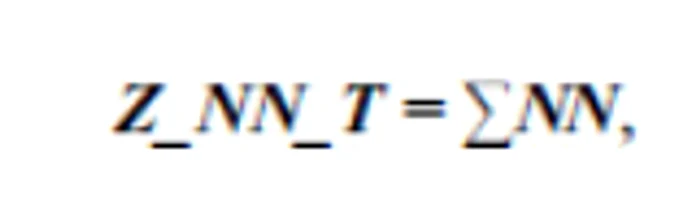
Starting with July 2005, the amount of the days worked in the month under normal conditions is no longer calculated according to the norm and the number of hours worked per day:
where:
– z_nn_t = the sum of the days declared by the employer/employers under normal conditions (without the days when the insured benefited from help/unemployment allowance/support allowance);
– Nn = the number of days worked under normal conditions (without the days when the insured benefited from aid/unemployment benefit/support allowance), registered in the nominal insurance declaration.
In compliance with the legal provisions, similarly is calculated:
– z_ss_t = the sum of the days worked in the month under special conditions;
– z_dd_t = the sum of the days worked in the month under special conditions;
– Z_PP_T = the sum of the days for which the insured has benefited from social insurance benefits under normal conditions;
– z_pps_t = the sum of the days for which the insured has benefited from social insurance benefits under special conditions;
– Z_PPD_T = the amount of the days for which the insured has benefited from social insurance benefits under special conditions;
– z_som_t = the sum of the days for which the insured has benefited from help/unemployment benefit/support allowance;
– Z_PP_SOM_T = the sum of the days for which the insured has benefited from social insurance benefits declared by the National Agency for Employment/County Agencies for Employment (ANOFM/AJOFM).
The order also sets the capping of the number of days worked at the number of working days of the month.
Example of calculation
If an employee has worked 20 days in a month who actually has 22 working days and 30 calendar days to establish the number of calendar days of internship is done by multiplying the number of days worked effectively (20) by the number of Canendar days (30), to be divided to the number of working days of that month (22) resulting that the number of calendar days is 27.27 days.
For the employees who worked throughout the year, without any interruption outside the leave, the number of days worked will be equal to that of the calendar days, resulting in a complete contribution period.
For the employees who worked half -time or interruptions or had several jobs at the same time, the contribution period is calculated proportionally for each day of work, without exceeding the number of working days of that month/year.
The technical procedure for transforming the working days into calendar days, in order to determine the contribution period realized by the insurances of the public pension system can be read in full here