The US “are ready to put the gun to everyone.” Now it's going to take revenge

Achieving the statutory debt limit always causes nervousness in the US and it was necessary to suspend some governmental tasks several times before political parties reached an agreement. However, no one has ever doubted Washington's fundamental financial liquidity and the security of American treasury bonds.
However, now this certainty is starting to be wobbled. And the drastic words of the Bessent were an attempt to dispel doubts. More and more votes indicate the danger of debt. For example, Jamie Dimon, the head of JP Morgan, warned against a bad ending if the United States did not take any action against growing debt.
Public debt is growing all over the world, but nowhere is as dramatic as in the USA. For years, expenses have been significantly exceeding income, which increased the mountain of debts to over $ 36 tr. [131 bln 944 mld zł]. The obligations have long exceeded the total annual economic production. The ratio of gross public debt to the gross domestic product (GDP) is the highest since World War II and according to the definition of the International Monetary Fund is 120 percent.
Already during the first term of Trump and during the rule of Joe Biden, the budget balance was deeply in the minus – partly due to the aid related to coronavirus. In 2024, the deficit was 6.5 percent However, under the rule of Trump 2.0 it will not be better: his new budget law “One Big Beautiful Bill” [ang. wielka piękna ustawa]which provides, among others, an extension of tax breaks introduced in 2017, according to the forecasts of the budget office of the Congress would double the deficit. It is estimated that soon the United States will have to spend most of the GDP to support the debt than traditionally indebted Italy.
This trend is evidenced by the fact that a few weeks ago the Moody's Rating Agency, the third of the world leading, also reduced the highest credit rating of world power, which is the United States.
Despite this, the ticking debt bomb still does not arouse too much interest. The fears related to the trade war and even the possibility of the outbreak of a new traditional war dominate. In addition, there are concerns about the economic breakdown and the consequences of climate and technological change.
In fact, however, all these risks and other challenges are closely related to the problem of debt, and the higher the debt and the faster it increases, the less possibilities are to meet these risks and challenges.
Countries can also go bankrupt
The risk of debt debt is often incorrectly compared to the probability of bankruptcy of private individuals. However, states have the right to collect taxes, while private entities depend on economic success. The company must close the business if it is unable to pay off its debts – in the case of you it is impossible. If the state has difficulties with payments or falls in arrears, there is talk of state bankruptcy, but the state still exists.
In history, the bankruptcy of countries occurred mainly during wars or in economically weak countries that did not have a strong currency. Excessive examples are Russia's insolvency in the late 90s, multiple bankruptcy of Argentina or Greek bankruptcy after a financial crisis.
And the United States?
For a superpower such as the United States, bankruptcy is practically excluded – unless politicians decide to suspend the repayment of interest or foreign debt, for example. Such plans have already been considered by Trump's administration and previous US rule, but they have never been implemented. And every time the statutory debt limit is approaching, and the parties cannot agree on its increase, there are fears that the bonds will not be repaid on time. Each time, however, the government decides instead to partially close the administration.
However, Greece has no control over the printing house since joining the euro area. Due to many historical cases of insolvency, it enjoys little trust in capital markets. Argentina has its own currency and central bank, but given the past periods of gigantic inflation and spiral of devaluation, foreign capital can only obtain at high percentage and hard currency.
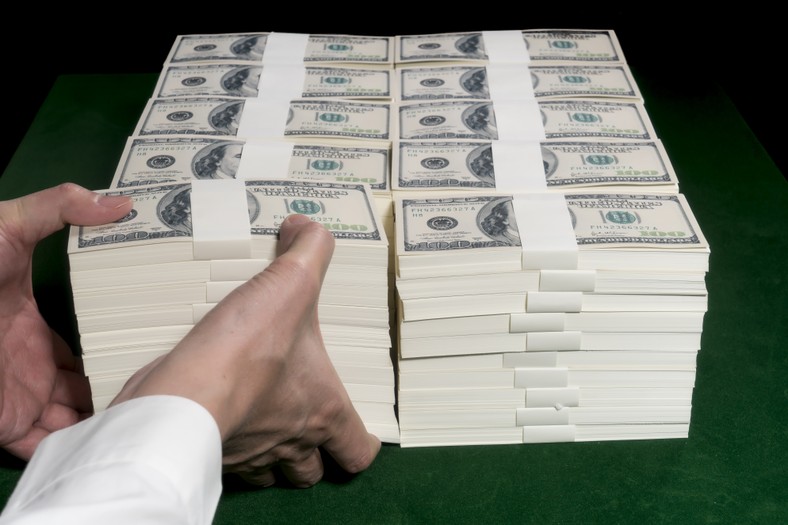
A million dollars in new banknotes (illustrative photo)
“Extraordinary privilege” of the USA
Thanks to the dollar, the United States has a special position, which is referred to as “exorbitant privilege”, or extraordinary privilege. Firstly, international trade transactions They are often settled in dollars, even if the United States is not involved in them. The dollar domination is particularly visible in the case of raw materials. On the other hand, about 60 percent reserves of all central banks in the world are located in Denominated securities in dollars; They also play a key role in balances of financial institutions. US tax bonds They are also decisive for the valuation of most investments on global capital markets. Their profitability is considered to be a measure of a risk -free interest rate. For these reasons, the world has so far been very willing to co -finance the US debt policy with relatively low interest rates.
This unique privilege of the US means that politicians in this country could have largely ignored the deficits, and even a reduction in ratings had almost no short -term consequences. Relative indifference to the growing debt is visible in the USA, regardless of whether the president from the Democratic or Republican party is ruled in the White House. The debt has long reached a level that was previously associated with highly indebted euro area countries.
Recognition for the dollar is a matter of trust
However, the dollar privilege is not written in stone. The American dollar has become a world currency as a result of the development of the United States as the greatest economic and military power of the world. Just before the end of World War II, the special status of the American currency was officially established at a conference at Bretton Woods.
Even after the fall based on the dollar of the permanent exchange rates from Bretton Woods Dolar and American tax bonds, they retained their dominant role. This has happened thanks to the relatively high stability of American institutions, which provide investors with safety. These include the independence of the American Central Bank of the FED, regulated, the largest and deepest capital market in the world and a generally reliable government system, which through the “check and balances” system limits the power of individuals – to the president – and thus reduces arbitrariness.
As the crucial importance for the dollar and debt financing is the trust of investors in these institutions, showed April: Historically high duties, which Trump introduced on the day of liberation without understandable justification, deeply worried investors. The dollar and American tax bonds, which usually ensure security during each stock exchange crash, have also been affected by a wave of sales, which fueled concerns about the serious financial crisis. The sharp reaction of bond markets prompted Trump to suspend his duties until the beginning of July.
For the second time the bond market showed its teeth at the end of May, when Trump threatened the EU with even higher duties, and the Moody's agency reduced the rating of treasury bonds due to a growing deficit. Long -term bond yields, which are the opposite of the course, have exceeded 5 percent for the first time in years. The bonuses for securing credit risk with credit risk swaps reached a level, which was previously recorded only after the S&P Global rating reduced in 2011.

Construction teams on a large construction site working using steel and concrete at Chelmsford, Massachusetts in the USA, June 23, 2025. US President Donald Trump recently raised duties on steel to 50 percent, which entered into force on June 4, 2025.
Trust in American institutions is decreasing
Trump's duties, budget design and rating reduction were panic. However, the real reason for this reaction lies deeper: Investors have lost their general trust in American policy and institutions. “We – the United States – we have shown that we are ready to put a gun to everyone” – describes this American economist Kenneth Rogoff in the podcast “The Ezra Klein Show”. And lost trust will be difficult to recover. According to Rogoff, it will last decades. The advantage resulting from the “extraordinary privilege” in the form of low interest rates has also disappeared.
More and more debts, but fewer and fewer investors ready to finance them – or only at higher interest rates: for each company it would be a direct way to bankruptcy. However, for the United States, as a sovereign state, there is an exit in the form of printing money, buying bonds by the Central Bank and financial repression. It is about regulatory interventions that discriminate against creditors, forcing them to maintain tax bonds and maintain inflation above interest rates. Americans will suffer.
The rest of the world will feel debt inflation primarily through the devaluation of the dollar. The most reasonable way to get out of the debt trap would be healing public finances. However, the United States is further than ever from a policy based on reason.