5 percent Defense GDP. After the NATO summit, Trump has reasons to be satisfied

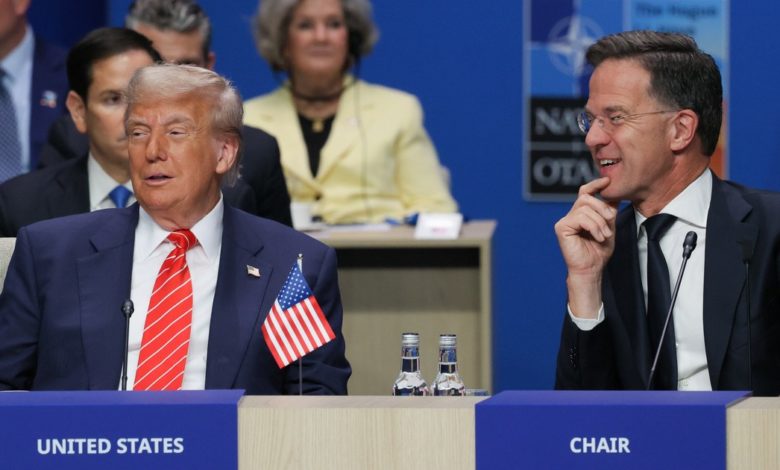
During the carefully planned NATO summit, which was guided by the principles of conciseness and predictability, the leaders signed A new purpose of defense expenditure in the amount of 5 percent, GDP to 2035 will consist of 3.5 percent of GDP into “hard” abilities, such as weapons and army, and 1.5 percent. for defense -related investments, such as cyberspace and mobility.
Trump called this result a “monumental victory for the United States” and He assigned the merit of the pressure on the members of the Allianceto increase their defense expenses. He said that it was “really moving” to see allies who want to defend their countries and need the help of the United States, and that NATO, however, “is not a ripple.”
The contract was finalized before the meeting in The Hague, and then signed by the leaders, what was to ensure the efficient course of the peak.
“This is a stronger, just and more deadly alliance, which began to build NATO leaders,” said secretary general Mark Rutte shortly after the end of the meeting. – President Trump expressed clearly: America is involved in NATO. […] At the same time, he clearly stated that America expects from European allies and Canada greater contribution. And this is exactly what we see.
In the final statement of the summit, which was limited to five paragraphs, Members of the Military Alliance agreed to the new long -term defense expenditure.. Leaders also undertook to quickly increase defense production throughout the alliance.
“This is the success of President Donald Trump”
Rutte flattered Trump, praising him for pressing other countries to increase defense expenses and emphasizing his commitment to the alliance. The Secretary General even called Trump “Daddy” for intervention in the fighting between Israel and Iran.
Other leaders also point to the US president's contribution. – This is the success of President Donald Trump – says President Andrzej Duda, a supporter of Trump. – He demanded from NATO countries to increase defense expenditure.
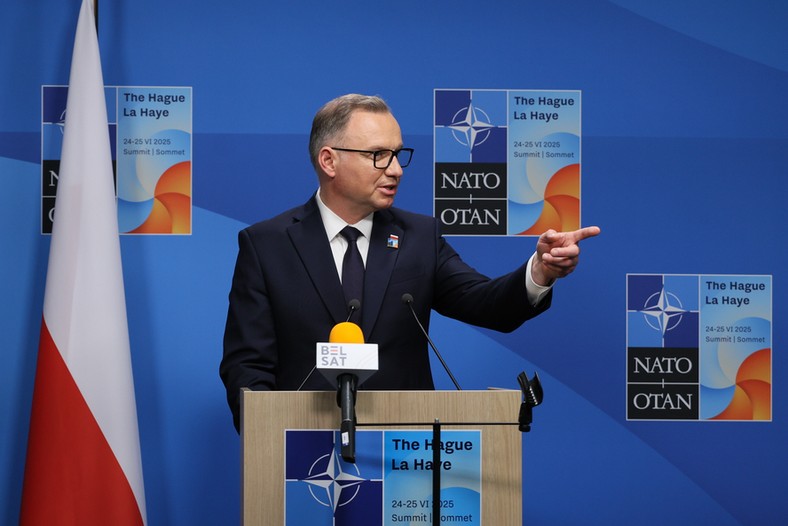
President Andrzej Duda at the NATO summit in Hague, June 25, 2025.
As a result, during the round table of leaders, which lasted two and a half hours, Trump spoke in a surprisingly balanced wayas the person present in the room, which we confessed to us, tells us, so that he can speak freely.
According to her, Trump confirmed America's involvement in NATO “For four years”, i.e. throughout his second term. Repeating concerns about the division of loads, he praised allies and paid attention to unity. After the summit, he admitted that he was “honored” that he could take part in it.
The positive mood of Trump was also helped by a telephone conversation with the Prime Minister of Israel Binjamin Netanyhu during his flight to Hagi, as one of the white home administration officials speak. The Israeli leader promised to follow Trump's proposal regarding the suspension of weapons in Iran.
Not all NATO members are satisfied
Despite this, the peak was not without shocks. In the days preceding a high -rate meeting, the agreement was almost storped, declaring her opposition to the main purpose of expenses – and then opened a can of Pandora, arguing that she secured the so -called opt-out. This prompted countries such as Belgium and Slovakia to demand more flexibility.
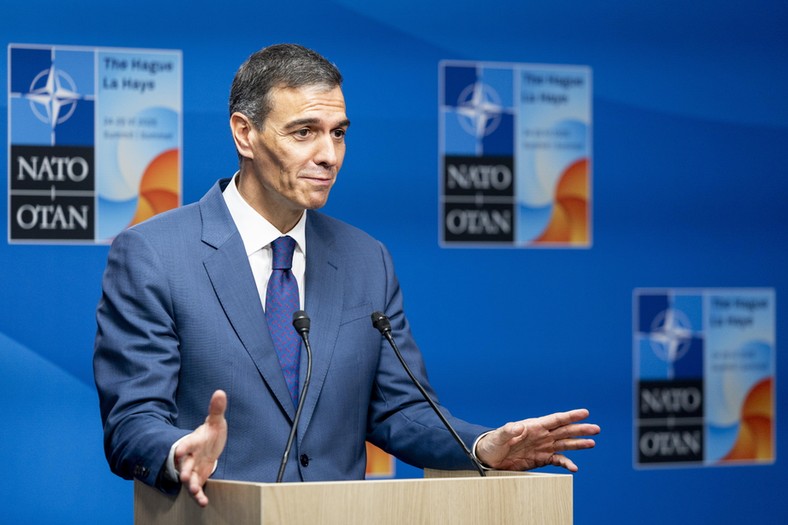
Pedro Sanchez, Spanish Prime Minister, at the NATO summit in Hague, June 25, 2025.
The key point of reference is to achieve new NATO goals in terms of ability. The alliance calculated that it would cost countries about 3.5 percent. GDP – although the Spanish Prime Minister Pedro Sanchez claims that Madrid can achieve these goals by spending only 2.1 percent. GDP. The Spanish prime minister called his expenditure “sufficient, realistic and compatible”.
However, Trump condemned the Spanish position as “terrible” and warned that will force Madrid to pay “twice as much” in ongoing commercial negotiations. It is not clear, however, how the United States could do this because Spain is part of the EU, and the block negotiates trade agreements for all its members.
On Tuesday, Trump dropped the proverbial bomb, suggesting that there are “numerous definitions” of the provisions of art. 5 on the joint defense of NATO. The front countries of the Alliance hastily underestimated this statement. However, at the end of the conference, Trump said: – We are here to help them defend their country.
Friedrich Merz, participating in his first peak of NATO as the German Chancellor, emphasized that Trump “stated very clearly” that remains involved in the NATO mutual defense clause contained in art. 5. “I was glad that in all his statements there were not a single sign of doubt on his part as to the desire to fully maintain solidarity and alliance,” he told reporters after the meeting.
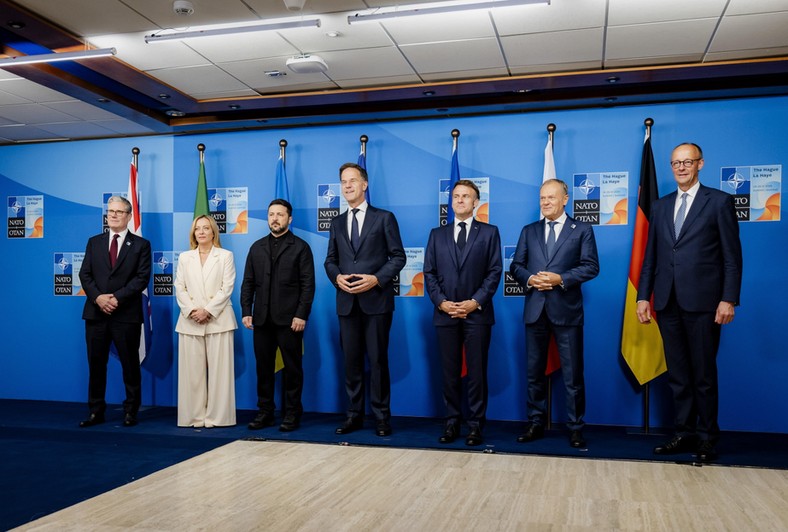
Keir Starmer, Giorgia Meloni, Wołodymyr Zelnski, Mark Rutte, Emmanuel Macron, Donald Tusk and Friedrich Merz at the NATO summit in Hague, June 25, 2025.
– President Trump said nothing about it today – adds President Duda. In the final NATO declaration, it was stated that a joint commitment to comply with Art. 5 is “iron”.
Ukraine goes to the background
At this year's meeting of Ukraine, much less time was devoted than the previous ones. This is a sign of Trump's reluctance to the Ukrainian president Volodymyr Zelanski and his constant efforts to convince Russia to consent to the suspension of weapons. In his final statement, Trump called Putin “lost”. After the summit, Trump met with Zelanski and said that Kiev was interested in striving for peace.
The final declaration of the summit did not mention Kiev's efforts to join the alliance, but it was noted that allies “confirm their permanent, sovereign obligations to provide support for Ukraine” and that Military assistance sent to Ukraine will be included in the defense expenses of member states.
In his comments after the summit, Rutte emphasized “unwavering support” of NATO for Ukraine. French President Emmanuel Macron also warned that Russia's War “remains the main concern of Europeans”. – This justifies long -term reinforcements, because it is a threat that will persist – he emphasized.